3.9 - Radio Waves
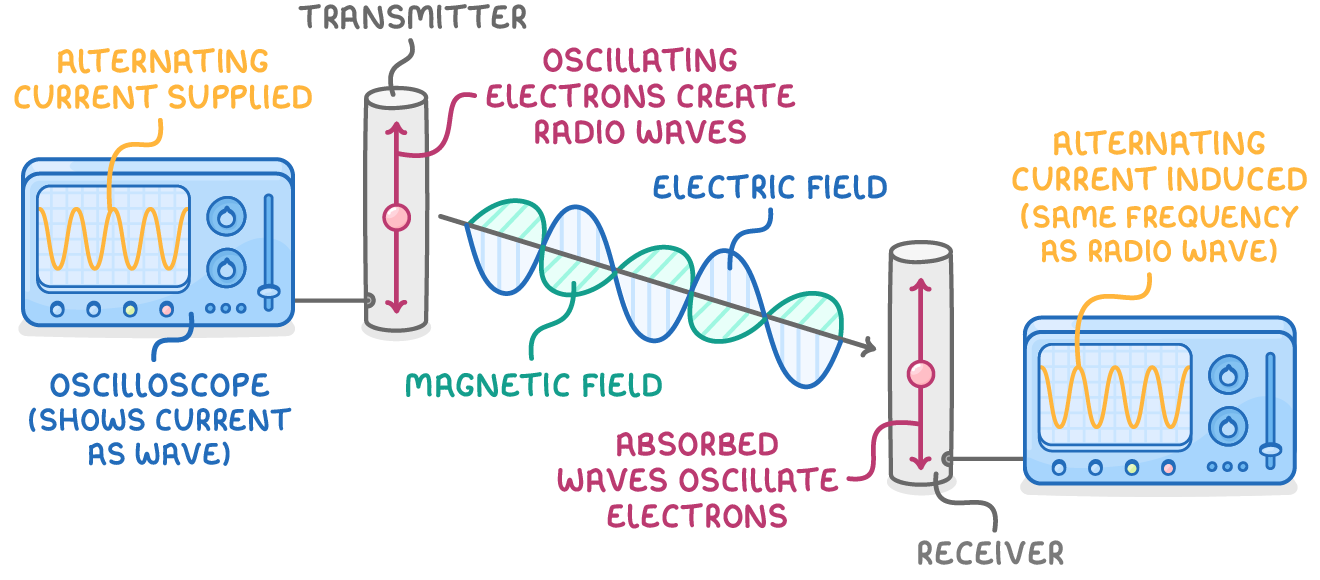
Radio waves are produced and received by oscillating charges
- EM waves are made of oscillating electric and magnetic fields.
- An alternating current (a.c.) is made of oscillating charges. When it flows in a circuit, the moving charges produce oscillating electric and magnetic fields - an EM wave.
- The frequency of the radio wave equals the frequency of the a.c.
- The object in which the charges oscillate to create the radio waves is called a transmitter.
Receiving radio waves
- When a radio wave reaches a receiver, it is absorbed and transfers its energy to the electrons in the receiver, making them oscillate.
- If the receiver is part of a complete circuit, this induces an alternating current.
- That induced current has the same frequency as the radio wave, allowing the signal to be recovered.
Radio waves carry communication signals
- Radio waves are used mainly for communication - they carry television and radio broadcasts from one place to another.
- Radio waves have wavelengths longer than about 10 cm, and how a radio wave travels from transmitter to receiver depends on its wavelength.
- Longer-wavelength radio waves can be received over very large distances.
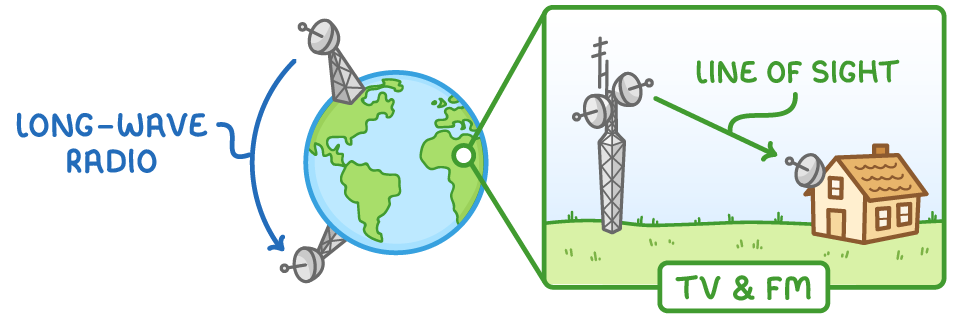
- The very short wavelengths used for TV and FM radio only reach a receiver in line of sight of the transmitter, because they don't bend or travel far through obstacles.
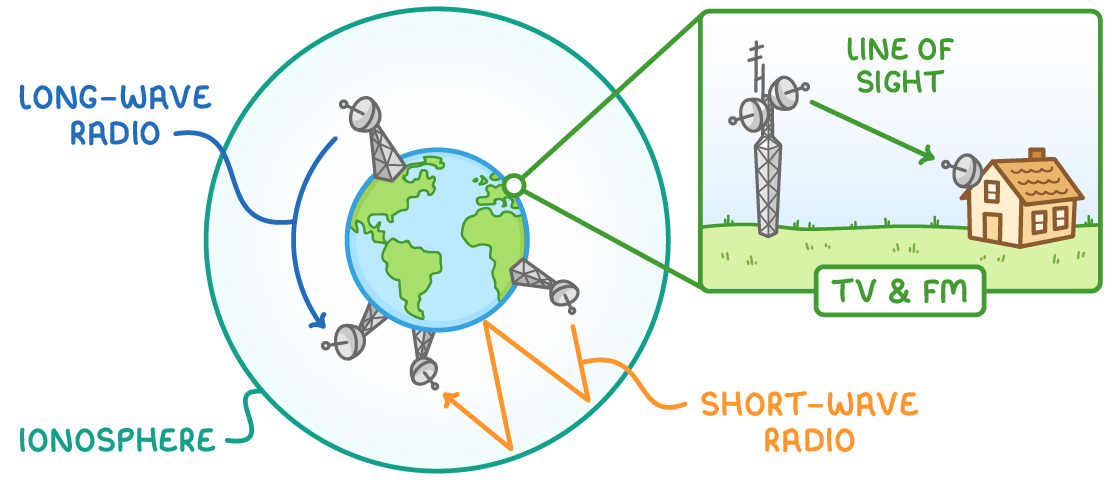
How radio wavelengths travel to a receiver
- Long-wave radio (wavelengths of about 1-10 km) - Can be received from halfway round the world because the long wavelengths diffract (bend) around the curved surface of the Earth, hills, and into tunnels.
- Short-wave radio (wavelengths of about 10-100 m) - Can be received at long distances because it is reflected by the ionosphere (an electrically charged layer high in the Earth's atmosphere).
- TV and FM radio - Use very short wavelengths that do not diffract around obstacles or travel far through buildings, so the receiver must be in line of sight of the transmitter.
Bluetooth uses radio waves
- Bluetooth uses radio waves to send data wirelessly over short distances between devices (for example, a phone and wireless headphones).
- The wavelengths used are even shorter than those for TV and FM radio.
- The waves can pass through walls but are weakened as they do so, which keeps the range short and reduces interference between nearby devices.
TermDefinition
TransmitterAn object in which electrical charges oscillate to produce radio waves.
IonosphereAn electrically charged layer high in the Earth's atmosphere that reflects short-wave radio signals.
Key points to remember
How were these notes?