9.2 - The Particle Model
The particle model of matter
- All matter is made up of tiny particles (such as atoms, molecules, ions or electrons).
- This way of describing matter is called the particle model (or kinetic theory).
What the model says
- Matter is made of particles, with nothing between them.
- There are forces of attraction between the particles, with different strengths in different substances.
- The particles are always moving.
The three states of matter
- The same substance can exist in three states: solid, liquid and gas.
- The particles are the same in each state; what differs is their arrangement, their energy, and the forces between them.
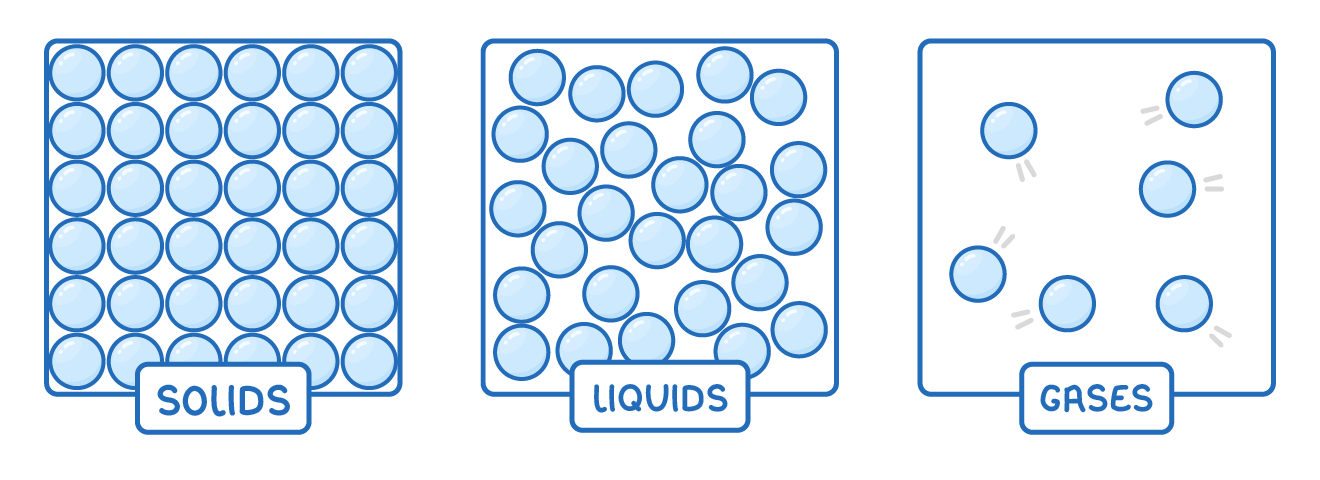
Solids
- Arrangement - Strong forces of attraction hold particles close together in a fixed, regular pattern.
- Energy and motion - Particles have little energy; they vibrate about fixed positions and cannot move past one another.
- Properties - Fixed shape and fixed volume.
Liquids
- Arrangement - Forces of attraction are weaker than in a solid. Particles are close together but randomly arranged, and can move past each other.
- Energy and motion - More energy than in a solid; particles move past each other in random directions at low speeds.
- Properties - Fixed volume, but takes the shape of its container.
Gases
- Arrangement - Almost no forces of attraction; particles are far apart.
- Energy and motion - More energy than in a solid or liquid; particles move freely in random directions at high speeds.
- Properties - No fixed shape or volume; spreads out to fill its container. Gases can be compressed because of the large empty spaces between particles.
Fluids
Liquids and gases can both flow because their particles can move past one another, so they're called fluids.
Explaining density with the particle model
- Density is a measure of how much mass is packed into a given volume.
- The more tightly packed the particles are, the denser the substance.
Comparing the states
- Solids - Usually the densest state. Particles are packed tightly together, so a given volume contains a lot of mass.
- Liquids - Usually slightly less dense than solids. Particles are close but randomly arranged with small gaps.
- Gases - Much lower density. Particles are far apart with large empty spaces between them, so a given volume contains very little mass.
TermDefinition
Particle modelA model describing matter as being made of tiny, constantly moving particles.
FluidA liquid or a gas, whose particles can move past one another so it can flow.
DensityThe mass per unit volume of a substance.
Key points to remember
How were these notes?