9.8 - Elastic Potential Energy
Stretching or squashing stores elastic potential energy
- Stretching, squashing, or bending an object transfers energy to its elastic potential energy store.
- An object deforms elastically when it returns to its original shape once the forces are removed.
- Doing work to deform an elastic object transfers energy to its elastic potential energy store. When the spring pushes or pulls back, that energy transfers back to the object's kinetic energy store.
Force-extension graphs and finding energy
Investigating force and extension
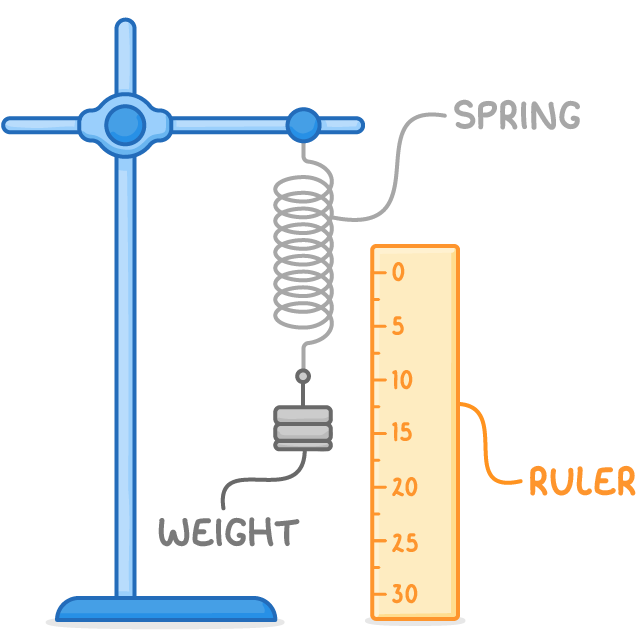
- Hang the spring from a clamp stand and measure its natural length with a millimetre ruler held vertically at eye level, using a marker at the end of the spring.
- Add a mass to the spring, let it come to rest, and measure the new length. The extension is the change in length.
- Repeat for at least six different masses, increasing the force each time.
- Plot a graph of force against extension and draw a line of best fit.
Stand up during the experiment so you can move clear if masses fall, and wear safety goggles in case the spring snaps.
Reading energy off the graph
- While the line is straight, force and extension are directly proportional.
- The work done in stretching the spring (and the energy transferred to its elastic potential energy store) is the area under the force-extension graph.
- For the straight linear section, calculate this area using the formula for the area of a triangle ( × base × height).
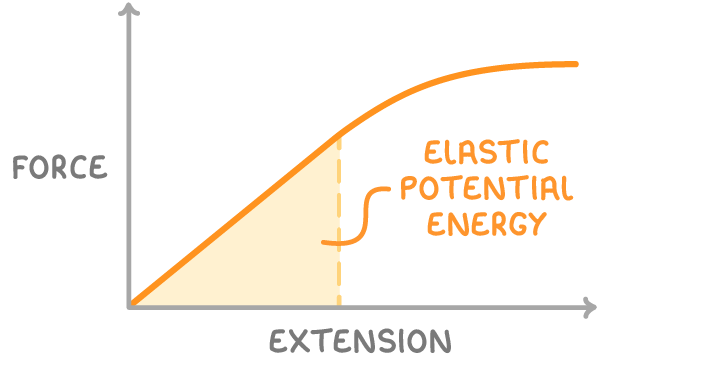
As shown above, the area can only be used while the graph is straight, not past the point where it bends.
Formula for elastic potential energy
Where:
- = Energy transferred in stretching, in joules (J)
- = Spring constant, in newtons per metre (N/m)
- = Extension (or compression), in metres (m)
This applies as long as the spring hasn't been stretched past its limit of proportionality.
For an elastic deformation, the work done in stretching the spring equals the energy transferred to its elastic potential energy store.
Worked example - Energy stored in a stretched spring
A spring has a spring constant of 25 N/m. It is stretched elastically from a length of 0.30 m to 0.38 m. Calculate the energy transferred to its elastic potential energy store.
Step 1 - Find the extension
Step 2 - Substitution and calculation
TermDefinition
Elastic deformationA change in shape where the object returns to its original shape and length once the forces are removed.
ExtensionThe increase in length of an object when it is stretched, equal to its stretched length minus its original (natural) length.
Limit of proportionalityThe point beyond which the extension of an object is no longer directly proportional to the force applied to it.
Key points to remember
How were these notes?