1.11 - Stopping Distances
Stopping distance = thinking + braking distance
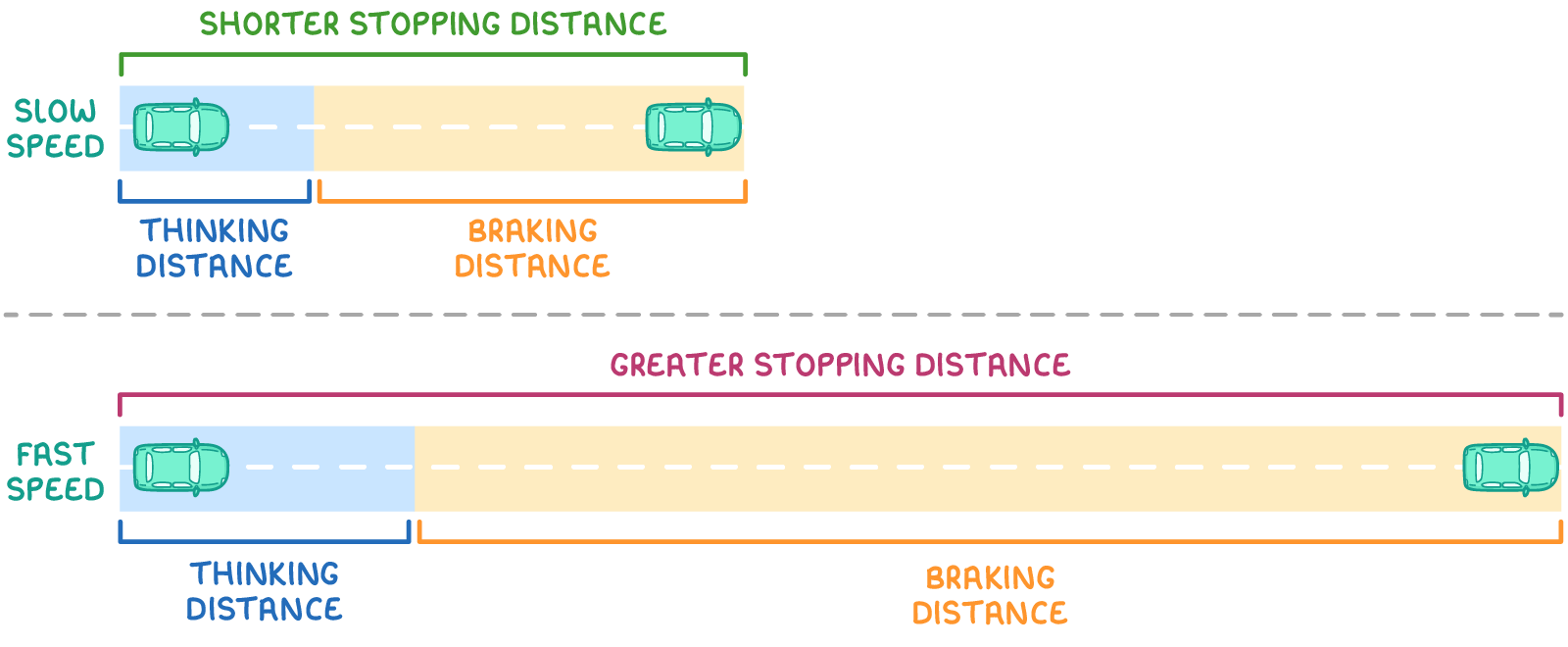
The stopping distance is the total distance a car travels from the moment a driver spots a hazard to when the car comes to a complete stop:
Stopping distance = thinking distance + braking distance
- Thinking distance - The distance the car travels during the driver's reaction time, between noticing the hazard and applying the brakes.
- Braking distance - The distance the car travels once the brakes are applied, while slowing to a stop.
In an emergency stop, the driver applies the maximum braking force to stop in the shortest possible distance.
What increases thinking distance
- Higher speed - The faster the car travels, the further it goes during the reaction time.
- Longer reaction time - Increased by tiredness, alcohol, drugs and distractions.
What increases braking distance
- Higher speed - A faster car travels further before the braking force brings it to a stop.
- Greater mass - A heavier car takes longer to stop under the same braking force.
- Worn or faulty brakes - These can't apply as much braking force.
- Poor road or tyre conditions - Wet or icy roads, dirt, or worn tyres reduce friction, making skidding more likely.
TermDefinition
Stopping distance
Thinking distance
Braking distance
Emergency stop