7.8 - How Appliances Transfer Energy
Appliances transfer energy electrically
- A moving charge transfers energy because it does work against the resistance of a circuit.
- Electrical appliances transfer energy electrically from a power source to their components, and from there to other stores:
- A battery stores energy in its chemical store.
- The mains supply delivers energy from a power station.
Examples of energy transfer
- Kettle - Transfers energy electrically from the mains supply to the thermal energy store of its heating element.
- Handheld fan - Transfers energy electrically from the battery's chemical store to the kinetic energy store of the fan's motor.

Not all energy is useful
- No appliance transfers all of its energy to useful stores.
- Some energy is always dissipated to the thermal energy stores of the wires and components, and then to the surroundings.
The heating effect of a current in a resistor
- When there's a current in a resistor, energy is transferred that heats the resistor up.
- The energy is dissipated to the thermal energy stores of the resistor and then to its surroundings.
Why the resistor heats up
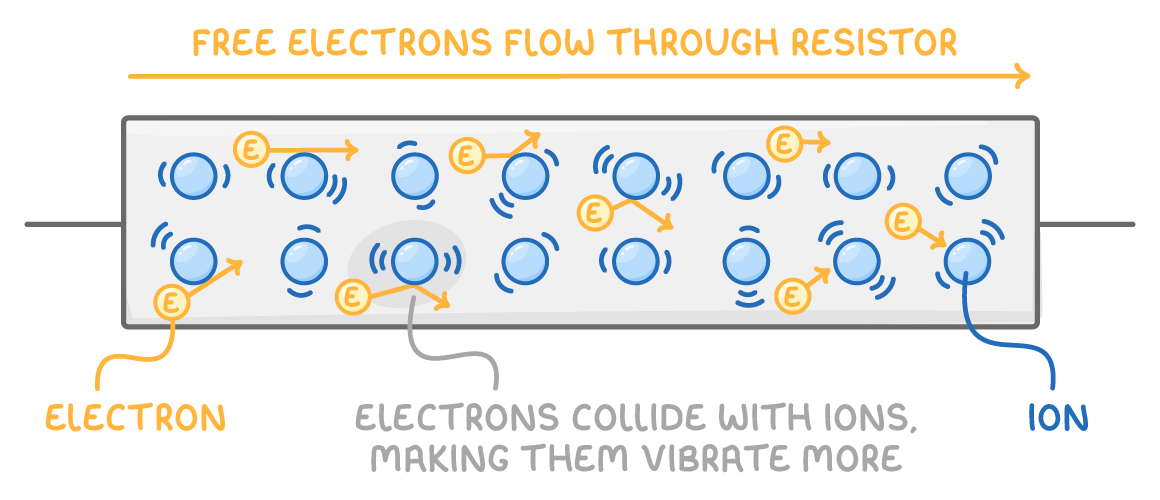
- As free electrons flow through the resistor, they collide with the ions in the metal lattice.
- Each collision transfers energy to the ions, making them vibrate more.
- The more the ions vibrate, the hotter the metal becomes.
Advantages and disadvantages
- Advantage (heat is useful) - A heater or toaster uses high-resistance wire that gets hot to transfer energy to its surroundings. A fuse uses the heating effect deliberately, melting to break the circuit if the current gets too high.
- Disadvantage (heat is not useful) - Energy transferred to thermal stores is wasted, reducing efficiency. Components that get too hot can be damaged, and heating can change how the circuit behaves.
Power ratings of appliances
- An appliance's power rating is its maximum operating power: the maximum energy it transfers each second when in use.
- The lower the power rating, the less energy transferred in a given time, so the cheaper it is to run.
- The higher the power rating, the faster the energy transfer.
- For example, a 1,200 W heater transfers twice as much energy each second as a 600 W heater.
A higher power rating isn't always better
- A higher power rating does not always mean more useful energy is transferred.
- An inefficient appliance with a higher power rating can transfer the same or less useful energy than a lower-power, more efficient one, because more of its energy is wasted to thermal stores.
TermDefinition
Power rating