4.3 - Alpha, Beta & Gamma Radiation
Radioactive decay and the types of nuclear radiation
- Some isotopes have unstable nuclei. An unstable nucleus tends to break down, or decay, releasing radiation as it changes into a more stable arrangement.
- This process is called radioactive decay. A radioactive substance can give out one or more types of ionising radiation when it decays.
- The radiation comes from the nucleus itself.
The types of radiation
- Alpha particle (α) - Two protons and two neutrons, the same as a helium nucleus. Comparatively large, heavy and slow-moving, and strongly ionising.
- Beta-minus particle (β−) - A fast-moving electron released by the nucleus. Virtually no mass and a relative charge of -1.
- Beta-plus particle (β+) - A fast-moving positron. The positron is the antiparticle of the electron: exactly the same mass as an electron but a positive (+1) charge.
- Gamma ray (γ) - A high-frequency electromagnetic wave released by the nucleus. Carries away energy but has no mass and no charge.
Effect on the element
- Emitting an alpha or beta particle usually changes the nucleus into a different element.
- Gamma radiation carries only energy, so it leaves the element unchanged.
Neutron emission
- An unstable nucleus with too many neutrons can get rid of the excess by emitting a neutron (n).
- A neutron carries no charge.
- The number of protons doesn't change, so the nucleus stays the same element, but with a different mass number - making it a different isotope.
- Neutron radiation is ionising.
Ionising radiation and ionising power
- Ionising radiation knocks electrons off atoms it passes, turning those atoms into positively charged ions.
- Ionising power measures how readily a source does this.
What affects ionising power
How strongly a type of radiation ionises depends on its charge and its energy:
- Charge - A more highly charged particle attracts or repels an atom's electrons more strongly, so it's more likely to remove electrons.
- Energy - A particle carrying more energy can transfer more energy to an atom it collides with, making ionisation more likely.
Ionising power of each type
- Alpha - Strongly ionising. It carries much more mass and energy than beta and has the largest charge (+2), so it collides with and ionises many atoms over a short distance.
- Beta - Moderately ionising.
- Gamma - Weakly ionising. With no mass and no charge, it tends to pass straight through atoms rather than collide with them.
Penetration and range of radiation
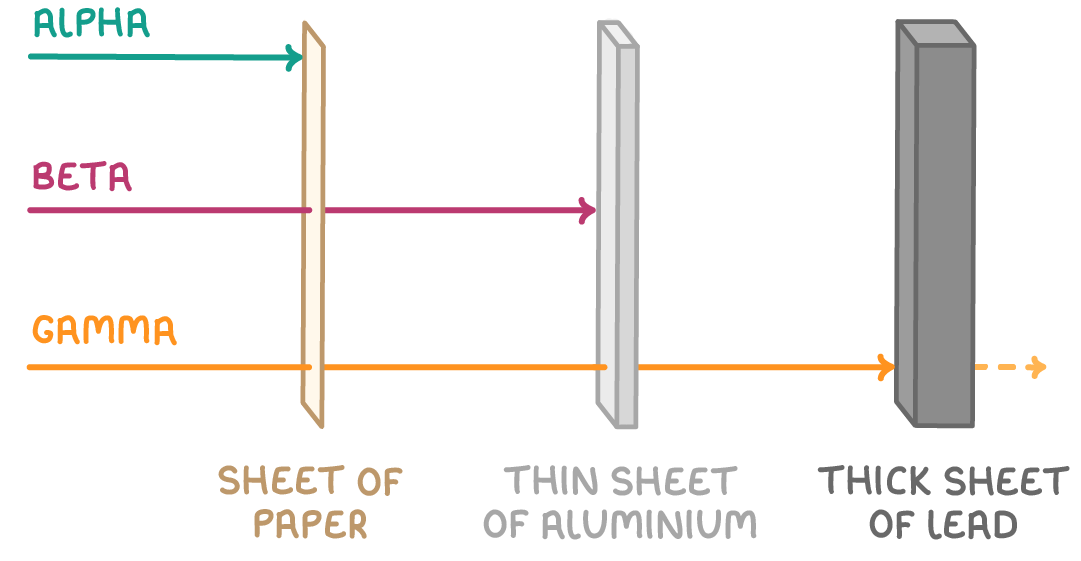
The more strongly a type of radiation ionises, the more it collides with atoms, so the shorter its range and the more easily it's absorbed.
Range and what stops each type
- Alpha - Travels only a few centimetres in air and is stopped by a sheet of paper.
- Beta - Travels up to a few metres in air and is stopped by a thin sheet of aluminium (around 5 mm thick).
- Gamma - Travels a long distance through air and is only absorbed by thick lead or metres of concrete. Gamma is never completely stopped; thick lead and concrete reduce its intensity rather than blocking it entirely.
TermDefinition
Positron
Radioactive decay
Ionising radiation