17.1 - Static Electricity - Charging
Charging an insulator by friction
- Atoms are built from positive protons and negative electrons. Most objects have equal numbers of each, so they have zero net charge - they're neutral.
- When two insulating materials are rubbed together, negatively charged electrons are transferred from one to the other.
- Insulators don't let charge flow, so transferred electrons stay trapped where they land. This trapped charge is static electricity.
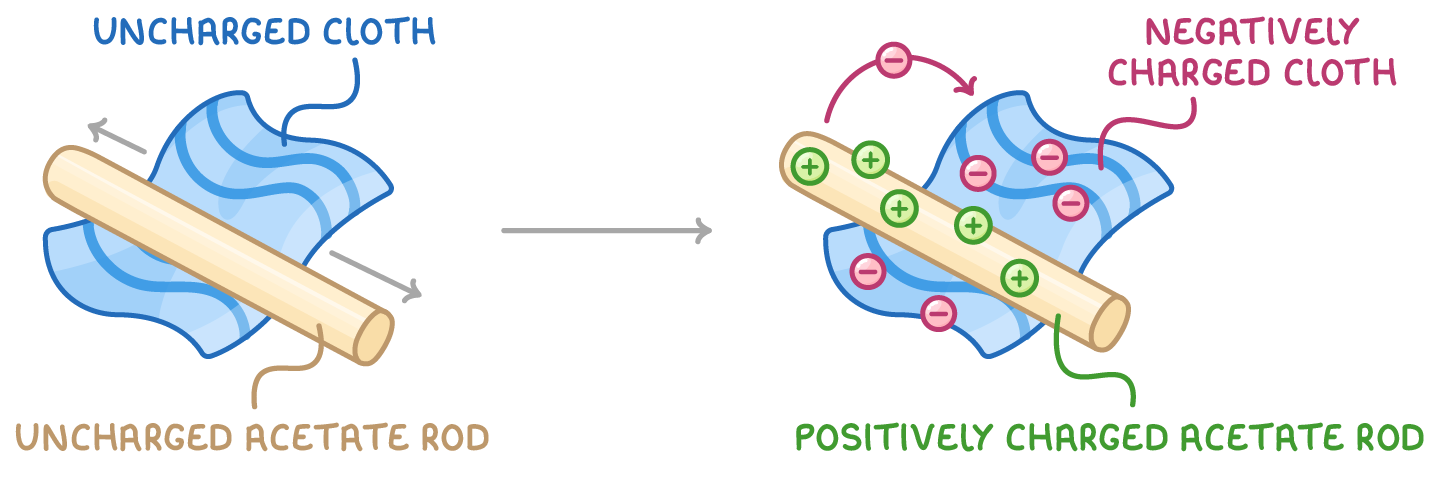
Which material gains which charge
- The material that gains electrons is left with a negative static charge.
- The material that loses electrons is left with an equal positive static charge.
- Only negative electrons move - positive charges don't. An object becomes positively charged only because electrons have moved away from it.
Polythene and acetate rods
- Polythene rod - Rubbing transfers electrons from the cloth onto the rod, leaving the rod negatively charged.
- Acetate rod - Rubbing transfers electrons from the rod onto the cloth, leaving the rod positively charged.
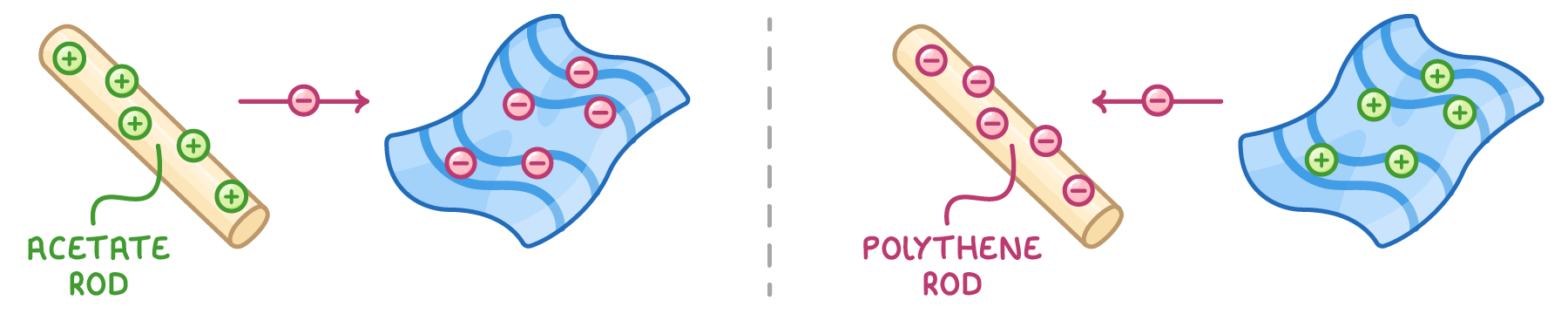
Conductors and insulators carry charge differently
- Electrical conductors - Let charge flow through them easily (usually metals, such as copper and silver). If electrons are rubbed on, they flow straight off, so conductors don't normally hold a static charge.
- Electrical insulators - Do not let charge flow (such as plastic and rubber). Electrons rubbed on stay trapped where they land, allowing static charge to build up.
Testing a material
- Put the material in a circuit in series with a cell and a bulb.
- If the bulb lights, charge is flowing - the material is a conductor.
- If the bulb stays off, no charge can flow - the material is an insulator.
Like charges repel, opposite charges attract
- When two charged objects are brought close, they exert a non-contact electrostatic force on each other.
- Opposite charges (one positive, one negative) attract each other.
- Like charges (both positive or both negative) repel each other.
- The force gets weaker the further apart the objects are.

Testing charge with a suspended rod
- Suspend a rod of known charge from a thread so it can swing freely.
- Bringing up an object with the same charge repels the rod (pushes it away).
- Bringing up an object with the opposite charge attracts the rod (pulls it towards it).
Detecting charge with a gold-leaf electroscope
- A gold-leaf electroscope detects whether an object is charged.
- It has a metal disc connected by a metal stem to two thin pieces of gold leaf that hang side by side inside an insulated box with windows.
Bringing a charged rod near
- The rod induces charge through the disc, down the stem and into the leaves.
- Both leaves gain the same type of charge, so they repel each other and rise.
- Taking the charged rod away allows charge to redistribute, and the leaves fall back together.
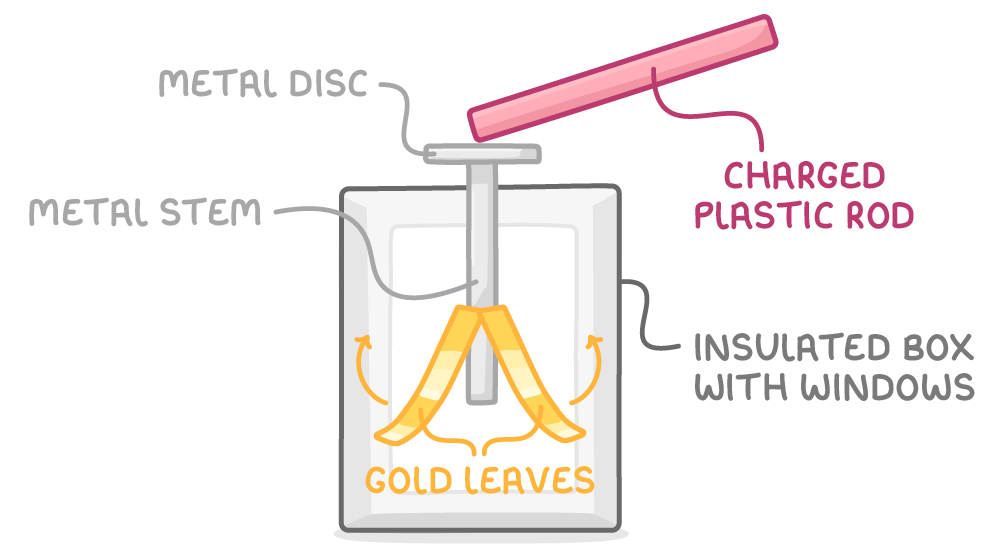
Touching a charged insulator onto the disc
- Charge transfers directly onto the electroscope, leaving the stem and leaves with the same charge so the leaves rise.
- If the leaves don't rise when an object is brought near or touched to the disc, the object is uncharged.
TermDefinition
Static electricity
Electrical insulator
Electrical conductor