10.4 - The Big Bang
The expanding Universe points to a beginning
Nearly all galaxies are moving away from one another, and the more distant a galaxy is, the faster it is moving away.
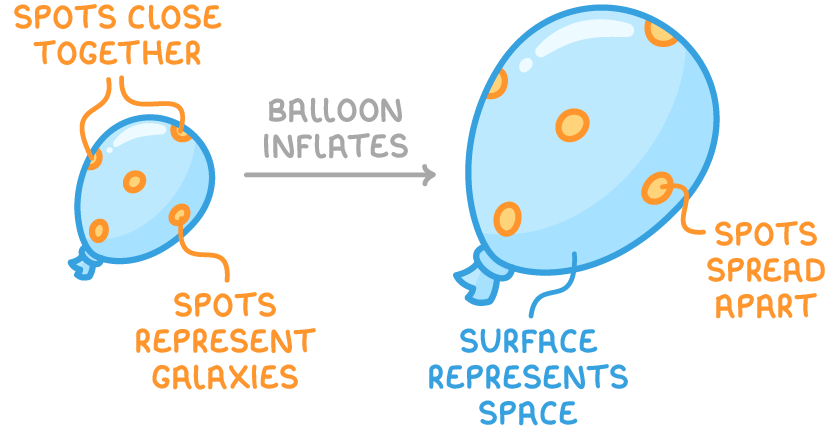
The balloon model
- Imagine a balloon with spots painted on it: as it inflates, the rubber stretches and every spot moves further from every other spot.
- The balloon's surface represents space itself and each spot represents a galaxy.
- Space is stretching and carrying the galaxies apart, so the whole Universe is expanding.
Working backwards
- Because galaxies are moving apart now, in the distant past they must have been much closer together.
- Following this backwards leads to the conclusion that the Universe began from a single, extremely small region - the starting point for the Big Bang theory.
The Big Bang theory
- The Big Bang theory is the accepted explanation of how the Universe began.
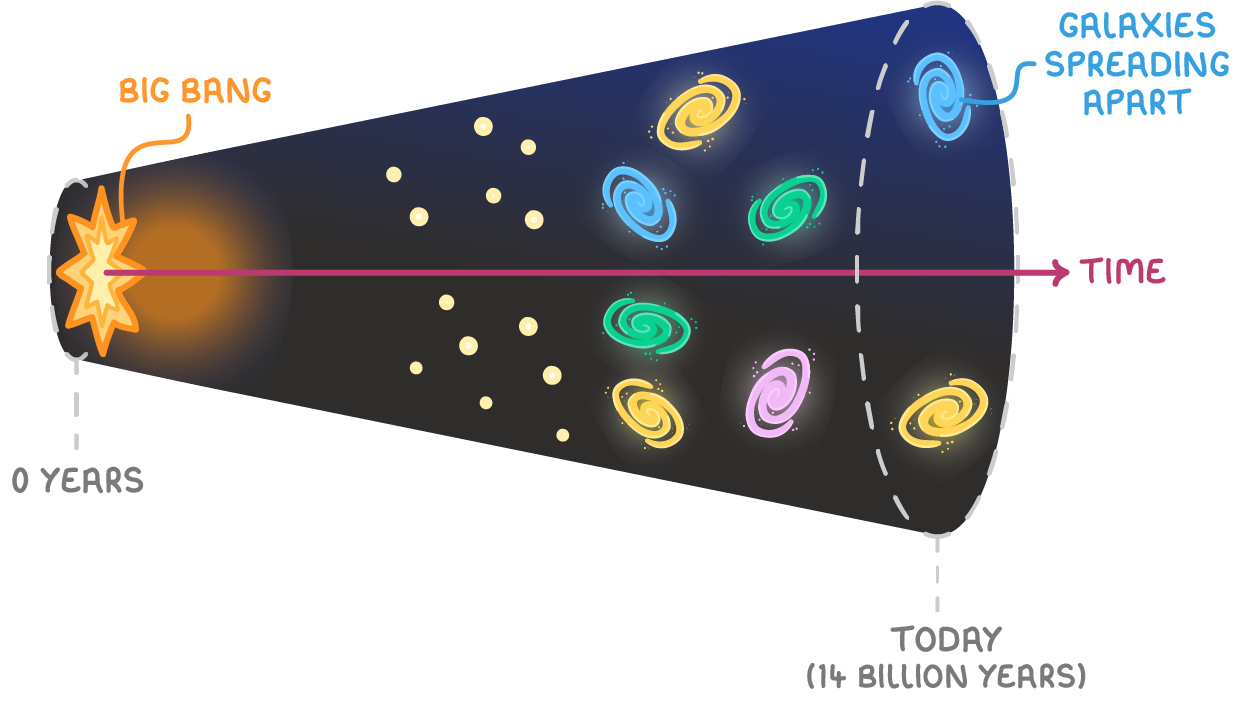
- All the matter and energy in the Universe was once concentrated into a single, tiny region that was extremely hot and dense.
- It then began to expand rapidly - the Big Bang - and space has been expanding ever since.
The age of the Universe
- The theory gives the Universe a finite age.
- Working back from the expansion rate gives an age of roughly 14 billion years (about 13.8 billion years).
Microwave radiation from every direction
- Detectors pointed anywhere in the sky pick up a faint glow of microwave radiation.
- It arrives from every direction at a specific frequency.
- This is the cosmic microwave background radiation (CMBR or CMB).
- It doesn't come from any single object - it fills all of space.
CMBR is stretched-out radiation from the early Universe
- CMBR is leftover radiation released shortly after the Universe began.
- When first emitted, it was high-energy, short-wavelength radiation.
- As space expanded, the radiation was stretched along with it to longer wavelengths, reaching the microwave region today.
- Because the Big Bang model predicted this leftover radiation, the CMBR is key evidence supporting the hot Big Bang model.
The temperature of the background radiation
- The cosmic microwave background matches the radiation emitted by a black body at a temperature of about 3 kelvin (roughly -270°C), so it's also called 3 K background radiation.
- It was first detected in the 1960s by physicists Arno Penzias and Robert Wilson.
- The Big Bang model is currently the only model that successfully explains this radiation.
How the Universe evolved after the Big Bang
As the early Universe expanded and cooled:
- In the first moments, the Universe expanded extremely rapidly and cooled.
- As it cooled, neutrons and protons formed.
- Further cooling let these combine into the first atomic nuclei.
- Much later, when the temperature had dropped far enough, electrons combined with nuclei to form the first atoms of hydrogen.
TermDefinition
Big Bang theory
Cosmic microwave background