2.5 - Mass, Weight & Gravity
Weight and mass are not the same
- Mass - The amount of matter in an object. Measured in kilograms (kg). Mass doesn't depend on location, so an object has the same mass anywhere in the universe. It's a scalar quantity.
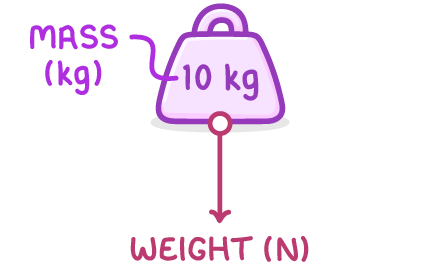
- Weight - The force acting on an object due to gravity. Weight is a force, so it's measured in newtons (N) using a calibrated spring balance (a newtonmeter).
- Weight acts as though it's concentrated at a single point on the object, called the centre of mass.
Why weight changes with location
- Weight depends on the gravitational field strength where the object is.
- An object has different weights in different places, even though its mass never changes.
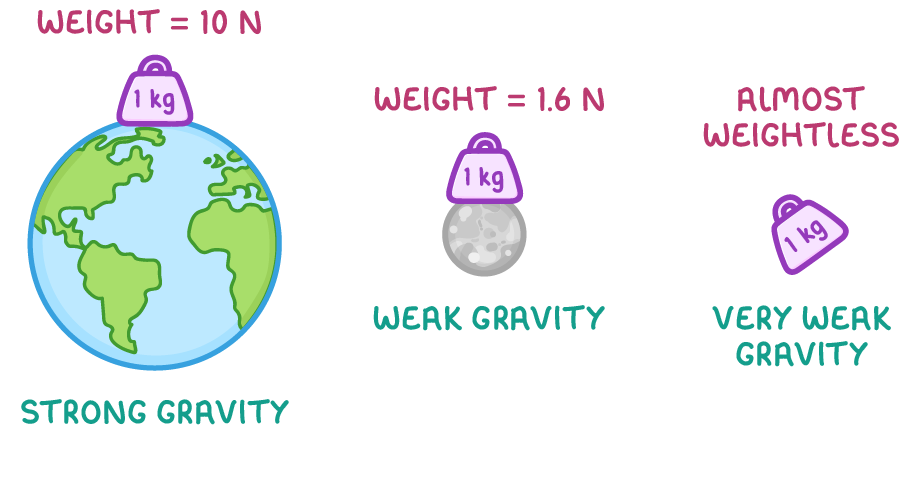
- A 1 kg mass weighs about 10 N on Earth but only about 1.6 N on the Moon, because the Moon's gravitational field strength is smaller.
Formula for weight
Where:
- = Weight, in newtons (N)
- = Mass, in kilograms (kg)
- = Gravitational field strength, in newtons per kilogram (N/kg)
Values of g
- On Earth, is about 10 N/kg - always use the value given in the question.
- On the Moon, is about 1.6 N/kg, and it's different again on other planets.
- Weight and mass are directly proportional () for a given gravitational field strength.
Worked example - Weight of a suitcase
A 6.0 kg suitcase is on Earth, where the gravitational field strength is 10 N/kg. Calculate its weight.
Step 1 - Formula
Step 2 - Substitution and calculation
Step 3 - Interpretation
Taken to the Moon ( = 1.6 N/kg), the same suitcase would weigh 6.0 × 1.6 = 9.6 N. Its mass stays 6.0 kg in both places; only the weight changes, because is different.
g is also the acceleration of free fall
- Gravitational field strength, , is also the acceleration of an object in free fall.
- Free fall is the motion of an object when the only force acting on it is gravity.
- Near the Earth's surface, a falling object accelerates at about 9.8 m/s2 (often rounded to 10 m/s2), so can be written in units of N/kg or m/s2.
All objects fall at the same rate
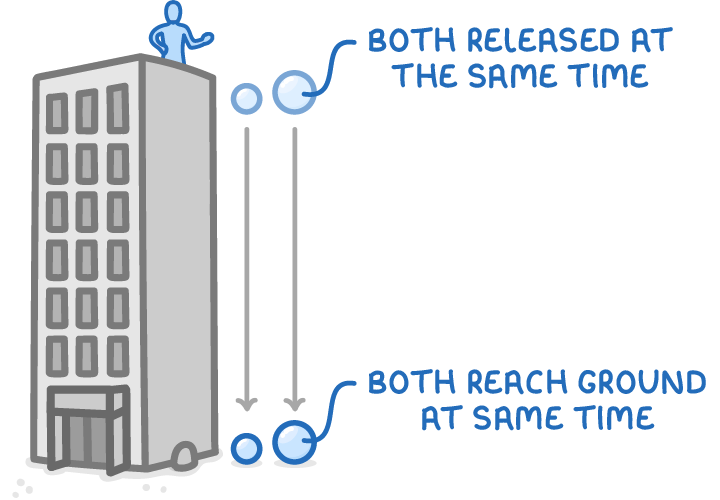
- With no air resistance, every object near the Earth's surface falls with the same acceleration, regardless of its mass.
- Gravity pulls harder on a heavier object, but a heavier object also has more mass to accelerate - the two effects cancel out.
- Without air resistance, a falling object's speed increases by about 9.8 m/s every second.
TermDefinition
Mass
Weight
Centre of mass
Free fall