5.14 - Newton's 1st & 2nd Laws
Newton's First Law - Resultant force changes motion
- Newton's First Law - If the resultant force on an object is zero, its velocity doesn't change:
- A stationary object stays stationary.
- A moving object continues at the same velocity (same speed and direction).
- When an object is stationary or moving at a constant velocity, the forces on it are balanced.
- Velocity only changes if the forces are unbalanced, giving a non-zero resultant force that causes an acceleration in the direction of the force.

A non-zero resultant force can cause an object to:
- start moving
- stop moving
- speed up
- slow down
- change direction
Newton's Second Law - Acceleration and resultant force
- The larger the resultant force on an object, the more it accelerates - force and acceleration are directly proportional ().
- Acceleration is inversely proportional to mass: for a fixed resultant force, a larger mass accelerates less than a smaller one.
Formula for Newton's Second Law
Where:
- = Resultant force, in newtons (N)
- = Mass, in kilograms (kg)
- = Acceleration, in metres per second squared (m/s2)
is always the resultant force, found by adding or subtracting the forces acting along the same line.
Worked example - Acceleration of a car
A car of mass 2,000 kg has an engine providing a driving force of 8,000 N. The drag force on the car is 2,000 N. Find its acceleration.
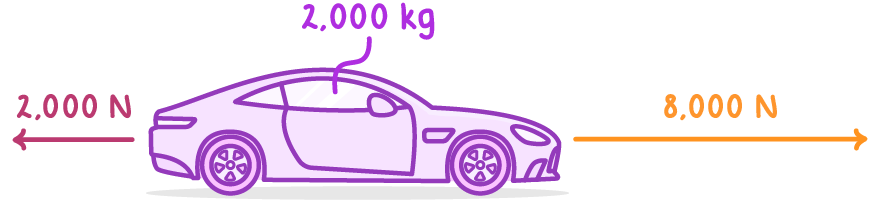
Step 1 - Work out the resultant force
The driving force and drag force act along the same line in opposite directions, so subtract them.
Step 2 - Rearrange F = ma for acceleration
Step 3 - Substitution and calculation
The car accelerates at 3 m/s2 in the direction of the resultant force.
Inertia and inertial mass
- Inertia is the tendency of an object to continue in its current state of motion (at rest or moving at a constant velocity).
- The larger an object's mass, the larger its inertia, and the harder it is to change its velocity.
Inertial mass
- An object's inertial mass measures how difficult it is to change its velocity.
- It's defined as the ratio of resultant force to acceleration:
TermDefinition
InertiaThe tendency of an object to stay at rest or to keep moving with uniform motion (at a steady speed in a straight line).
Inertial massA measure of how difficult it is to change an object's velocity, defined as the ratio of resultant force to acceleration.
Key points to remember
How were these notes?