3.4 - Specific Latent Heat
Why temperature stays constant during a change of state
- Heating a substance transfers energy to the kinetic energy stores of its particles, usually raising its temperature.
- During a change of state, the temperature stays constant even though energy is still being transferred.
Energy goes into breaking bonds, not raising temperature
- When a substance melts or boils, the energy supplied breaks the bonds between particles rather than raising the temperature.
- The internal energy still increases, but that increase goes entirely into separating the particles.
- The energy transferred during a change of state with no change in temperature is the latent heat.
- When a substance condenses or freezes, bonds form between particles, releasing energy. The internal energy decreases, but the temperature doesn't fall until all of the substance has changed state.
Flat spots on heating and cooling graphs
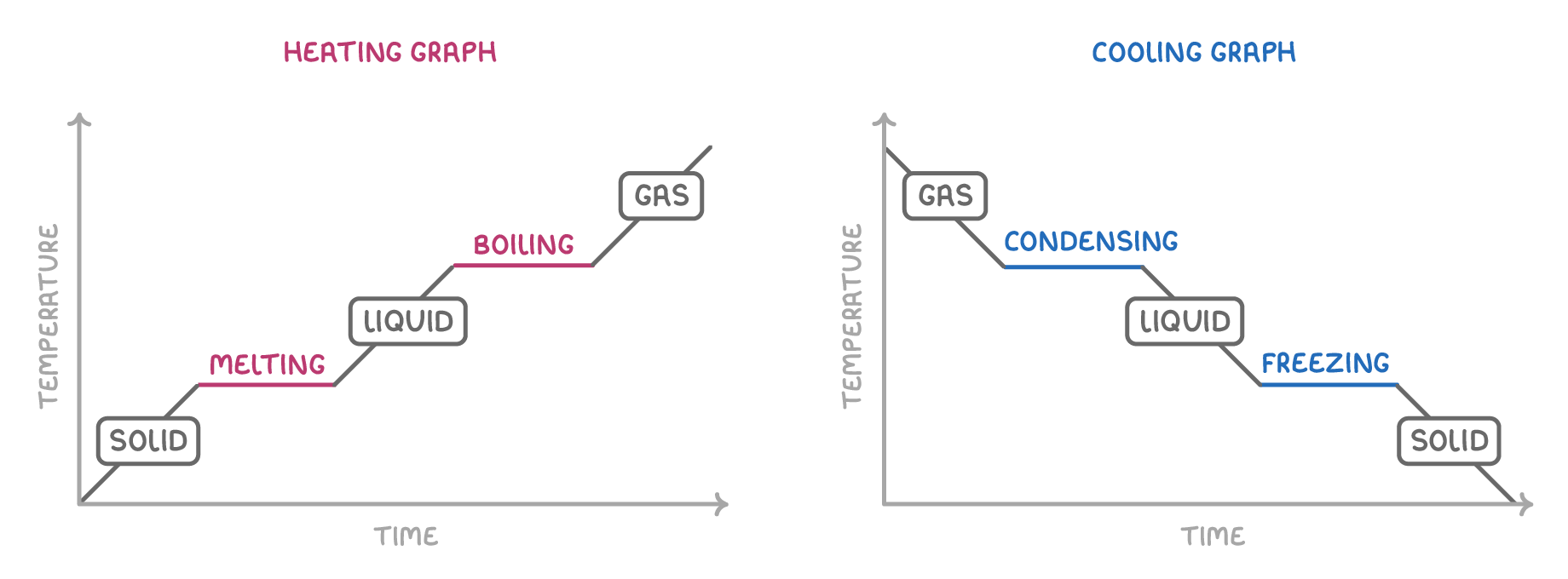
A graph of temperature against time has flat spots during changes of state:
- On a heating graph, at the melting point and boiling point (internal energy rises while bonds break).
- On a cooling graph, where the substance condenses and freezes (internal energy falls while bonds form).
Demonstrating it with melting ice
- Heat a beaker of crushed ice with a Bunsen burner, recording the temperature and state every 20 seconds until the water boils.
- Plotting temperature against time gives:
- A flat spot at 0 °C while the ice melts
- A flat spot at 100 °C while the water boils
- Sloping sections in between where the temperature rises
Specific latent heat - Fusion and vaporisation
- The specific latent heat of a substance is the energy needed to change the state of 1 kg of it with no change in temperature.
- When the change is reversed, the same amount of energy is released.
The two types
- Specific latent heat of fusion - The energy needed to change 1 kg of a substance from a solid to a liquid at its melting point with no change in temperature (and released when 1 kg of liquid freezes).
- Specific latent heat of vaporisation - The energy needed to change 1 kg of a substance from a liquid to a gas at its boiling point with no change in temperature (and released when 1 kg of gas condenses).
Vaporisation needs more energy than fusion
- For any substance, the specific latent heat of vaporisation is always larger than the specific latent heat of fusion.
- More bonds must be broken to separate particles completely from a liquid into a gas than to loosen them from a solid into a liquid.
Formula for the energy of a change of state
Where:
- = Energy transferred (or released) in the change of state, in joules (J)
- = Mass, in kilograms (kg)
- = Specific latent heat, in joules per kilogram (J/kg)
This can also be written as or .
- is the energy to change the state of the whole mass; is the energy to change just 1 kg.
- The value of depends on the change taking place:
- Fusion for melting or freezing
- Vaporisation for boiling or condensing
Worked example - Energy to boil water
The specific latent heat of vaporisation of water is 2,260,000 J/kg. How much energy is needed to completely boil away 2.00 kg of water that is already at 100 °C?
Step 1 - Formula
Step 2 - Substitution and calculation
So 4,520,000 J of energy is needed. The value used for is the specific latent heat of vaporisation, because liquid is turning into gas.
Worked example - Mass of water boiled away
The specific latent heat of vaporisation of water is 2.26 × 10⁶ J/kg. A pan of water at 100 °C is boiled dry, and 1.695 × 10⁶ J of energy is transferred to do it. What was the mass of water in the pan?
Step 1 - Formula
Step 2 - Rearrange the formula
Step 3 - Substitution and calculation
So the pan held 0.75 kg of water. The specific latent heat of vaporisation is used, because liquid is boiling into gas.
TermDefinition
Latent heatThe energy transferred during a change of state with no change in temperature.
Specific latent heatThe energy needed to change the state of 1 kg of a substance with no change in temperature.
Specific latent heat of fusionThe energy needed to change 1 kg of a substance from a solid to a liquid at its melting point with no change in temperature.
Specific latent heat of vaporisationThe energy needed to change 1 kg of a substance from a liquid to a gas at its boiling point with no change in temperature.
Key points to remember
How were these notes?