9.8 - Force, Mass & Acceleration (F = ma)
The experiment
Aim
To find out how the accelerating force and the mass being accelerated each affect the acceleration of an object, and to test the rule linking them.
Background
- Newton's second law links the resultant force on an object, its mass, and its acceleration by , where is in newtons, is in kilograms, and is in m/s2.
- For a fixed mass, doubling the force doubles the acceleration. For a fixed force, doubling the mass halves it.
- Here the force is the weight of the masses on the hook. The string accelerates those masses as well as the car, so is the mass of the whole system.
- You can't measure acceleration directly, but you can time how long the car takes to travel 1 m from rest.
- So in this practical you time the car, first with different forces and then with different masses, and work out each acceleration.
Variables
- Independent variable - The accelerating force, then the total mass of the system.
- Dependent variable - The acceleration, found from the time to travel 1 m.
- Control variables - The total mass while the force changes, the force while the mass changes, and the distance.
Method
- Set up the pulley - Clamp a pulley to the far end of the bench. Tie a string to the car, pass it over the pulley, and hang a mass hook on the free end.
- Compensate for friction - Raise the start end of the bench very slightly, until a nudged car keeps rolling at a steady speed.
- Find the total mass - Weigh the car, the hook, and each of the masses, and add them up.
- Time the car - Hold it on a chalk start line with the string taut, and let go without pushing as you start the stopwatch. Stop it as the car crosses a chalk line 1 m away.
- Repeat - Do each run three times and find the mean time.
- Change the force - Start with all the masses on the car, and move them to the hook one at a time.
- Change the mass - Keep the load on the hook fixed, and add masses to the car one at a time.
- Plot the graphs - Acceleration against force, and acceleration against mass.
Safety
- Catch the masses - Put a cushioned box under the hanging masses so they don't land on anyone's feet.
- Stand, don't sit - So you can move away if the masses fall.
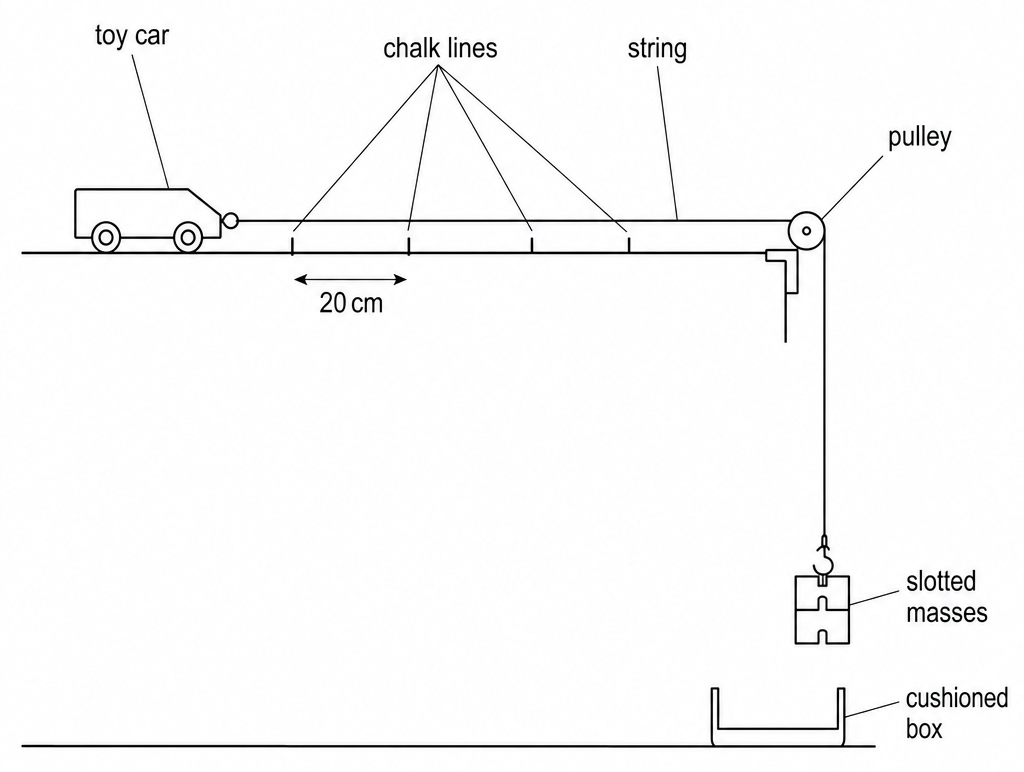
Worked example - Analysing F = ma results
A student kept the total mass of the system at 0.50 kg and moved masses from the car to the hook one at a time, timing how long the car took to travel 1.00 m from rest.
| Accelerating force (N) | 0.50 | 1.00 | 1.50 | 2.00 |
|---|---|---|---|---|
| Mean time over 1.00 m (s) | 1.41 | 1.00 | 0.82 | 0.71 |
They then kept the load on the hook at 1.00 N and added masses to the car.
| Total mass (kg) | 0.25 | 0.50 | 0.75 | 1.00 |
|---|---|---|---|---|
| Acceleration (m/s2) | 4.0 | 2.0 | 1.33 | 1.0 |
Find the accelerations, say what the graphs show, explain why the masses were moved rather than added, and sort the errors.
Step 1 - Turn each time into an acceleration
The car starts from rest and speeds up steadily, so , which rearranges to this.
- At 0.50 N, 2.00 ÷ 1.412 = 1.0 m/s2.
- At 1.00 N, 2.00 ÷ 1.002 = 2.0 m/s2.
- At 1.50 N, 2.00 ÷ 0.822 = 3.0 m/s2.
- At 2.00 N, 2.00 ÷ 0.712 = 4.0 m/s2.
Step 2 - Describe the acceleration-force graph
Acceleration on the y-axis against force on the x-axis is a straight line through the origin, so the acceleration is directly proportional to the force.
Step 3 - Turn the gradient into a mass
Since , the gradient is .
This matches the 0.50 kg measured on the balance.
Step 4 - Describe the acceleration-mass graph
Acceleration against total mass is a curve. Doubling the mass from 0.25 kg to 0.50 kg halves the acceleration from 4.0 to 2.0 m/s2, so the acceleration is inversely proportional to the mass.
Step 5 - Straighten the curve
Since , plot acceleration against . The values of 1 ÷ mass are 1 ÷ 0.25 = 4.0, 1 ÷ 0.50 = 2.0, 1 ÷ 0.75 = 1.33, and 1 ÷ 1.00 = 1.0 per kg.
The points lie on a straight line through the origin, with a gradient of 4.0 ÷ 4.0 = 1.0 N, the force the student set.
Step 6 - Explain why the masses were moved rather than added
The hanging masses are accelerated too, so adding masses to the hook would increase the total mass as well as the force. Moving a mass from the car to the hook increases the force and keeps the total mass the same.
Step 7 - Sort the errors into random and systematic
- Hand timing is a random error. It varies from run to run, and taking a mean reduces its effect.
- Friction that hasn't been compensated for is a systematic error. It acts on every run, so every acceleration comes out slightly too small.
Common exam questions
Question 1
A resultant force of 6.0 N acts on a system of total mass 2.0 kg. Calculate the acceleration.
a = F ÷ m = 6.0 ÷ 2.0 = 3.0 m/s2.
Question 2
Why is the car held with the string taut before it's released?
So it starts from rest with the full pulling force acting. With a slack string, the hook would drop first and give the car an unknown starting speed.
Question 3
Why is the start end of the bench sometimes raised very slightly?
To cancel out friction. When a nudged car rolls at a steady speed, friction is balanced by part of the car's weight, so the weight on the hook is the only unbalanced force.
Question 4
A graph of acceleration against force is a straight line that crosses the force axis at 0.2 N. What does that show?
Friction hasn't been fully compensated for. The first 0.2 N of pulling force is used up overcoming it, and only the force beyond that accelerates the car.
Question 5
Give one advantage of using a light gate instead of a stopwatch.
The light gate is triggered by the car itself, so there's no reaction time in the measurement and the timing is more precise.