9.2 - Infrared Radiation & Absorption (Leslie Cube)
The experiment
Aim
To find out how the colour and the finish of a surface affect how much infrared radiation it gives out.
Background
- Every object gives out infrared radiation all the time, and takes it in from its surroundings.
- How much an object gives out depends on how hot it is and on its surface. Dark, matt surfaces give out more than pale, shiny ones.
- A surface that's good at giving out infrared is equally good at absorbing it.
- You can't see infrared radiation, but an infrared detector gives a reading that goes up with the amount it picks up.
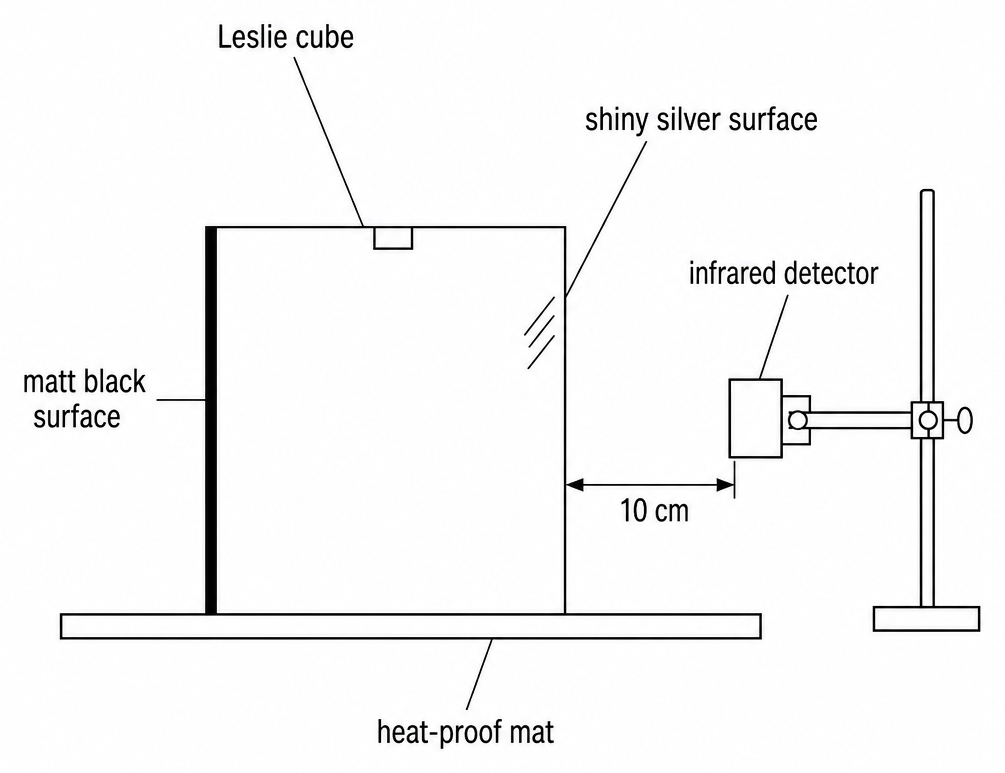
- So in this practical you fill a Leslie cube with hot water and measure the infrared given out by each of its four faces, from the same distance.
Variables
- Independent variable - The surface facing the detector, which is shiny black, matt black, shiny silver, or matt white.
- Dependent variable - The detector reading.
- Control variables - The distance from the face to the detector, the temperature of the water, and the detector pointing at the middle of each face.
Method
- Fill the cube - Stand the Leslie cube on a heat-proof mat, fill it with hot water where it stands, and put the lid on.
- Let it warm through - Leave it for a few minutes, then check with a thermometer that all four faces are at the same temperature.
- Take a reading - Clamp the infrared detector 10 cm from one face, pointing at the middle of it, and record the reading. If there's no detector, an infrared thermometer or a thermometer with a matt black bulb can be used instead.
- Turn the cube - Turn it so each face in turn is in front of the detector, at exactly the same distance, and record each reading.
- Repeat - Take the whole set of readings again, and find a mean for each face.
Safety
- Hot water scalds - Don't carry the cube once it's full, keep it away from the edge of the bench, and leave it to cool before emptying it.
Worked example - Presenting Leslie cube results
A student filled a Leslie cube with hot water, checked that all four faces were at 78 °C, and took a detector reading 10 cm from each face.
| Surface | Matt black | Shiny black | Matt white | Shiny silver |
|---|---|---|---|---|
| Detector reading (units) | 48 | 38 | 30 | 12 |
Present the results, rank the surfaces, and explain what the results show about colour and finish.
Step 1 - Choose the right chart
The independent variable is a type of surface, which is categoric, so use a bar chart with gaps between the bars, not a line graph.
Step 2 - Rank the surfaces
Matt black gives out the most infrared, then shiny black, then matt white. Shiny silver gives out the least.
Step 3 - Separate colour from finish
- Matt black (48) and shiny black (38) are the same colour with a different finish, so a matt finish gives out more than a shiny one.
- Matt black (48) and matt white (30) have the same finish and a different colour, so a dark colour gives out more than a pale one.
- Comparing matt black with shiny silver changes the colour and the finish at once, so it can't show the effect of either.
Step 4 - Explain why the temperatures had to match
How much infrared a surface gives out depends on its temperature as well as its surface. Checking that all four faces were at 78 °C means any difference in the readings comes from the surface alone.
Step 5 - Compare the readings
The detector reads in arbitrary units, so the results can only be compared with each other. Matt black gave 48 and shiny silver 12, and 48 ÷ 12 = 4, so the matt black face gave out four times as much infrared as the shiny silver face.
Common exam questions
Question 1
Why is the detector held the same distance from every face?
Radiation spreads out as it travels, so the further away the detector is, the less it picks up. Keeping the distance fixed means any difference in the readings comes from the surface.
Question 2
Why is a Leslie cube used rather than four separate containers?
All four faces are part of the same metal box holding the same water, so they're at the same temperature. Four separate containers would cool at different rates.
Question 3
Why is the cube left for a few minutes after being filled?
So the metal warms right through and the faces reach a steady temperature. Readings taken straight away would catch the faces still warming up, probably at different rates.
Question 4
A student uses a thermometer with a matt black bulb instead of an infrared detector, and the four faces give very similar readings. Suggest why.
A thermometer has a much coarser resolution, usually to the nearest degree, so differences the detector shows clearly end up within one or two divisions of each other.
Question 5
Two metal sheets, one matt black and one shiny, have coins stuck to the back with wax and are placed the same distance from an infrared source. Explain which coin falls first.
The one on the matt black sheet. That surface absorbs infrared faster, so the sheet warms up more quickly, the wax melts sooner, and the coin drops off first.