1.17 - Hydroelectricity & Tidal Barrages
Hydroelectric power uses falling water
- Hydroelectric power generates electricity from falling water.
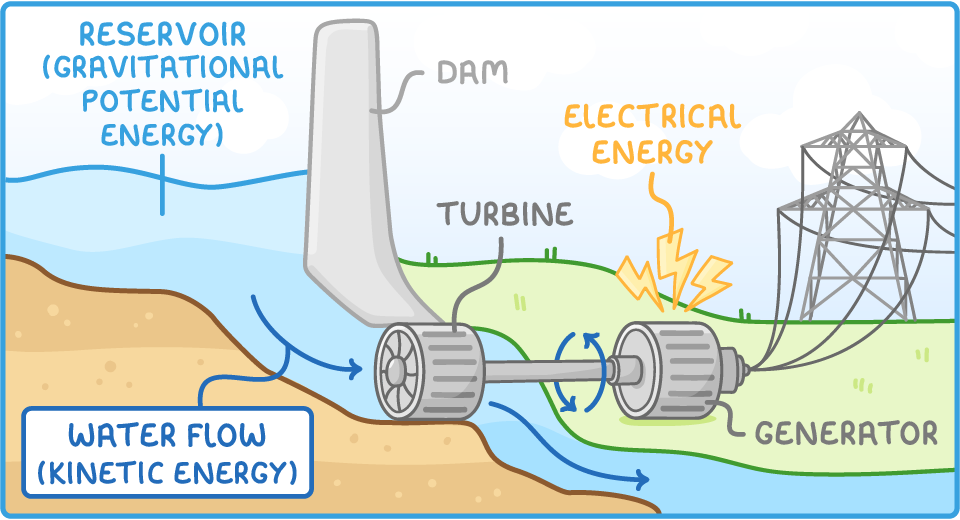
- A valley is flooded by building a dam, creating a reservoir that catches rainwater.
- Water is released through turbines: the water's gravitational potential energy at the top is transferred to kinetic energy as it falls.
- The moving water turns the turbines, which drive generators to produce electricity.
Advantages
- No pollution created directly once the dam is built.
- Responds immediately to rising demand - water is released through the turbines whenever extra electricity is needed.
- Reliable in areas with high rainfall; no fuel costs and minimal running costs.
Disadvantages
- High initial cost of building the dam and power station.
- Big environmental impact from flooding the valley - rotting vegetation releases methane and carbon dioxide, and habitats and homes can be lost.
- Reservoirs can look unsightly when water levels drop.
- Unreliable in times of drought, and requires a suitable valley to flood.
Tidal barrages use the Sun and Moon's gravity
- Tides are produced by the gravitational pull of the Sun and the Moon.
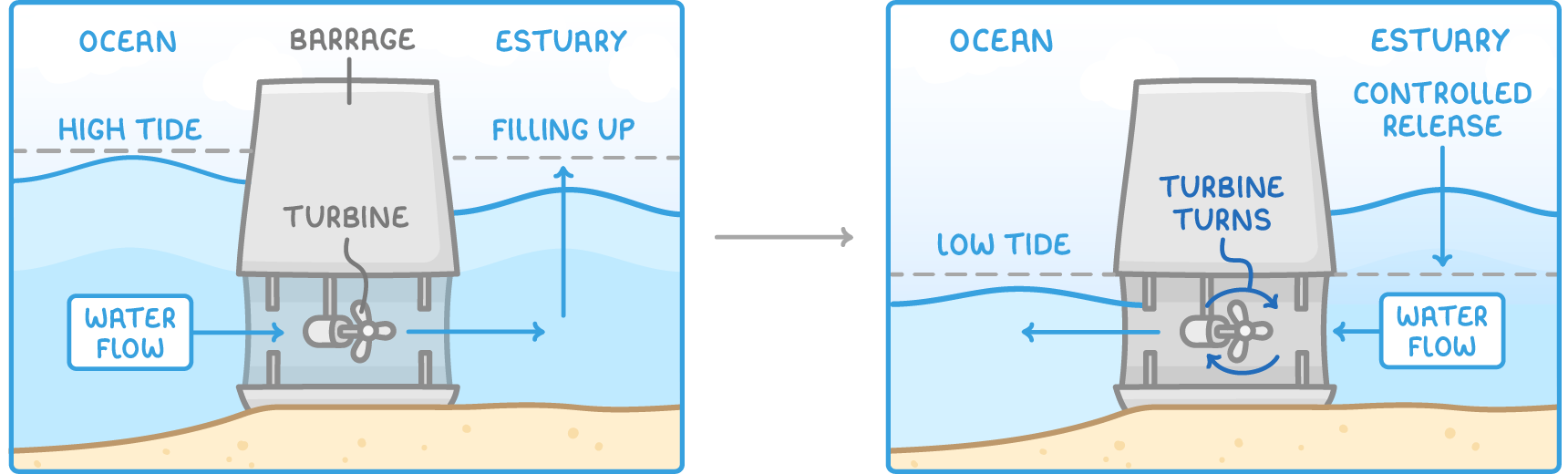
- A tidal barrage is a big dam built across a river estuary, with turbines in it.
- As the tide comes in, it fills the estuary. The water is then let out through the turbines at a controlled speed, turning them to drive generators.
- Some barrages also drive the turbines on the way in, generating electricity on both the incoming and outgoing tide.
Advantages
- No pollution once the barrage is running.
- Tides are reliable - they happen twice a day at predictable times.
- No fuel costs and minimal running costs.
Disadvantages
- High initial building costs.
- Prevents free access for boats, spoils the view, and alters wildlife habitats (e.g. for wading birds).
- Lower neap tides provide much less energy than bigger spring tides.
- Doesn't generate electricity when the water level is the same on each side, which happens four times a day.
- Needs a suitable estuary with a large difference between high and low tides.
Wave power
- Wave power captures the energy carried by waves at the surface of the sea.
- Waves are made mainly by the wind blowing across the water.
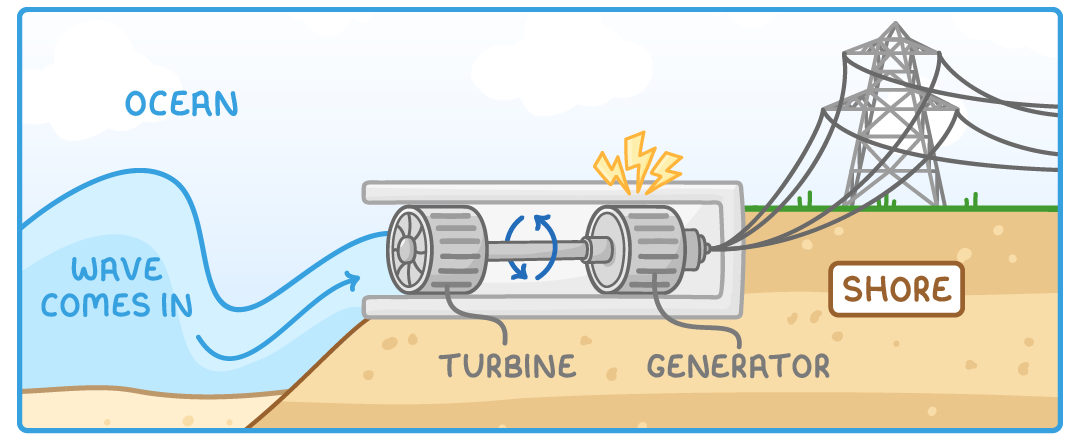
- As waves come in to the shore, the up-and-down motion of the water moves wave converters placed around the coast.
- This motion drives a turbine, which turns a generator to produce electricity.
Advantages
- Renewable - Waves keep coming as long as there's wind.
- No pollution while running.
- No fuel costs and low running costs.
Disadvantages
- Disturbs the seabed and marine habitats.
- Spoils the view along the coast and can be a hazard to boats.
- Unreliable - Waves die out when the wind drops, so output varies.
- High initial building costs and produces only a small amount of electricity per device.
TermDefinition
Hydroelectric powerThe generation of electricity using the kinetic energy of falling water.
Tidal barrageA dam built across a river estuary with turbines that generate electricity as the tide moves in and out.
Wave powerThe generation of electricity using the up-and-down motion of waves at the surface of the sea.
Key points to remember
How were these notes?