4.6 - Why Radiation Is Harmful
How ionising radiation damages living cells
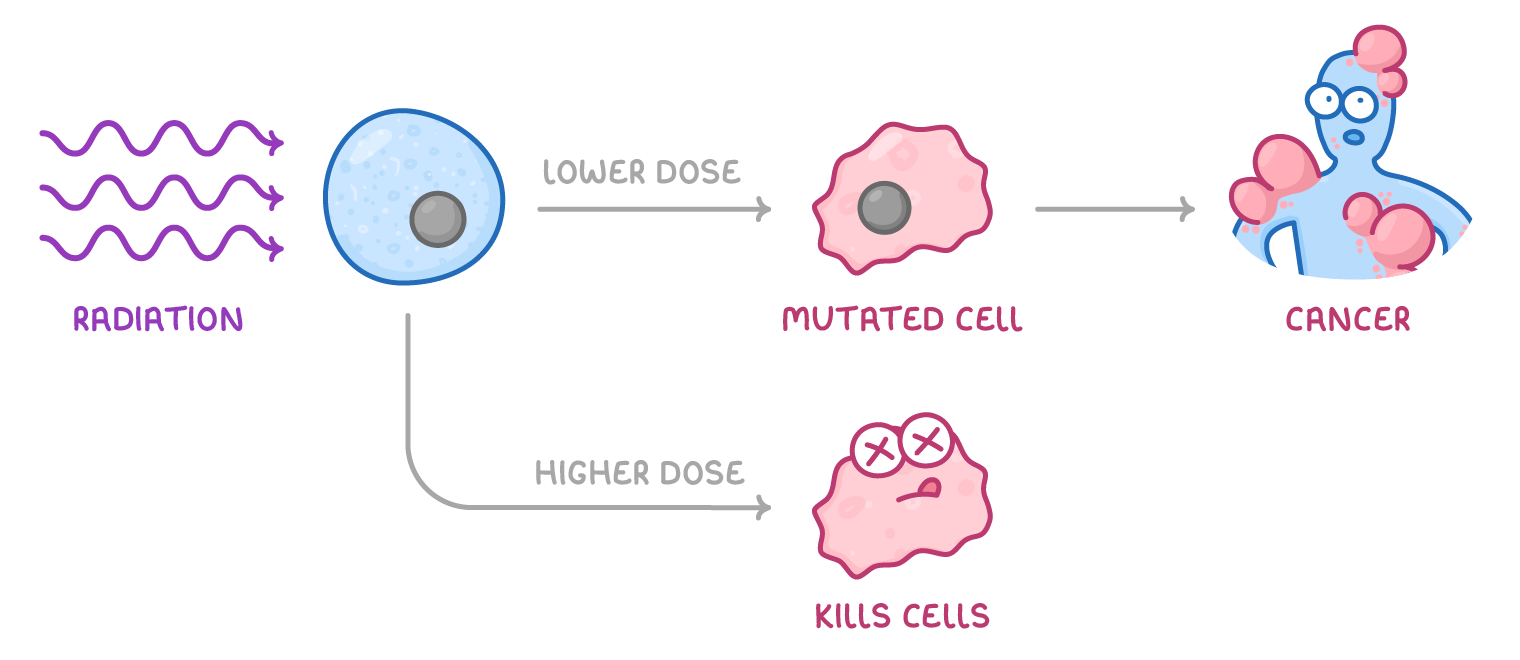
- Ionising radiation enters living cells and ionises the atoms and molecules inside them.
- Removing electrons damages or destroys these molecules, which damages the cell.
- The amount of harm depends on the radiation dose.
Lower dose - Mutation and cancer
- A lower dose tends to cause minor damage without killing the cell.
- This damage can mutate the cell's DNA.
- A mutated cell may divide uncontrollably, leading to cancer.
Higher dose - Radiation sickness
- A higher dose kills cells outright.
- Killing a large number of cells at once causes radiation sickness, with symptoms such as vomiting, tiredness and hair loss.
- Very high doses can be fatal.
Ionising power
- The more ionising the radiation, the more damage it causes to cells.
- Most to least ionising: alpha → beta → gamma.
Irradiation
- Irradiation is the process of exposing an object to radiation.
- Irradiating an object does not make it radioactive.
- Irradiation stops as soon as the source is removed or shielded.
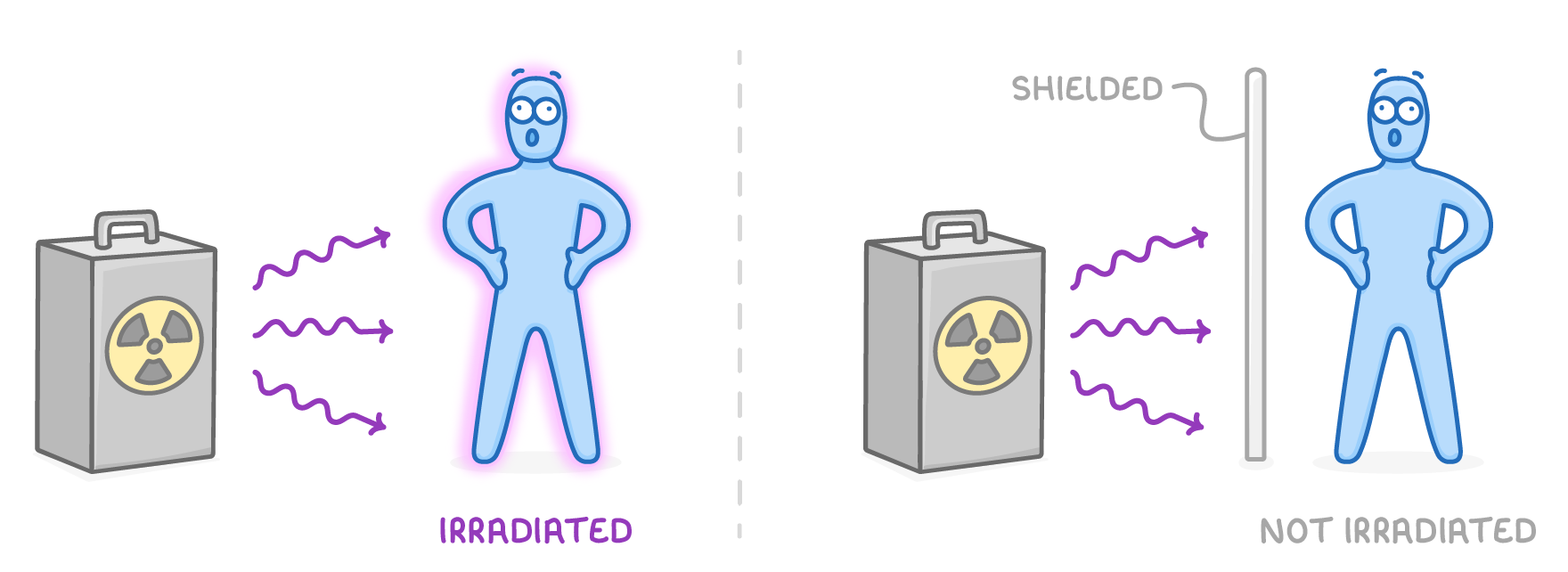
Reducing the risk of irradiation
- Store sources in lead-lined boxes.
- Stand behind barriers or work from a different room.
- Use long-handled tools to stay as far from the source as possible.
- Limit the time spent near the source.
- Wear photographic film badges (dosimeters) so total exposure can be monitored and kept within safe limits.
Contamination
- Contamination occurs when unwanted radioactive atoms get onto or into an object or person.
- The contaminating atoms decay, emitting radiation directly on or inside the body.
- Contamination poses a high risk because the radioactive material stays in place, exposing tissues to radiation until it is removed or decays away.
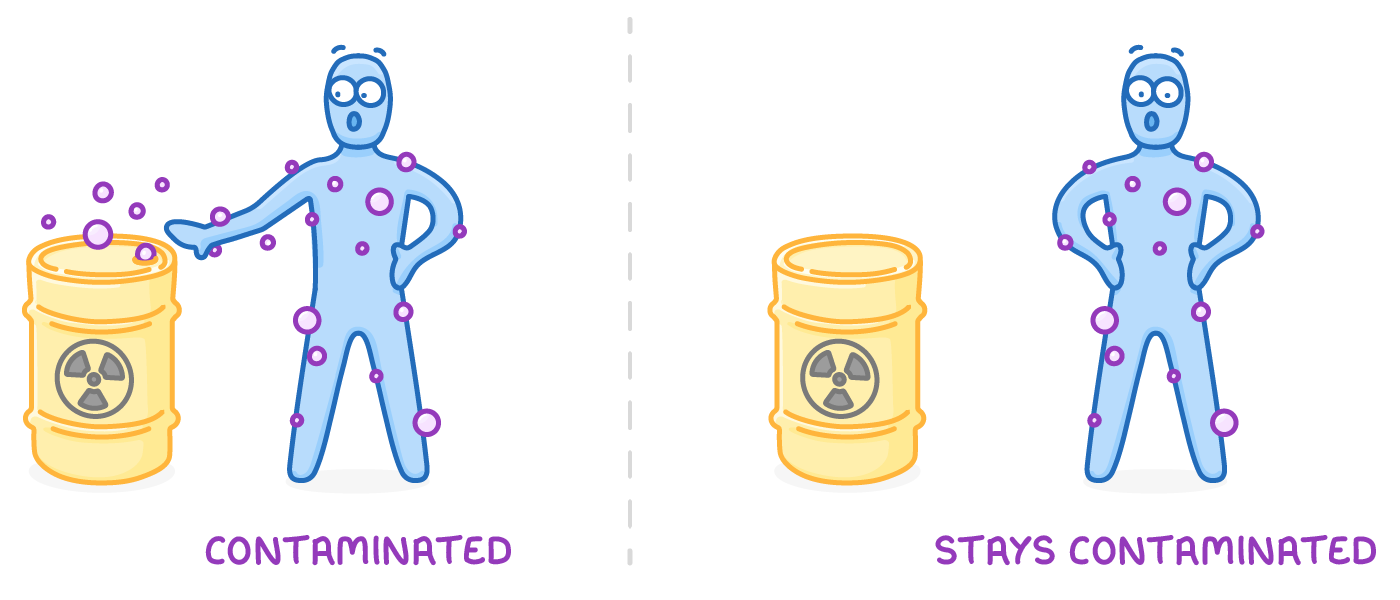
Precautions against contamination
- Wear gloves and protective clothing so radioactive material can't touch the skin.
- Use tongs to avoid touching sources.
- Wear masks or protective suits to avoid breathing in radioactive dust or gas.
Radiation hazards inside and outside the body
How dangerous a radioactive source is depends on the type of radiation and whether the source is outside the body (irradiation) or inside it (contamination).
Outside the body (irradiation)
- Beta and gamma are the most dangerous because they can penetrate the skin and reach internal organs.
- Alpha is the least dangerous because it can't penetrate the outer layer of skin and is stopped by a few centimetres of air.
Inside the body (contamination)
- Alpha is the most dangerous because it is the most strongly ionising and all of its energy is absorbed in a small, concentrated area of tissue.
- Beta is less dangerous because its energy is spread over a wider area, and some passes out of the body.
- Gamma is the least dangerous because it is weakly ionising and most of it passes straight out of the body without being absorbed.
TermDefinition
Radiation sicknessA condition caused by a high dose of radiation killing a large number of cells at once.
IrradiationThe process of exposing an object to radiation.
ContaminationThe unwanted presence of radioactive atoms on or inside an object or person.
Key points to remember
How were these notes?