2.6 - Parallel Circuits
Parallel circuits and independence
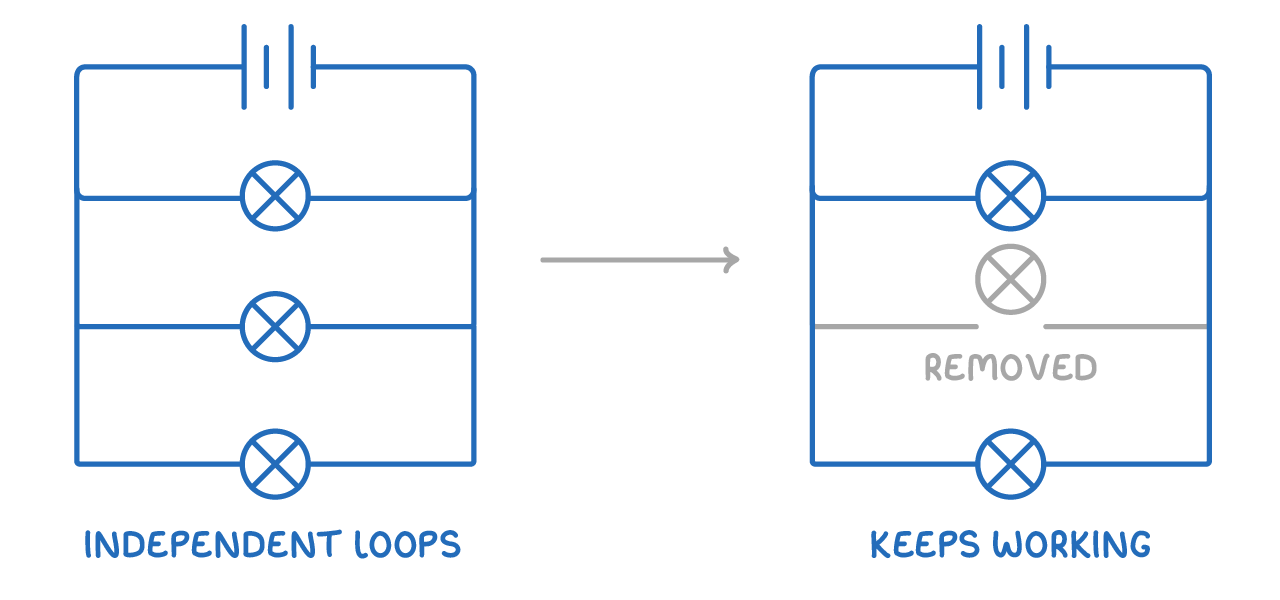
In a parallel circuit, each component sits on its own loop, or branch, connected separately to the supply.
Components work independently
- Because the branches are separate, components work independently - if one is disconnected, the others keep working.
- This is why parallel circuits are used in cars and house lighting, where lamps and appliances must be switched on and off separately.
Mixed circuits
When components are on the same branch in a mixed circuit, the series-circuit rules apply to that branch.
Potential difference and current rules
Potential difference is the same across every branch
- Each branch gets the full supply potential difference, so the p.d. is the same across all branches:
- Because each charge travels down only one branch, it transfers all its energy to the components on that branch.
- Identical bulbs connected in parallel are therefore all equally bright.
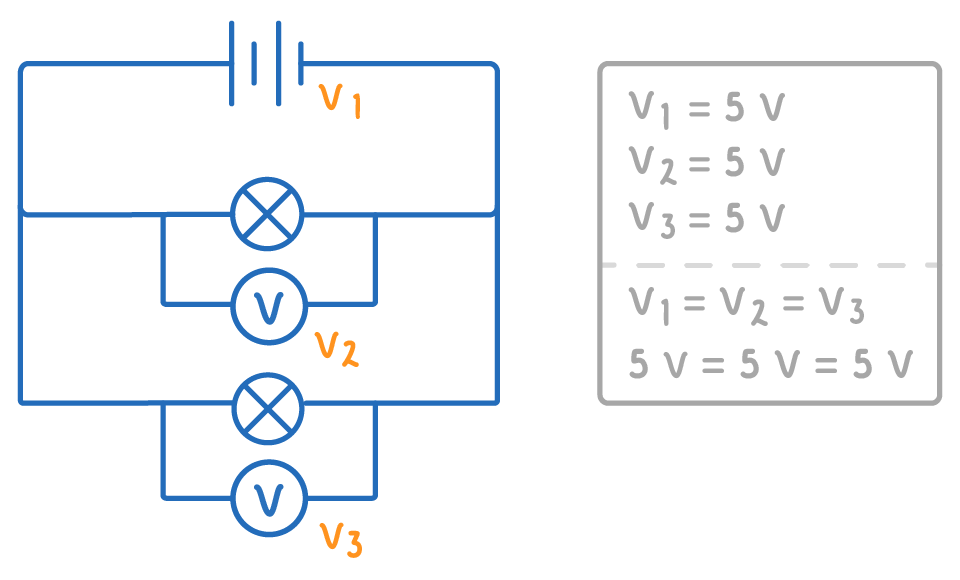
V1 is the supply p.d., V2 and V3 are the branch p.d.s.
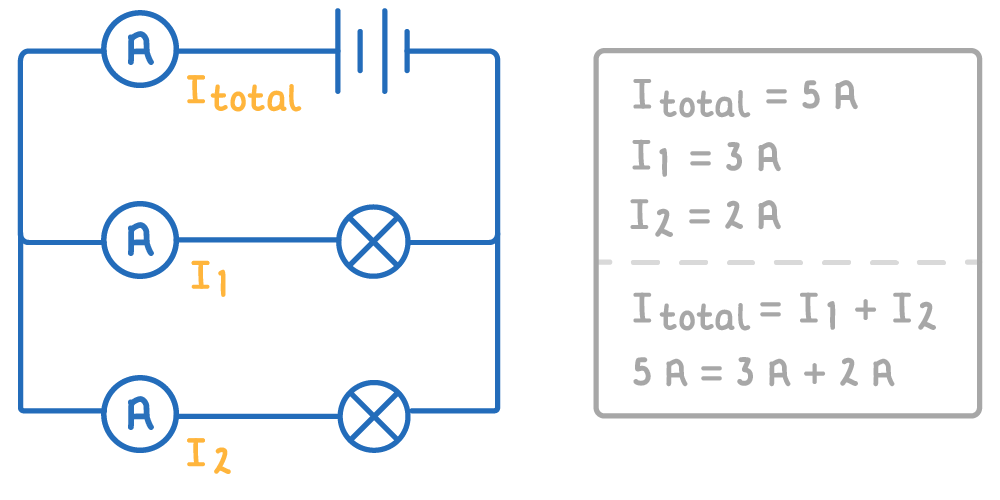
The branch currents add up to the total current
- The total current equals the sum of the currents in the separate branches:
- At any junction, the total current going in equals the total current coming out, because charge is conserved.
Current in a single branch
- The current in a branch is , where is the supply p.d. and is that branch's resistance.
- The branch with the lowest resistance carries the largest current.
- Changing the resistance of one branch only affects the current in its own branch; the other branches are unchanged.
Why adding a resistor in parallel lowers resistance
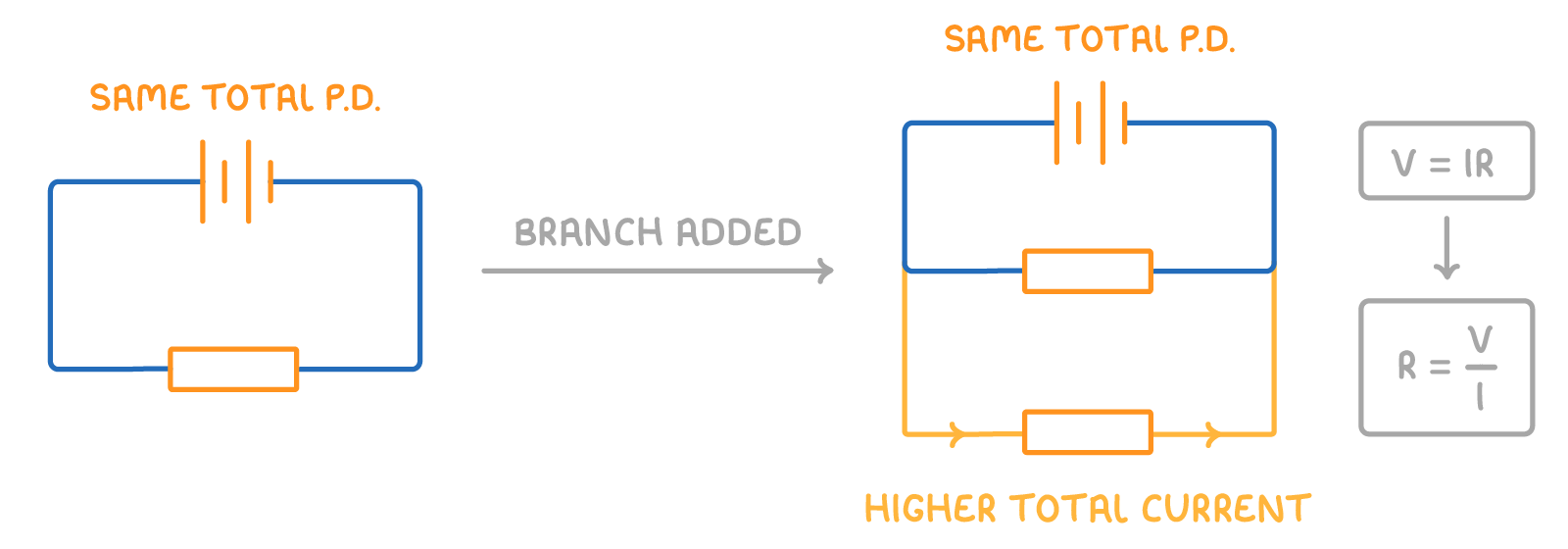
- The total resistance of a parallel circuit is always less than the resistance of any individual branch.
- Adding another resistor in parallel lowers the total resistance further.
The reasoning
- Every branch has the full source p.d. across it.
- Adding another branch gives the current an extra path, so the current in the existing branches stays the same while new current is drawn.
- This increases the total current drawn from the supply.
- Since and is constant, an increase in total current means total resistance decreases.
TermDefinition
Parallel circuitA circuit where the components are connected on separate branches, so each one can work independently of the others. Components connected across each other like this are said to be in parallel.
BranchA separate loop in a parallel circuit that provides an independent path for current.
Key points to remember
How were these notes?