5.13 - Terminal Velocity
Drag and air resistance
- Drag is the frictional force on an object moving through a fluid (a liquid or a gas).
- Air resistance is a type of drag.
- Drag increases as speed increases - the faster an object moves, the more drag acts against it.
- For example, a car has much more drag to work against at 70 mph than at 30 mph, so the engine must provide a larger driving force to maintain that steady speed.

Streamlining and reducing drag
- The most important way to reduce drag is to give an object a streamlined shape.
- A streamlined shape lets fluid flow easily past it, reducing drag.
- A parachute is designed to do the opposite - its shape produces as much drag as possible.
Objects falling through a fluid reach a terminal velocity
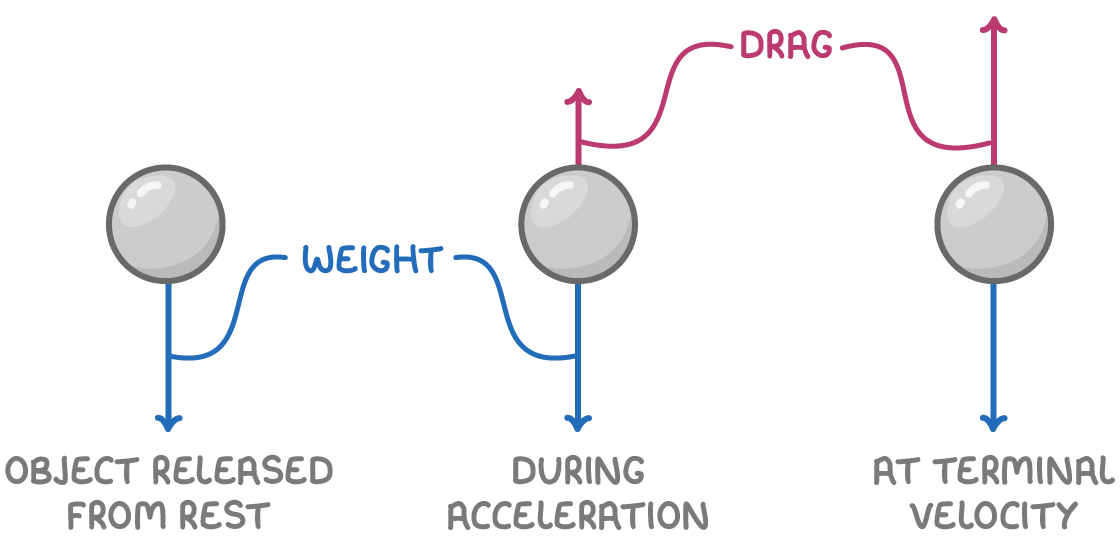
- When an object falls through a fluid, two forces act on it:
- Weight pulls it down.
- Drag (such as air resistance) pushes up against its motion.
- The object reaches a maximum constant speed called the terminal velocity.
How terminal velocity is reached
- At the start, weight is greater than drag, so there's a resultant force downwards and the object accelerates.
- As it speeds up, drag increases, which reduces the resultant force and decreases the acceleration.
- Eventually drag increases until it equals the weight. The resultant force is now zero, so the object falls at a steady speed - the terminal velocity.
Terminal velocity depends on shape and area
- A larger surface area produces more drag.
- An object with a larger area reaches terminal velocity at a lower speed, because drag balances its weight sooner.
The skydiver example
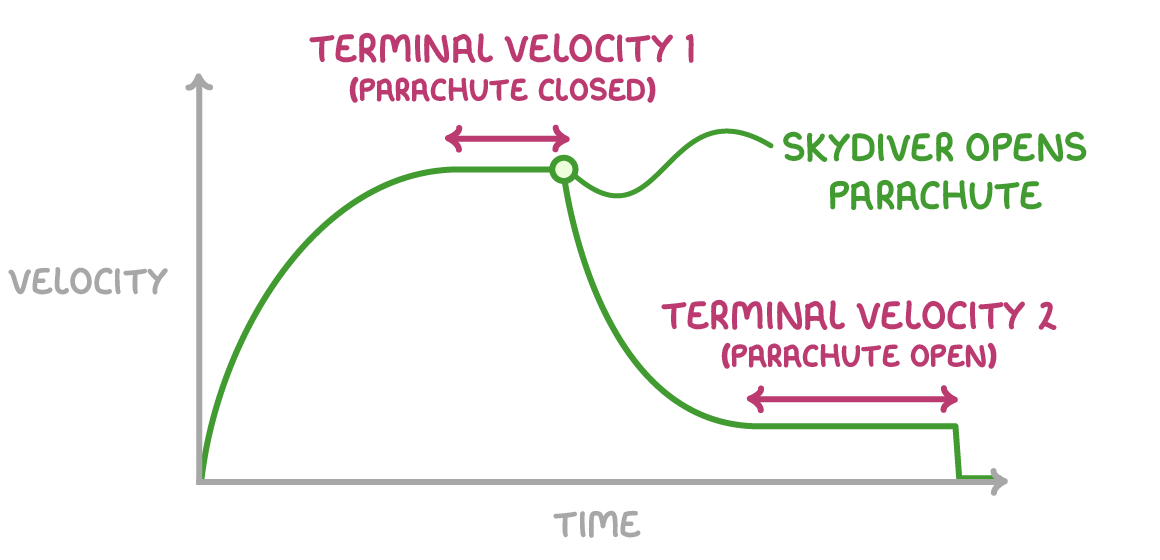
- Parachute closed - Small area gives low drag, so the skydiver reaches a high terminal velocity.
- Parachute open - Area is much larger, so drag is suddenly greater than weight and the skydiver decelerates. As speed falls, drag decreases until it equals weight again at a much lower, safe terminal velocity.
TermDefinition
DragThe frictional force that acts on an object moving through a fluid.
FluidA liquid or a gas, whose particles can move past one another so it can flow.
Air resistanceA type of drag that acts on objects moving through the air.
StreamlinedDescribes a shape that lets a fluid flow easily past it, which reduces drag.
Terminal velocityThe maximum constant speed reached by a falling object when drag equals weight.
Key points to remember
How were these notes?