1.10 - Conduction, Convection & Radiation
Conduction transfers energy through vibrating particles
- Conduction is the way energy spreads through a material when its particles pass energy from one to the next.
- It's the main way energy is transferred by heating through solids.
How it works
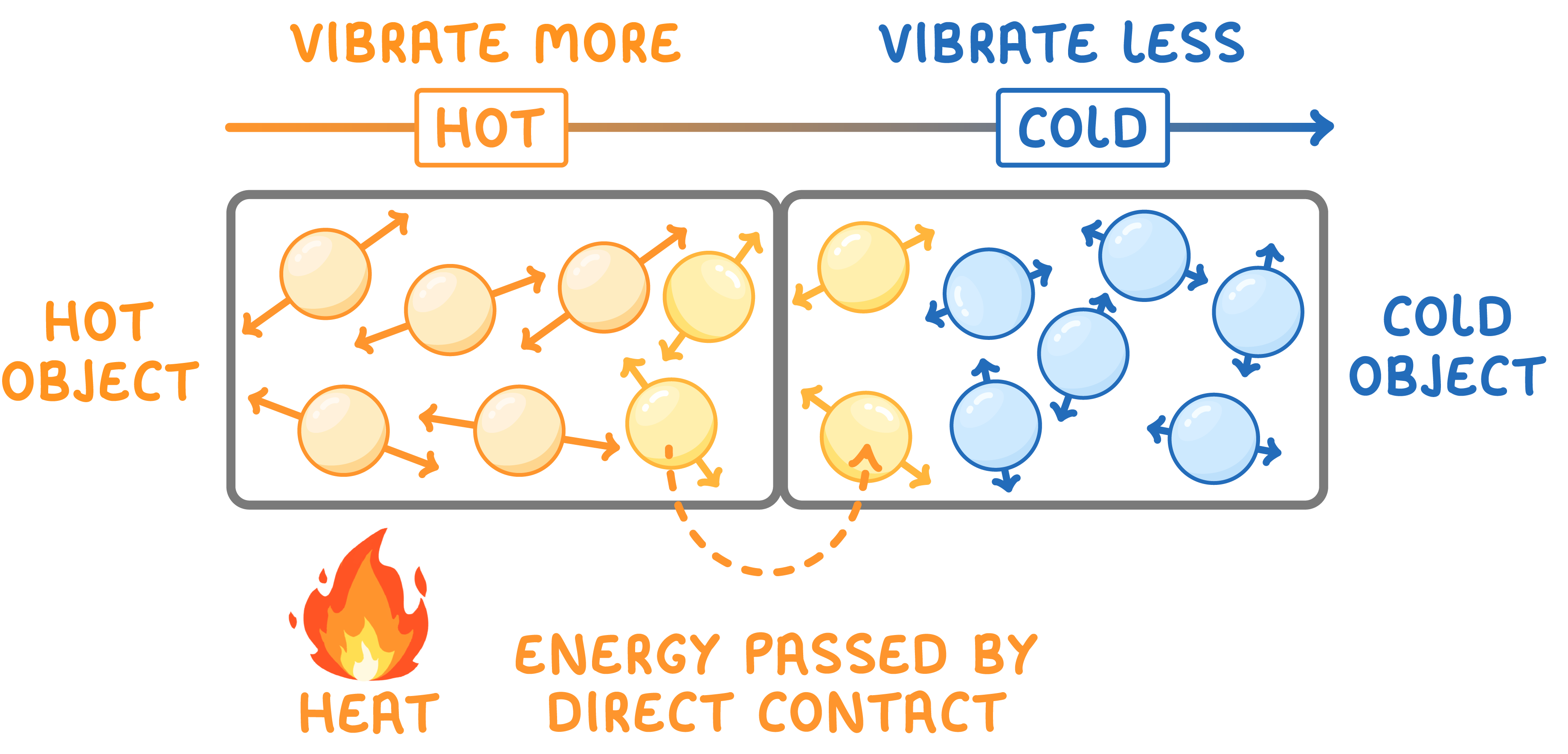
- Heating one part of an object transfers energy to the kinetic energy stores of its particles, so the particles in the heated part vibrate faster.
- As they vibrate, they collide with their neighbours and pass some energy on. Those particles then vibrate faster too.
- The process carries on through the object until energy has spread to the other side, raising its temperature.
Good and bad conductors
- Thermal conductivity describes how quickly a material transfers energy this way.
- A material with high thermal conductivity transfers energy quickly and is a good thermal conductor (such as metals).
- A material with low thermal conductivity transfers energy slowly and is called a thermal insulator (such as gases, most liquids, plastic, and wood).
Convection transfers energy by moving particles
- Convection is the way energy is carried through a liquid or a gas by the movement of the particles themselves.
- It can't happen in solids, because the particles are fixed in place and can only vibrate.
Why heated regions rise
- When a region of a liquid or gas is heated, its particles gain energy and move faster, spreading further apart.
- This makes the heated region expand and become less dense than the cooler material around it.
- The warmer, less dense region rises, and the cooler, denser material sinks to take its place.
How a convection current forms
With a constant heat source, this sets up a circulation called a convection current:
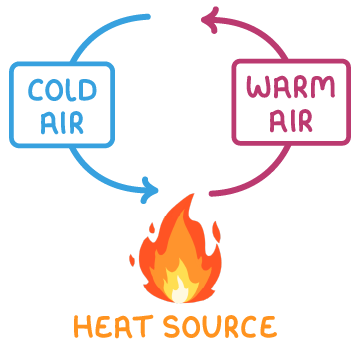
- Material above the heat source warms, becomes less dense and rises.
- Cooler, denser material flows in below to replace it.
- The risen material cools, becomes denser again and sinks.
- The cycle repeats, circulating energy through the whole liquid or gas.
Radiation transfers energy without particles
- Conduction and convection both need particles to carry energy - radiation does not.
- Thermal radiation is energy transferred by infrared electromagnetic waves.
- Because these waves need no particles to travel through, radiation is the only method that works through a vacuum (such as energy reaching Earth from the Sun).
- Every object emits infrared radiation all the time, and the hotter an object is, the more radiation it emits.
TermDefinition
ConductionThe transfer of energy through a material as its particles vibrate and collide with their neighbours.
Thermal conductivityA measure of how quickly a material transfers energy by conduction.
ConvectionThe transfer of energy through a liquid or gas by the movement of the particles themselves.
Convection currentA circulating flow in a fluid caused by hotter, less dense material rising and cooler, denser material sinking.
Thermal radiationThe transfer of energy by infrared electromagnetic waves.
Key points to remember
How were these notes?