6.10 - Dangers of Electromagnetic Radiation
Why high-frequency EM radiation can harm the body
- Whether EM radiation is harmful depends on how much energy it transfers to living tissue.
- The higher the frequency, the more energy the radiation carries, and generally the more harmful it is.
- Low-frequency radiation (e.g. radio waves) passes straight through soft tissue without being absorbed.
- High-frequency radiation (e.g. ultraviolet, X-rays, gamma rays) transfers large amounts of energy and can cause severe damage.
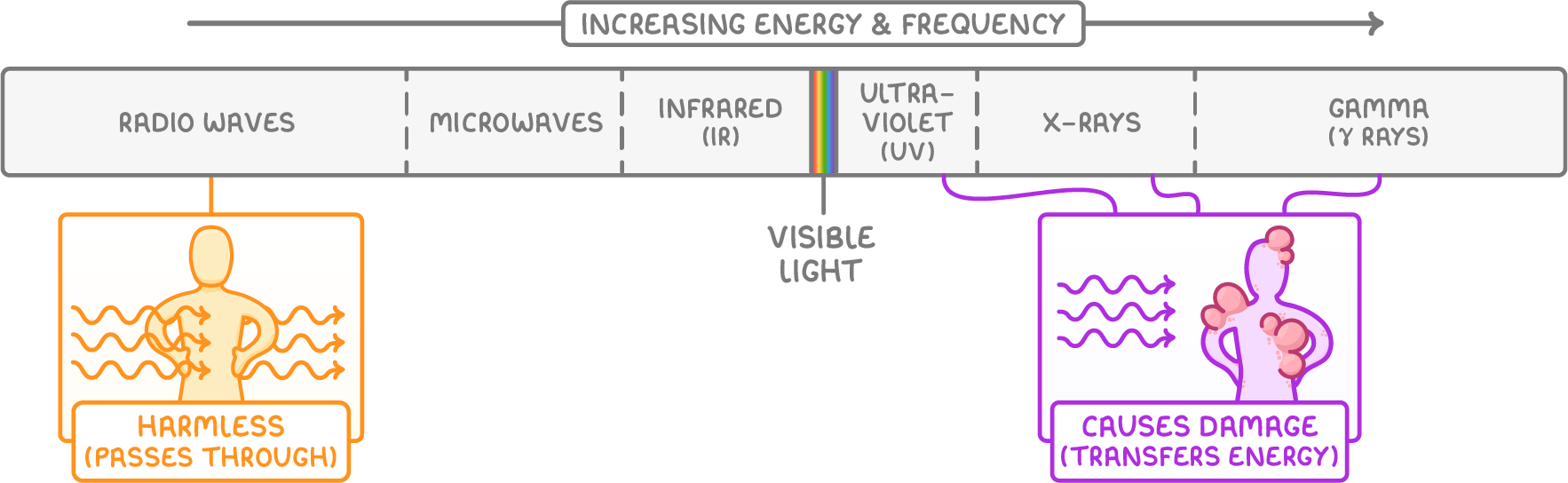
Ultraviolet, X-rays and gamma rays are ionising
- These are types of ionising radiation: they carry enough energy to knock electrons off atoms, damaging living cells.
- Ultraviolet (UV) - Absorbed by the skin, where it damages surface cells. It can cause premature ageing of the skin, skin cancer, and eye damage including blindness.
- X-rays and gamma rays - Carry even more energy than UV. They pass through the skin and are absorbed by deeper tissues, damaging cells throughout the body and leading to mutations and cancer.
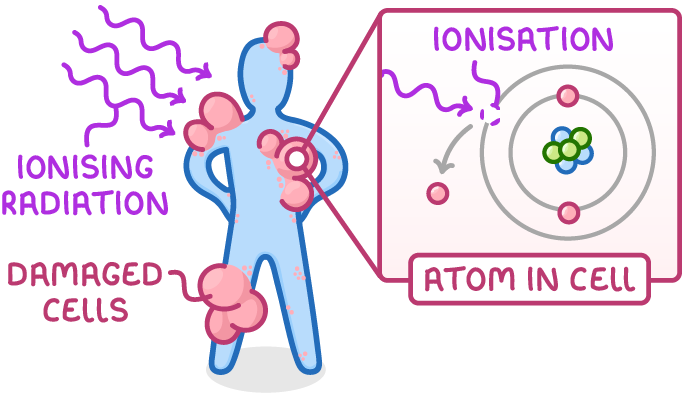
Radiation dose from a medical exposure
- Before radiation is used in medicine, the benefits are weighed against the health risks.
- For example, the risk of developing cancer from a single diagnostic X-ray is much smaller than the risk of leaving an injury undiagnosed.
Radiation dose measures the risk of harm
- Radiation dose is a measure of the risk of harm to the body from exposure to radiation, not the total amount of radiation absorbed.
- The risk depends on:
- The total amount of radiation absorbed
- The type of radiation
- Radiation dose is measured in sieverts (Sv) or millisieverts (mSv), where 1,000 mSv = 1 Sv.
Dose can differ for different parts of the body
The dose received also depends on which part of the body is exposed. For example, a CT scan delivers different doses depending on the area scanned:
| Body part scanned | Radiation dose (mSv) |
|---|---|
| Head | 2.0 |
| Chest | 8.0 |
The chest scan delivers four times the dose of the head scan (8.0 mSv compared to 2.0 mSv), so the added risk of harm from a chest scan is four times higher.
TermDefinition
Ionising radiationRadiation that has enough energy to knock electrons out of atoms, turning them into ions.
Radiation doseA measure of the risk of harm to the body from exposure to radiation.
Key points to remember
How were these notes?