5.5 - Resultant Forces
Resultant force, balanced and unbalanced forces
When several forces act on an object, they can be replaced by a single force that has the same effect. This is the resultant force (or net force).
Finding the resultant force
For forces acting along the same straight line:
- Add forces that act in the same direction.
- Subtract forces that act in opposite directions.
Balanced vs unbalanced forces
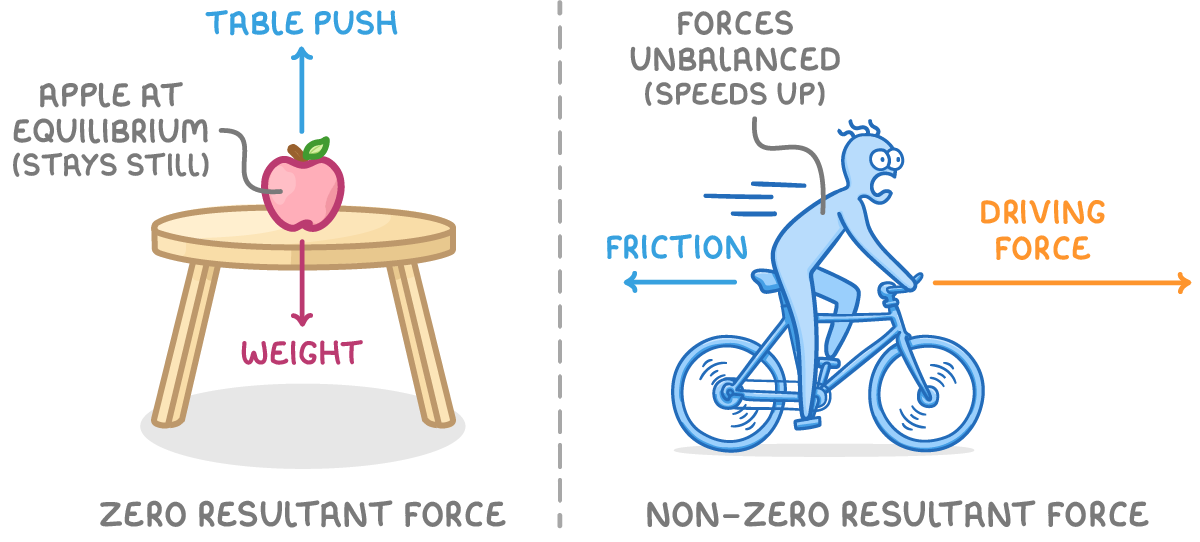
- Zero resultant force - The forces are balanced. The object stays stationary or keeps moving at a steady speed in a straight line (it's in equilibrium).
- Non-zero resultant force - The forces are unbalanced. The object speeds up, slows down, or changes direction in the direction of the resultant force.
Example - Apple on a table
- An apple resting on a table has its weight acting downwards and an equal upward push from the table.
- These forces are equal and opposite, so the resultant force is zero and the apple stays still.
Worked example - Resultant force on a van
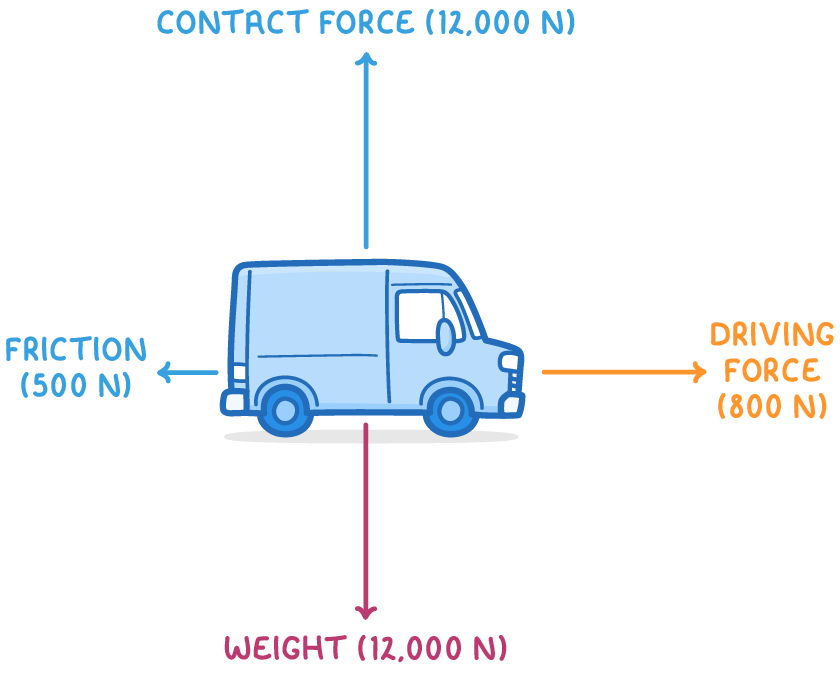
A van is being driven along a flat road. The forces acting on it are: a driving force of 800 N forwards, friction of 500 N backwards, weight of 12,000 N downwards, and a normal contact force of 12,000 N upwards from the road. Find the resultant force on the van.
Step 1 - Take the vertical direction
The weight (12,000 N down) and the normal contact force (12,000 N up) act along the same line in opposite directions:
12,000 - 12,000 = 0 N
There's no resultant force in the vertical direction.
Step 2 - Take the horizontal direction
The driving force (800 N forwards) and friction (500 N backwards) act along the same line in opposite directions:
800 - 500 = 300 N
Step 3 - State the size and direction of the resultant force
The resultant force is 300 N forwards (in the direction of the driving force).