2.1 - Levers
What lever systems are and how they help movement
Lever systems form when the muscular and skeletal systems work together to produce movement in the body. A lever is a rigid structure that rotates around a fixed point when a force is applied, allowing for efficient motion. In the human body, bones act as levers, joints serve as pivot points, and muscles provide the force needed to move body parts or overcome resistance.
The key components of a lever system
Every lever system in the body consists of four essential parts that work together to create movement.
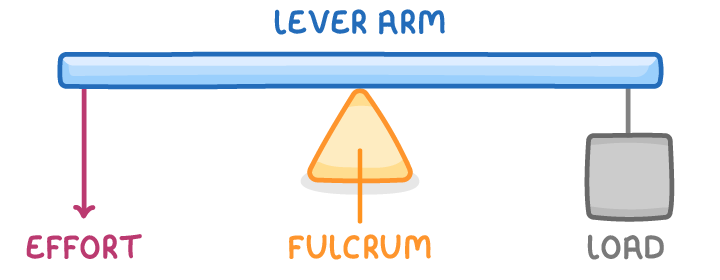
Main components of a lever system
- Lever arm - This is the rigid bone or body part that moves around a fixed point, acting as the bar in the lever.
- Fulcrum - The joint where the lever arm pivots, providing the fixed point of rotation; it is often represented as a triangle in diagrams.
- Effort - The force generated by muscle contraction applied to the lever arm; it is typically shown as an arrow indicating the direction of the pull.
- Load - The resistance or weight opposing the effort, such as the mass of a body part, the entire body, or an external object like a ball; it is represented as a square or an arrow pointing downwards.
First-class lever systems and their uses
First-class levers have the fulcrum positioned between the effort and the load, similar to a see-saw. This arrangement allows for balanced movement and is common in actions requiring control and stability.
Structure of first-class levers
- The load and effort are at opposite ends of the lever arm.
- The fulcrum is in the middle, acting as the pivot point.
Examples in the body
- Elbow extension - The elbow joint acts as the fulcrum, the triceps muscle provides the effort by contracting to straighten the arm, and the load is the weight of the forearm and hand (or any object held).
- Sporting application - Used in a football throw-in, where the head and neck also demonstrate this lever during nodding actions.
Second-class lever systems and their uses
Second-class levers position the load between the fulcrum and the effort, enabling powerful movements with less muscle force. This setup is ideal for lifting heavy loads over short distances.
Structure of second-class levers
- The fulcrum and effort are at opposite ends of the lever arm.
- The load is in the middle.
Examples in the body
- Plantar flexion at the ankle - The toe joints serve as the fulcrum, the gastrocnemius muscle (in the calf) provides the effort by pulling on the heel, and the load is the body weight acting through the lower leg.
- Sporting application - Seen when standing on tiptoes to jump, such as in basketball or volleyball, where it helps generate upward force.
Third-class lever systems and their uses
Third-class levers have the effort between the fulcrum and the load, allowing for quick movements through a large range but requiring more muscle force. This is the most common type in the body, supporting dynamic actions.
Structure of third-class levers
- The fulcrum and load are at opposite ends of the lever arm.
- The effort is in the middle.
Examples in the body
- Elbow flexion - The elbow joint is the fulcrum, the biceps muscle provides the effort by contracting to bend the arm, and the load is the weight of the forearm, hand, and any object being lifted.
- Sporting application - Used in lifting a weight during bicep curls or in flexion and extension at the shoulder, hip, and knee, such as swinging a cricket bat or kicking a ball.
Mechanical advantage in lever systems
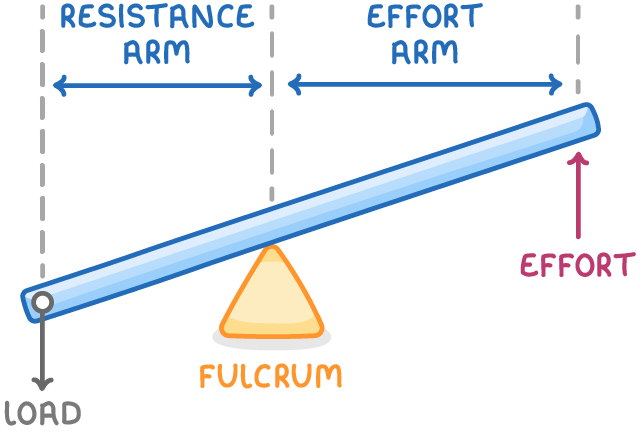
Mechanical advantage measures how effectively a lever system can move a load with a given effort. It is determined by the relative lengths of the effort arm (distance from fulcrum to effort) and the resistance arm (distance from fulcrum to load).
Formula for mechanical advantage:
Where:
- Effort arm - Distance between the fulcrum and the point where effort is applied
- Resistance arm - Distance between the fulcrum and the point where the load acts
How mechanical advantage affects efficiency
The type of lever influences its mechanical advantage, impacting how the body performs tasks.
Effects of different mechanical advantages
- High mechanical advantage (greater than 1) - Moves large loads easily but limits speed and distance; common in second-class levers like those used in jumping.
- Low mechanical advantage (less than 1) - Requires more effort but allows rapid, extensive motion; typical in third-class levers for actions like throwing.
Types of levers and their mechanical advantages
- Second-class levers - These typically have high mechanical advantage, as the effort arm is longer than the resistance arm, allowing heavy loads to be moved with minimal effort but over short distances and at low speeds.
- Third-class levers - These have low mechanical advantage, with a shorter effort arm, requiring greater muscle effort for smaller loads but enabling quick movements through large ranges.
- First-class levers - These can have either high or low mechanical advantage depending on whether the fulcrum is closer to the load (high) or the effort (low).
Worked example: Calculating mechanical advantage
In a second-class lever at the ankle, the effort arm measures 25 cm, and the resistance arm measures 5 cm. Calculate the mechanical advantage.
Step 1: Formula
Step 2: Substitution and calculation
Step 3: Interpretation
The mechanical advantage is 5, meaning this lever can move a load five times greater than the effort applied, making it efficient for powerful, short-range movements like jumping.