5.3 - Coaching: Guidance & Feedback
Guidance in skill development
Guidance involves providing information or support to help someone learn or improve a skill in sports.
Types of guidance
Verbal guidance:
- Definition - Explaining a technique using words, such as a coach describing how to execute a serve in tennis
- Advantages:
- Can be combined with other guidance methods for better understanding
- Particularly useful for elite performers who can grasp technical language
- Allows guidance during actual performance, which is helpful for open skills
- Disadvantages:
- May not work well for complex skills that are hard to describe accurately
- Can confuse beginners if the language is too advanced or complicated
Visual guidance:
- Definition - Uses visual aids like demonstrations, videos, or diagrams to show how to perform a skill, for example, watching a video of a perfect dive
- Advantages:
- Ideal for beginners who can imitate what they see
- Effective for teaching closed skills that involve repeating the same movement
- Features like slow-motion playback can reveal fine details for elite performers
- Disadvantages:
- Less effective for complex or open skills that are difficult to replicate exactly
- Demonstrations need to be straightforward and brief to avoid overwhelming beginners
Manual guidance:
- Definition - A coach physically guides the performer's body through the movement, such as holding a gymnast's arms during a vault
- Advantages:
- Helps beginners develop the 'feel' of a skill before trying it alone
- Useful for breaking down complex skills
- Disadvantages:
- Performers might become dependent on the support and struggle without it
- Challenging to apply in large groups due to the hands-on nature
Mechanical guidance:
- Definition - Employs equipment to assist, like a harness in gymnastics to support balance during practice
- Advantages:
- Provides safety for beginners learning potentially risky skills
- Supports the teaching of complex movements
- Disadvantages:
- Learners may not be able to perform the skill independently without the equipment
- Not practical for large groups because of equipment limitations
Feedback in skill improvement
Feedback is information about how well a skill was performed, helping performers identify what went right or wrong.
Types of feedback
Intrinsic feedback:
- Self-generated information based on how the movement felt, also known as kinaesthetic feedback
- Most effective for elite performers who have the experience to evaluate their own actions accurately
Extrinsic feedback:
- Comes from an external source, such as a coach or video replay, providing details on what happened and how to improve
- Particularly suited to beginners who do not yet have the knowledge to assess themselves
Focus areas of feedback
Feedback can target specific elements of a performance, helping to refine skills progressively.
Knowledge of performance:
- Assesses whether the correct movements or technique were used
- Can be intrinsic or extrinsic
- Especially valuable for elite performers to fine-tune advanced skills
Knowledge of results:
- Focuses on the outcome of the action, such as the time achieved in a sprint or the score in a game
- Often extrinsic and may include measurable data
- Helpful for beginners to confirm if they reached the desired result
Effective approaches to providing feedback
The way feedback is delivered can influence motivation and learning.
Key principles of feedback delivery
- Positive feedback is more effective for beginners, as it reinforces correct actions and builds confidence
- Excessive negative feedback can demotivate beginners by focusing too much on mistakes
- Negative feedback can benefit elite performers, as it motivates them by identifying precise goals for improvement
- Overall, feedback helps pinpoint strengths and weaknesses, enabling the creation of an action plan for targeted practice
The information processing model
The information processing model describes how performers handle information during skill execution or practice.
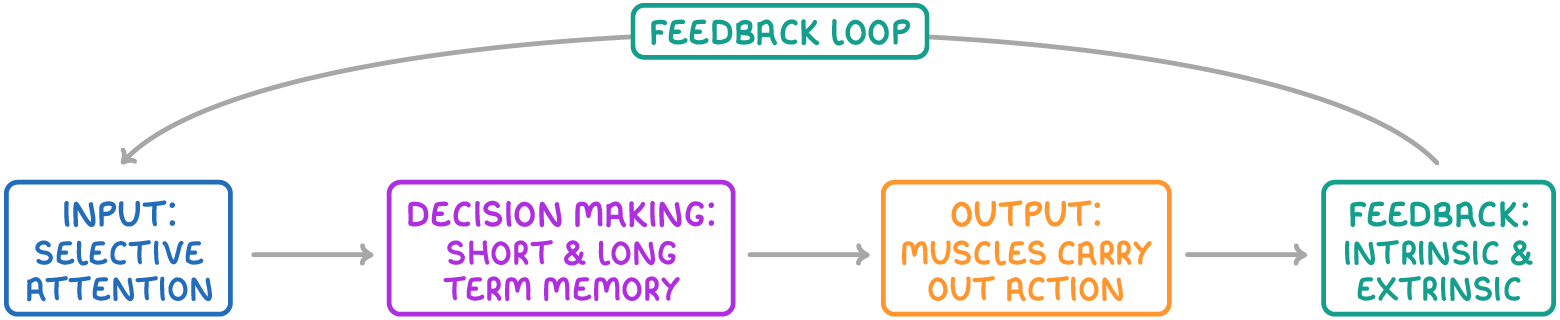
Stages of the information processing model
- Input - Information is gathered from the environment using the senses. This stage involves selective attention, where the performer focuses on relevant cues while ignoring distractions
- Decision making - The brain compares the current situation (held in short-term memory) with past experiences (stored in long-term memory) to choose a response
- Output - Muscles respond to signals from the brain, carrying out the chosen action or skill
- Feedback - Information about the performance is received, either intrinsically or extrinsically. This loops back to improve future inputs and decisions
TermDefinition
GuidanceInformation or support provided to help someone learn or improve a skill in sports.
FeedbackInformation about how well a skill was performed, used to identify what went right or wrong.
Intrinsic feedbackSelf-generated information based on how the movement felt during performance.
Extrinsic feedbackInformation from an external source, such as a coach or video replay.
Knowledge of performanceFeedback that assesses whether the correct movements or technique were used.
Knowledge of resultsFeedback that focuses on the outcome or measurable data of the action.
Selective attentionThe process of filtering out irrelevant information and focusing only on the important cues in the environment.