1.5 - Tropical Cyclones: Characteristics & Formation
Definition and alternative names
Tropical cyclones are powerful, low-pressure weather systems characterised by heavy rainfall and strong, spiralling winds that rotate around a central point. These intense storms are known by different names depending on the region, though they refer to the same phenomenon.
Alternative names for tropical cyclones
- Hurricanes - Commonly used in the North Atlantic and Northeast Pacific regions.
- Typhoons - The term used in the Northwest Pacific region.
- Cyclones - Often applied in the South Pacific and Indian Ocean areas.
Conditions required for tropical cyclone formation
Tropical cyclones form under specific environmental conditions, primarily over warm ocean waters. These conditions provide the necessary energy and atmospheric setup for the development of such intense storms.
Essential conditions for formation
- Warm sea temperatures - Sea surface temperatures must be at least 26.5°C to provide sufficient energy through evaporation and heat transfer.
- Low wind shear - Minimal difference in wind speed between the upper and lower atmosphere is needed to allow the storm to organise and strengthen without disruption.
- Moist air - Warm, moist air over the ocean surface rises, aiding in cloud formation and storm development.
- Energy release - As moist air rises and condenses, it releases significant amounts of latent heat, further powering the storm.
Global distribution and seasonal patterns
Tropical cyclones are not randomly distributed across the globe; their occurrence is tied to specific geographical zones and seasonal temperature variations in ocean waters.
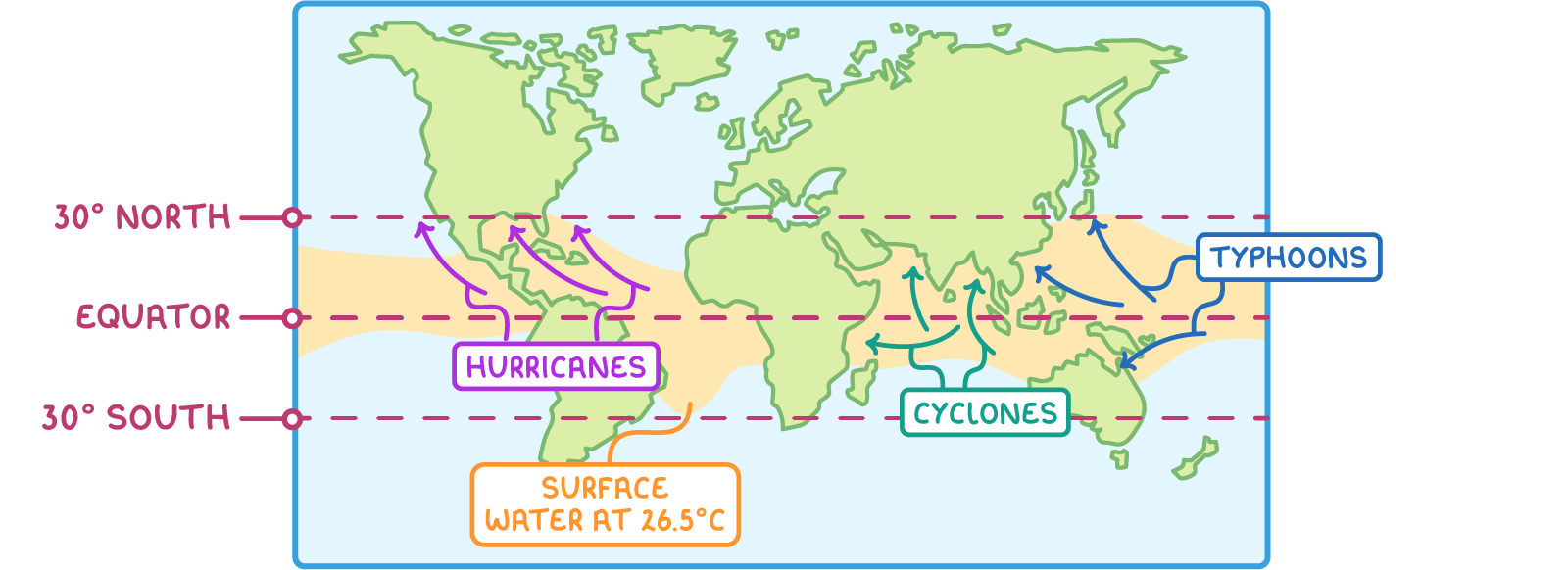
Distribution of tropical cyclones
- Latitudinal range - Typically form between 5° and 30° north and south of the equator, where sea temperatures are sufficiently warm.
- Exclusion zones - Do not form beyond these latitudes as water temperatures are too cool to sustain cyclone development.
Seasonal occurrence of tropical cyclones
- Northern hemisphere - Most active from June to November, peaking when sea temperatures are highest.
- Southern hemisphere - Most active from November to April, corresponding to warmer ocean conditions in that period.
The movement and life cycle of tropical cyclones
Tropical cyclones follow distinct paths influenced by global wind patterns and undergo a life cycle of formation, intensification, and dissipation based on their energy source.
Movement patterns of tropical cyclones
- Westward drift - Initially move westwards due to easterly trade winds near the equator.
- Curving paths - As they travel further from the equator, they may curve eastward when influenced by mid-latitude westerly winds.
Life cycle stages of tropical cyclones
- Formation - Begins over warm water as rising moist air creates a low-pressure area, drawing in surface winds that start to spiral due to Earth's rotation.
- Intensification - Gains strength from the energy of warm ocean water, increasing wind speeds and storm size.
- Dissipation - Weakens when moving over land or cooler water, as the energy supply is reduced, or when disrupted by changing wind speeds or other weather systems.
Impact of climate change on tropical cyclones
- Rising sea temperatures - Could expand areas with temperatures above 26.5°C, potentially increasing the frequency and range of tropical cyclones.
- Shifting source areas - Warmer oceans may alter traditional cyclone formation zones, affecting global distribution patterns.
Physical characteristics and structure
Tropical cyclones have a distinct structure with varying conditions across different parts of the storm. They are large, circular systems that can persist for several days.
General features of tropical cyclones
- Shape and size - Circular in form, spanning hundreds of kilometres in diameter.
- Duration - Typically last between 7 to 14 days.
- Rotation direction - Spin anticlockwise in the northern hemisphere and clockwise in the southern hemisphere due to the Coriolis effect.
Structural components of tropical cyclones
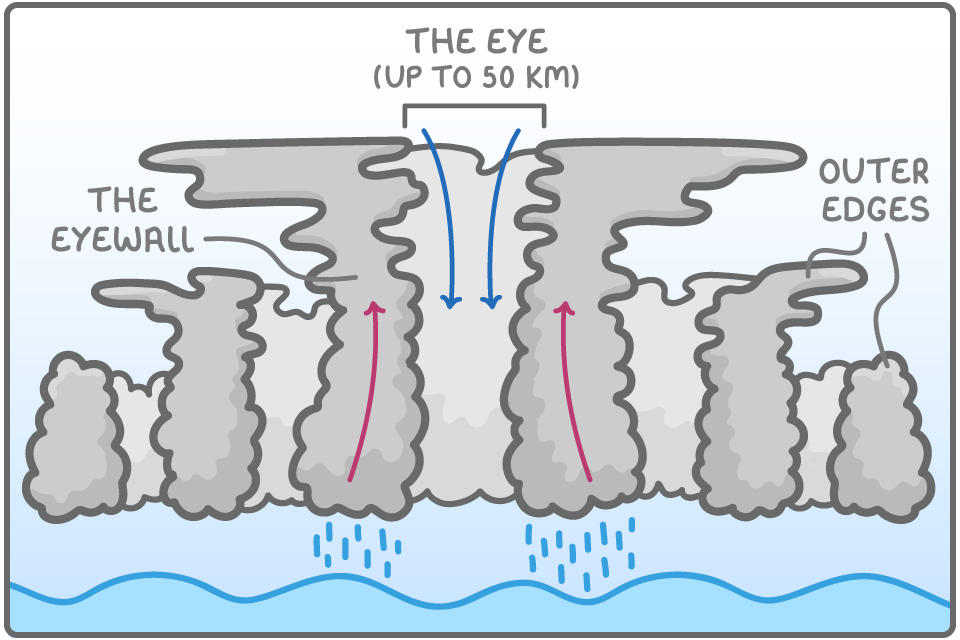
| Component | Characteristics |
|---|---|
| Eye | The calm centre, up to 50 km across, with descending air, very low pressure, light winds, no clouds or rain, and high temperatures. |
| Eyewall | Surrounds the eye, featuring spiralling rising air, extremely strong winds (around 160 km per hour), storm clouds, torrential rain, and low temperatures. |
| Outer edges | Wind speeds decrease, clouds become smaller and more scattered, rain lessens, and temperatures rise compared to the eyewall. |
These structural differences create a gradient of intensity across the cyclone, with the most severe conditions concentrated near the centre and diminishing towards the periphery.