2.5 - Globalisation & Development
The definition and components of globalisation
Globalisation refers to the growing interconnectedness of countries across the world, where economies, cultures, and systems integrate to form a more unified global community. This process breaks down barriers between nations, creating a sense of a single, shared world.
Core elements of globalisation
- Integration of systems - Every nation has unique political, economic, and cultural frameworks, and globalisation links these diverse systems together.
- Cultural exchange - As countries connect, traditions, ideas, and ways of life are shared, influencing societies globally.
- Global community - The process fosters a sense of unity, making the world feel like one large community despite geographical distances.
Causes and factors increasing globalisation
Globalisation is driven by various forces that facilitate the movement of resources and information across borders. Several key factors have accelerated this process, making international connections stronger and more efficient.
Main causes of globalisation
- Movement of money and people - Financial transactions and migration between countries create economic and social ties.
- Business expansion - Companies increasingly operate and sell products in multiple nations, building global networks.
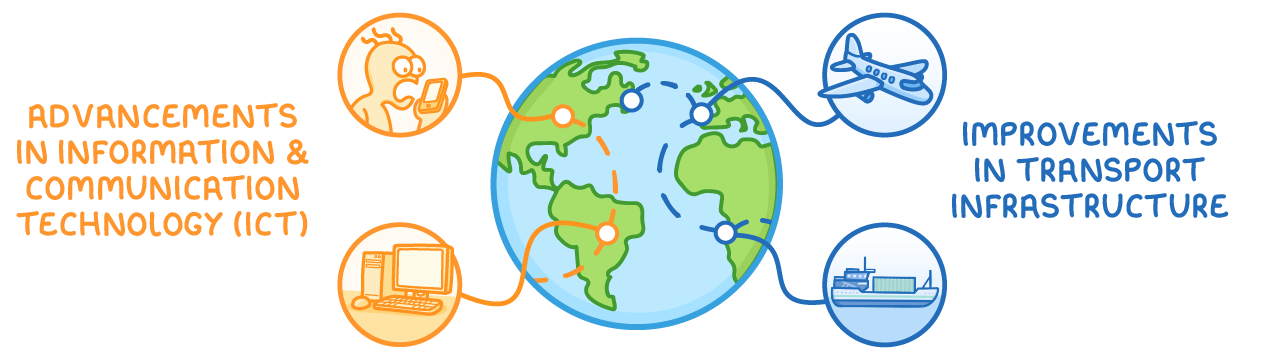
Factors accelerating globalisation
- Advancements in information and communication technology (ICT) - Tools such as email, the internet, mobile phones, and improved phone networks allow businesses to share information rapidly across the globe.
- Improvements in transport infrastructure - Developments like expanded airports, high-speed rail networks, and larger cargo ships enable quicker and more efficient movement of goods and people worldwide.
The role of transnational corporations
Transnational corporations (TNCs) are businesses that operate in multiple countries, playing a significant role in driving globalisation. They connect nations through the production, distribution, and sale of goods and services.
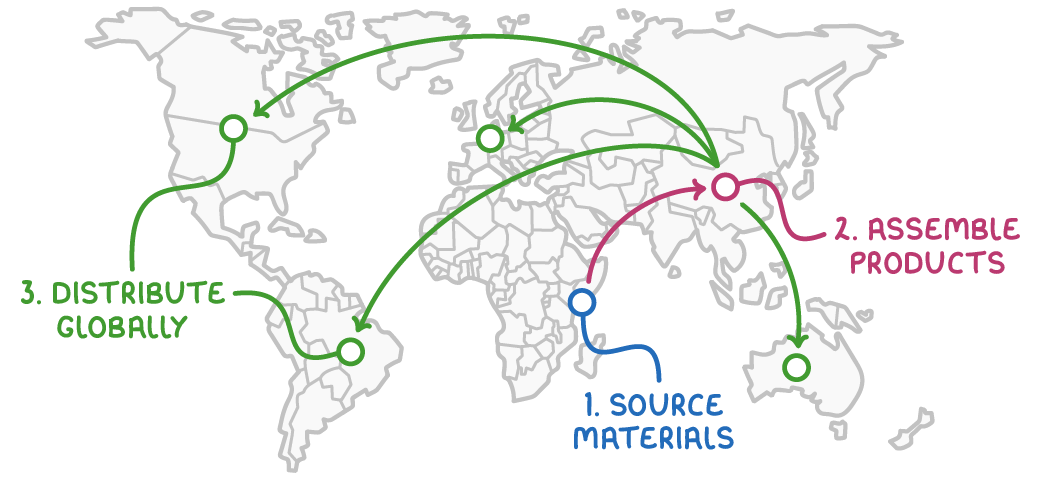
How TNCs contribute to globalisation
- Global operations - TNCs manufacture, sell, or establish bases in various countries, linking economies through their activities. For instance, a technology company might source materials in one region and assemble products in another for global distribution.
- Cultural influence - By operating internationally, TNCs introduce their corporate culture and products to diverse regions, shaping local lifestyles.
- Promotion of consumerism - TNCs expose people in developing and emerging economies to products popular in developed nations, creating demand and encouraging a global consumer culture.
The influence of governments on globalisation
Governments play a crucial role in shaping the pace and nature of globalisation through policies and initiatives that encourage international trade and investment. Their actions can significantly impact how connected their country becomes on a global scale.
Government policies supporting globalisation
- Free trade agreements - By reducing tariffs and barriers, governments make it easier for goods, money, and services to flow between countries.
- Attracting investment - Nations compete to draw in TNCs by offering incentives, as these companies create jobs, boost tax revenues, and drive economic growth.
- Privatisation of services - Governments often transfer control of industries or services, such as utility systems, to private or international firms, integrating them into global markets.
Uneven benefits and criticisms of globalisation
While globalisation offers opportunities for growth and connectivity, its benefits are not distributed equally among countries. This uneven impact, alongside other challenges, has led to significant criticism of the process.
Certain countries gain more from globalisation due to:
- Large, low-cost workforces that attract business investment.
- Governments welcoming foreign investment with open policies.
- Less stringent environmental, labour, and planning regulations.
- Access to inexpensive raw materials and adequate infrastructure.
- Availability of land for industrial development.
Key criticisms of globalisation
- Increased inequality - Globalisation can widen the gap between rich and poor nations, as wealth often concentrates in developed countries.
- Free trade disparities - Profits from TNCs typically return to their headquarters in wealthier nations, leaving poorer countries with limited gains.
- Competitive struggles - Developing nations often find it hard to compete with the resources and influence of richer countries.
- Brain drain effect - Skilled workers, such as doctors trained in poorer countries, migrate to wealthier nations for better pay and living conditions, depleting talent in their home countries.