5.1 - Human Landscape in the UK
Population distribution and density in the UK
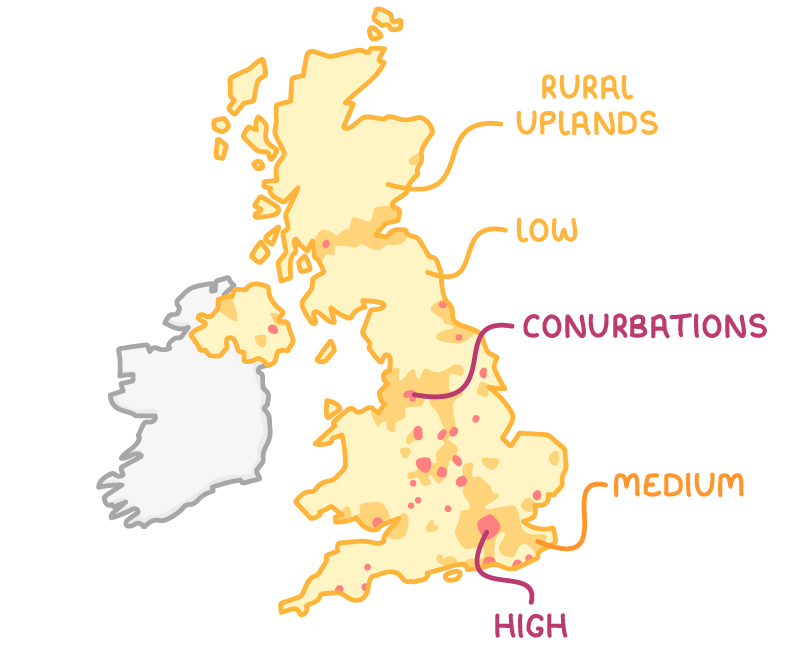
The UK's population is not spread evenly across the country. Instead, it varies significantly between regions, with some areas being densely populated while others remain sparsely inhabited.
Factors influencing population distribution
- Urban concentration - Population density is highest in the central parts of major cities, often referred to as urban cores.
- Proximity to cities - Areas surrounding large cities also show high population density.
- Conurbations - Some regions have seen towns merge into continuous urban areas, known as conurbations, leading to even higher population densities.
- Rural sparsity - Upland regions, such as northern Scotland and central Wales, along with parts of south-west and northern England and Northern Ireland, are predominantly rural and have much lower population densities.
Defining population density
Population density refers to the number of people living within a specific area.
Economic activity in urban and rural areas
Economic activity in the UK varies greatly depending on whether an area is urban or rural.
Economic activity in urban areas
- High concentration of jobs - A significant majority (60%) of employment opportunities are located in cities.
- Dominance of tertiary sector - The majority of jobs in urban areas are in services such as retail and finance.
- Manufacturing presence - Urban regions also support secondary industries, including electronics and food production.
- Attraction for workers - People are drawn to cities due to the availability of jobs, often with higher wages compared to rural areas.
Economic activity in rural areas
- Limited job opportunities - Rural regions generally offer fewer employment options compared to urban centres.
- Focus on primary industries - Employment is often in agriculture, forestry, fishing, and quarrying.
- Seasonal tourism - Some rural areas rely on tourism during specific times of the year.
- Commuter settlements - Rural areas near cities often become commuter zones, where residents live but travel to urban areas for work.
Age structure in urban and rural regions
The age composition of populations in the UK differs between urban and rural areas.
Age distribution patterns
- Youth in urban areas - Major cities tend to have a higher proportion of younger people.
- Working-age dominance in cities - Urban areas also have a larger share of working-age individuals.
- Older population in rural areas - Rural regions often have a higher proportion of older residents, as many retire to quieter, more peaceful environments.
- Migration trends - Younger individuals frequently leave rural areas to seek employment in cities, while older people move out of urban centres upon retirement.
Challenges of rural poverty and depopulation
Rural areas in the UK face significant economic and social challenges, often leading to poverty and a decline in population.
Issues contributing to rural poverty
- Economic stagnation - Some rural areas struggle to achieve economic growth.
- Isolation and inaccessibility - Remote rural regions on the periphery of the UK are relatively inaccessible.
- Scarce job opportunities - With fewer jobs available, many residents, especially young people, leave to find work elsewhere.
- Depopulation effects - As people move away, rural areas lose essential services such as shops and healthcare facilities.
- Legacy of industrial decline - Former industrial rural areas suffer from high unemployment rates following the decline of manufacturing industries.
Government policies to address wealth disparities
To tackle the economic inequalities between urban and rural areas, the UK government and other bodies have implemented various policies.
Strategies to reduce wealth gaps
- Enterprise Zones - There are 55 Enterprise Zones across England, Scotland, and Wales, offering benefits to attract businesses to high-unemployment areas:
- Reduced taxes to lower operational costs for companies.
- Simplified planning rules to ease the process of setting up businesses.
- Improved infrastructure to support industrial and commercial activities.
- Transport Infrastructure Development - Investments in transport aim to connect regions and boost economic activity:
- High-speed rail projects link major cities, increasing capacity and reducing travel times.
- Faster journeys promote industry and job creation in poorer rural areas.
- Local road improvements encourage business investment by enhancing accessibility.
- Regional Development Initiatives - Programmes target growth in underprivileged areas through funding and support:
- The European Regional Development Fund has supported poorer rural regions by investing in high-tech businesses, training, and infrastructure.
- The Sustainable Farming Incentive provides financial rewards to farmers for adopting sustainable practices that improve water quality, soil health, and biodiversity.
TermDefinition
Population densityThe number of people living within a specific area, usually measured per square kilometre.
ConurbationA continuous urban area formed by the merging of several towns and cities.
Commuter settlementA rural town or village where residents live but travel to nearby urban areas for work.
DepopulationThe decline in the number of people living in a specific area, often due to out-migration.
Enterprise ZoneA designated area where the government offers tax breaks and simplified planning rules to encourage business investment.