3.3 - How Urban Areas Generate Income
Types of employment in urban economies
Urban economies are shaped by the nature of employment available to workers. Employment can be broadly categorised into two distinct types based on regulation and legal recognition.
Categories of employment in urban settings
- Formal employment - This type of work is officially recognised and regulated by the government. Workers benefit from legal protections, including limits on working hours, minimum age requirements, and health and safety standards. Taxes are deducted from their earnings to contribute to public funds.
- Informal employment - This refers to unofficial work that operates outside government regulation. Such jobs are not taxed, and workers often face long hours, unsafe conditions, and minimal pay with no legal safeguards.
The four economic sectors in urban areas
Urban economies are also defined by the types of industries and activities that dominate them. These are classified into four key sectors.

Key economic sectors in urban environments
- Primary sector - Focuses on the extraction and collection of raw materials. Examples include farming, fishing, mining, and timber production.
- Secondary sector - Involves manufacturing and processing raw materials into finished goods. This includes industries producing textiles, furniture, chemicals, metal products, and automobiles.
- Tertiary sector - Centres on providing services rather than goods. This sector encompasses a wide range, from banking and medical care to retail, policing, and transport services.
- Quaternary sector - Relates to the knowledge and information economy. It includes research and development for new technologies, innovation in digital and consumer products, and professional consulting services for businesses.
How urban economies vary by level of development
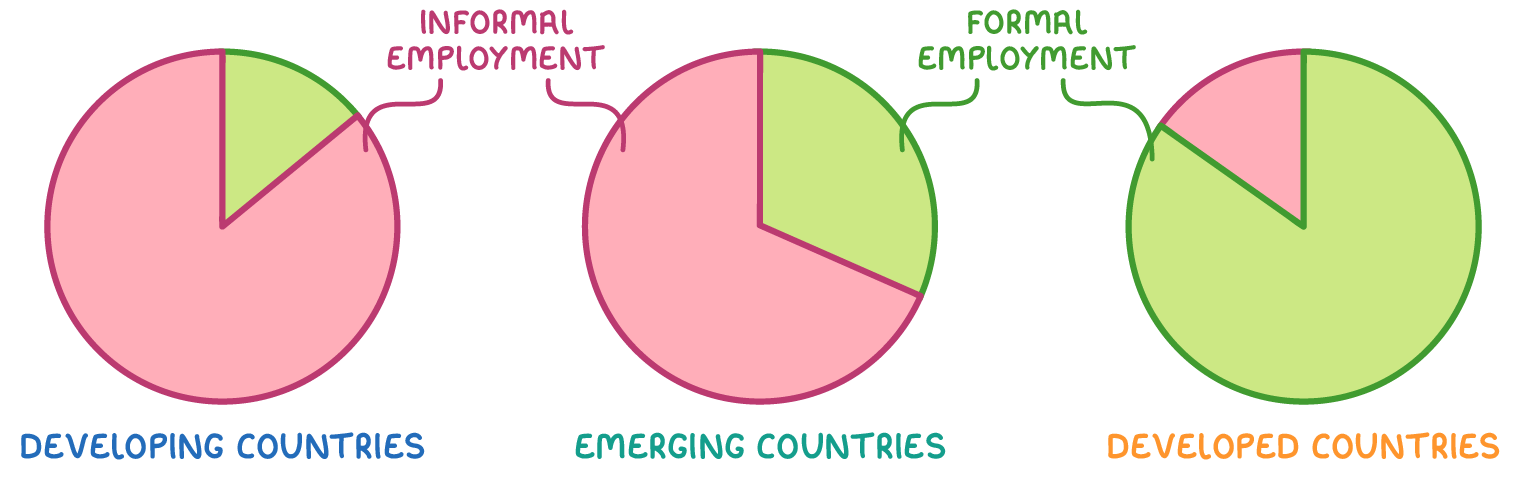
The structure of urban economies differs significantly depending on a country's level of economic development. This variation is evident in the balance between formal and informal employment, the dominance of certain economic sectors, and the overall economic focus of cities.
Urban economies in developing countries
- Employment structure - A large proportion of workers are engaged in the informal sector.
- Dominant sectors:
- Many individuals work in low-skilled tertiary jobs, such as selling goods in open-air markets.
- The secondary sector is underdeveloped due to limited investment in industrial infrastructure.
- Only a small fraction of the workforce is employed in high-skilled tertiary roles, like office administration or IT support.
Urban economies in emerging countries
- Employment structure - As development progresses, the number of workers in the informal sector decreases, with more moving into formal employment.
- Dominant sectors:
- The secondary sector sees significant growth, with industrial zones and improved infrastructure supporting manufacturing.
- Low-skilled tertiary jobs, such as those in retail or tourism, are common, while the expanding industrial base increases disposable income, creating demand for higher-skilled tertiary roles in areas like healthcare and law.
- Some cities become specialised hubs, for instance, focusing on technology and software innovation.
Urban economies in developed countries
- Employment structure - The informal sector is minimal, with the vast majority of workers in formal employment.
- Dominant sectors:
- The secondary sector employs fewer people compared to emerging countries, as the focus shifts towards the tertiary sector, driven by a skilled workforce and high demand for services like finance and retail.
- The quaternary sector also plays a role, supported by investment in technology and a highly educated labour force engaged in research and advisory roles.
Working conditions across levels of development
Working conditions in urban economies are closely tied to the level of economic development, reflecting differences in regulation, worker rights, and economic priorities.
Differences in working conditions:
- Developing countries - Conditions are often harsh, with low wages, extended working hours, and hazardous environments.
- Emerging countries - As economies grow, working conditions generally improve. There is a gradual increase in workers' rights.
- Developed countries - Workers have good conditions, with higher wages and comprehensive legal rights protected by law.