14.2 - The Demographic Transition Model
The DTM and its link to development
The Demographic Transition Model (DTM) is a framework that illustrates how population growth changes over time as a country develops. It connects economic and social progress with shifts in birth and death rates, helping to explain variations in population size across different levels of development.
Key features of the DTM
- Development linkage - The DTM ties population changes to a country's level of economic and social advancement.
- Birth and death rate dynamics - It tracks how these rates evolve, impacting overall population growth.
- Country-specific variations - Birth and death rates differ between nations based on their development status.
- Temporal changes - Within a single country, these rates shift as development progresses over time.
How birth and death rates affect population growth
Birth rates and death rates are fundamental in determining whether a population grows, stabilises, or declines. These rates are influenced by factors such as healthcare, education, and economic conditions, which vary with development.
Factors affecting population growth
- Natural increase - Occurs when the birth rate exceeds the death rate, leading to population growth.
- Natural decrease - Happens when the death rate surpasses the birth rate, resulting in population decline.
- Development impact - In less developed regions, high birth and death rates often balance out, while in more developed areas, lower rates can lead to stability or decline.
Characteristics of the five stages of the DTM
The DTM is divided into five distinct stages, each representing a different phase of population change linked to a country's development level. These stages outline the typical patterns of birth rates, death rates, and population growth.
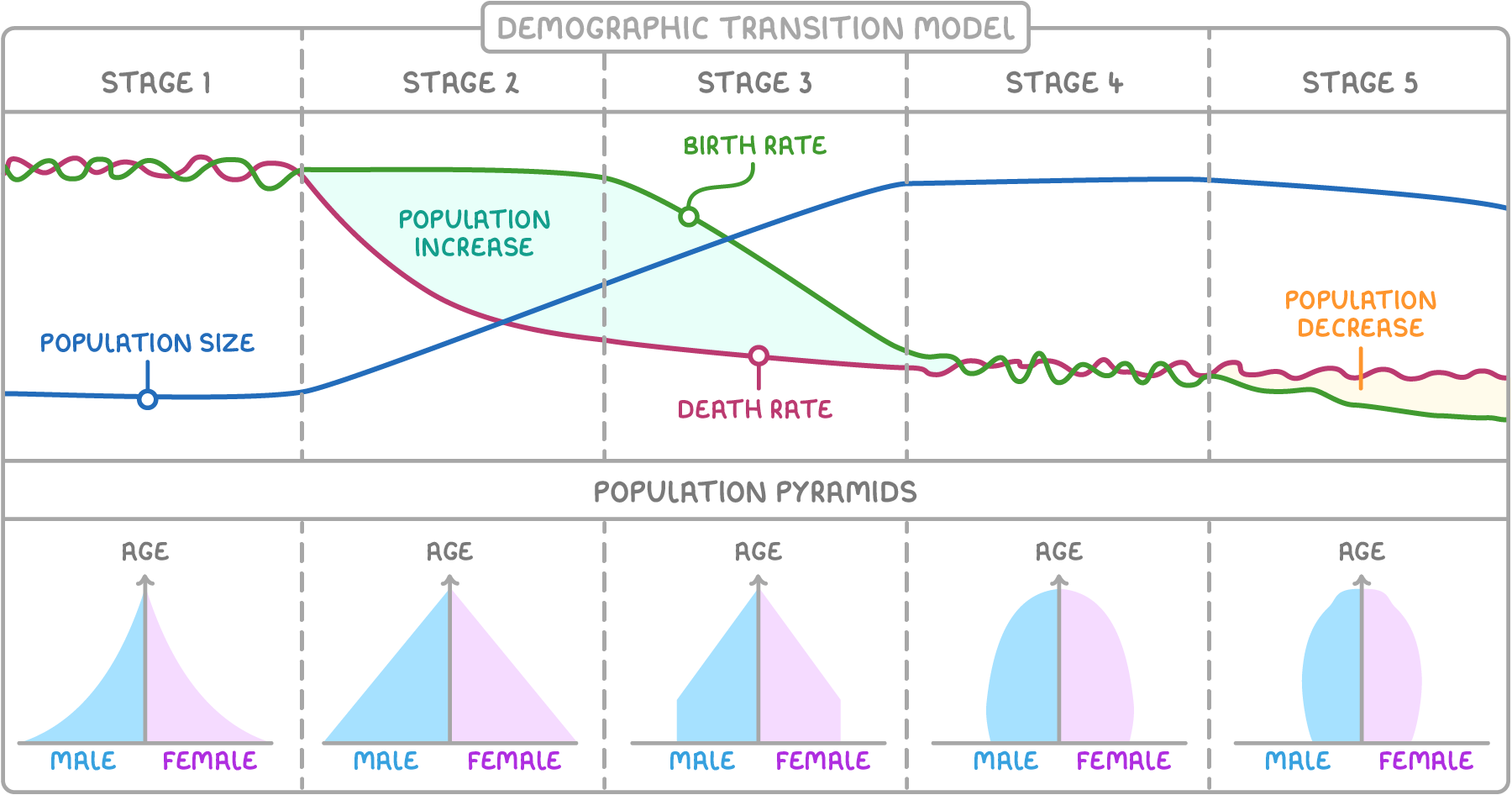
Stage 1: Least developed
- Current prevalence - Very few regions remain in this stage today.
- Birth rate factors - High due to lack of contraception and the need for many children to offset high infant mortality.
- Death rate factors - High because of limited healthcare and risks like famine.
- Population traits - Low and stable population size with zero growth rate.
- Rate patterns - Both birth and death rates are high and fluctuate.
Stage 2: Early development
- Current prevalence - Many low-income countries (LICs) are in this stage.
- Birth rate factors - Remains high due to agricultural economies where children are needed as labour on farms.
- Death rate factors - Begins to decline with improvements in healthcare, increasing life expectancy.
- Population traits - Rapid population increase with a very high growth rate.
- Rate patterns - Birth rate stays high and steady, while death rate falls quickly.
Stage 3: Developing economies
- Current prevalence - Most newly emerging economies (NEEs) are at this stage.
- Birth rate factors - Declines sharply as contraception becomes more available and more women enter the workforce.
- Economic shift - Transition from agriculture to manufacturing reduces the need for large families.
- Death rate factors - Continues to decrease with better healthcare, further raising life expectancy.
- Population traits - Population still grows, with a high growth rate.
- Rate patterns - Birth rate drops rapidly, while death rate falls more slowly.
Stages 4 and 5: Advanced development
- Current prevalence - Most high-income countries (HICs) are in one of these stages.
- Birth rate factors - Low due to high living standards, financial constraints, and responsibilities like caring for elderly relatives.
- Death rate factors - Low with advanced healthcare systems, leading to high life expectancy.
- Stage 4 traits - High and stable population size with zero growth rate.
- Stage 5 traits - Slow population decline with a negative growth rate.
- Rate patterns - Both birth and death rates remain low in both stages.
Development indicators and DTM stages
Development indicators such as the Human Development Index (HDI) and Gross National Income (GNI) correlate with the stages of the DTM. These metrics reflect a country's socio-economic status, which in turn influences population dynamics.
Development indicators across DTM stages
- Human Development Index (HDI) - Measures factors like life expectancy, education, and income. HDI tends to be low in Stages 1 and 2 (LICs), moderate in Stage 3 (NEEs), and high in Stages 4 and 5 (HICs).
- Gross National Income (GNI) - Represents the total income of a country's residents and businesses. GNI is typically low in early DTM stages due to limited economic activity and rises significantly in later stages with industrial and service-based economies.
- Link to population trends - As HDI and GNI improve, birth and death rates generally decline, reflecting better access to healthcare, education, and economic opportunities, which align with progression through the DTM stages.