14.1 - How to Measure Development
Development and the global development gap
Development refers to the progress a country makes in improving economic growth, adopting technology, and enhancing the welfare of its people. As a country develops, the quality of life for its citizens generally improves, with advancements in areas such as income, health, and safety.
However, the level of development varies significantly across the world, creating disparities between nations.
The global development gap:
- This term describes the difference in development levels between more developed countries and less developed ones.
- It highlights inequalities in economic and social progress, as different countries are at different stages of progress, with some far ahead in terms of wealth and living standards compared to others.
Measures of development and their limitations
To compare the development levels of different countries, specific indicators are used. These measures focus on either economic factors, which reflect a country's wealth, or social factors, which provide insight into people's quality of life. However, each measure has its own limitations when used in isolation.
Economic measures of development
- Gross National Income (GNI) - Represents the total value of goods and services produced by a country in a year, including income earned from overseas. It is typically expressed in US dollars.
- GNI per head (or per capita) - Calculated by dividing the total GNI by the country's population, giving an average income per person, also usually in US dollars.
Social measures of development
- Birth rate - The number of live births per thousand people in the population each year.
- Death rate - The number of deaths per thousand people in the population annually.
- Infant mortality rate - The number of infants who die before reaching the age of one, per thousand live births.
- People per doctor - The average number of individuals for each available doctor, indicating access to healthcare.
- Literacy rate - The percentage of adults who can read and write, reflecting education levels.
- Access to safe water - The percentage of the population with access to clean drinking water, a key indicator of living conditions.
- Life expectancy - The average age a person is expected to live to, showing overall health and quality of life.
Limitations of development measures
- GNI per head inaccuracies - As an average, it can be deceptive because it hides inequalities within a country. For instance, a high GNI per head might reflect the wealth of a small elite while many others remain in poverty.
- Social indicators' inconsistencies - Using a single social measure can mislead because development is uneven. A country might show progress in one area, like a low birth rate suggesting advancement, but lag in another, such as a high death rate indicating underdevelopment.
- Need for multiple measures - Relying on just one indicator often fails to capture the full picture of a country's development status due to these variations and disparities.
Classification of countries based on wealth
Countries are frequently categorised according to their economic status, primarily using wealth as the key criterion. Despite the limitations of focusing on a single measure like GNI per head, it remains the most common method for grouping nations by development level.
Categories of countries by wealth
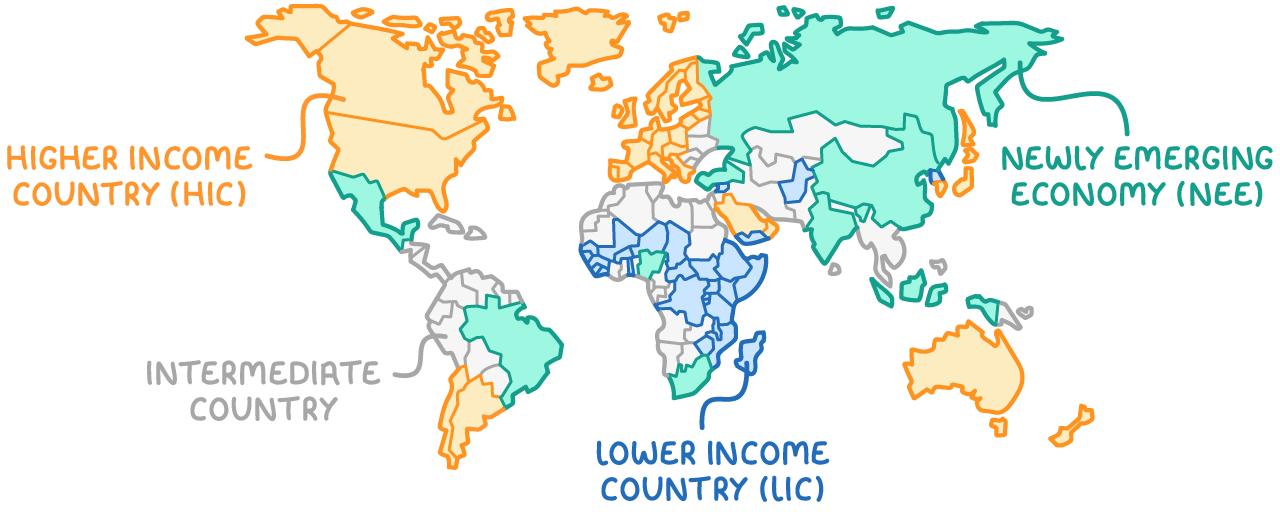
- Higher Income Countries (HICs) - These are the wealthiest nations globally, characterised by a high GNI per head, reflecting advanced economies and high living standards.
- Lower Income Countries (LICs) - The poorest countries in the world, with very low GNI per head, often facing significant economic and social challenges.
- Newly Emerging Economies (NEEs) - Nations experiencing rapid economic growth as their economies transition from primary industries, such as farming, to secondary industries like manufacturing. Examples include the BRICS countries (Brazil, Russia, India, China, and South Africa) and the MINT countries (Mexico, Indonesia, Nigeria, and Turkey).
- Intermediate countries - Some nations have a medium GNI per head, positioning them between LICs and NEEs in terms of economic development.
The Human Development Index (HDI)
To address the shortcomings of individual development indicators, a more comprehensive approach called the Human Development Index (HDI) is used. This index integrates multiple factors to provide a broader view of a country's progress.
Calculating the HDI
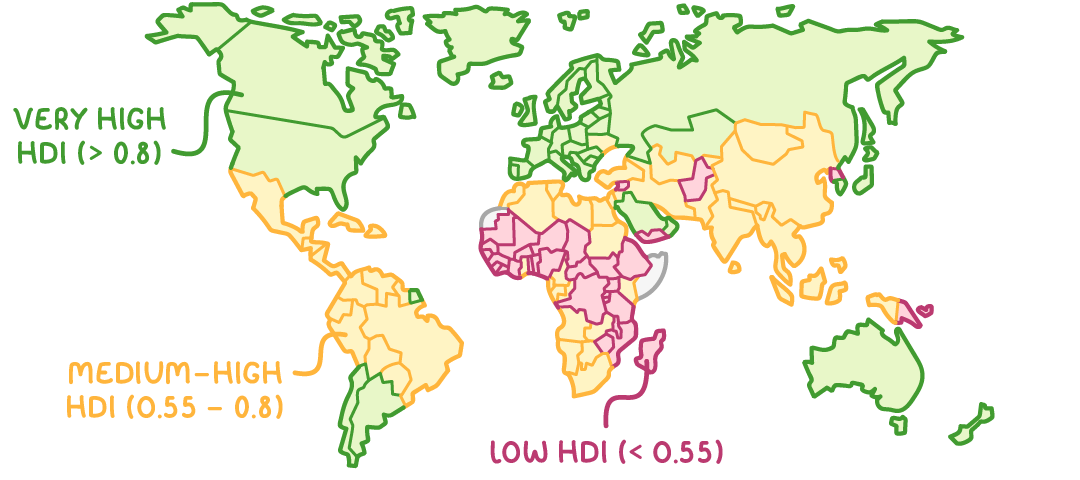
HDI combines three key measures:
- Income (GNI per head)
- Health (life expectancy)
- Education (average years of schooling)
Each country receives a score between 0 (least developed) and 1 (most developed), reflecting its overall development level.
Evaluation of the HDI
- Dual focus - The HDI provides insights into both economic advancement and the quality of life for residents, offering a more balanced perspective than single measures.
- Comparison with GNI per head - While HDI classifications often align with those based on wealth, discrepancies can occur. For example, a country might be classified as an NEE due to its economic growth but have a lower HDI score due to lagging health or education indicators.