13.1 - Global Urbanisation Patterns
The concept of urbanisation and global trends
Urbanisation refers to the increasing proportion of a population living in urban areas, such as towns and cities. More than half of the world's population lives in urban areas, and this continues to rise.
These areas are becoming more popular as places to live, reflecting a significant shift in where people choose to settle globally. Urban areas are increasingly attractive due to various social, economic, and infrastructural factors, driving consistent growth in urban populations worldwide.
Differences in urbanisation rates across countries
The rate and extent of urbanisation vary significantly between countries at different levels of economic development. These differences are influenced by historical patterns, economic conditions, and societal changes.
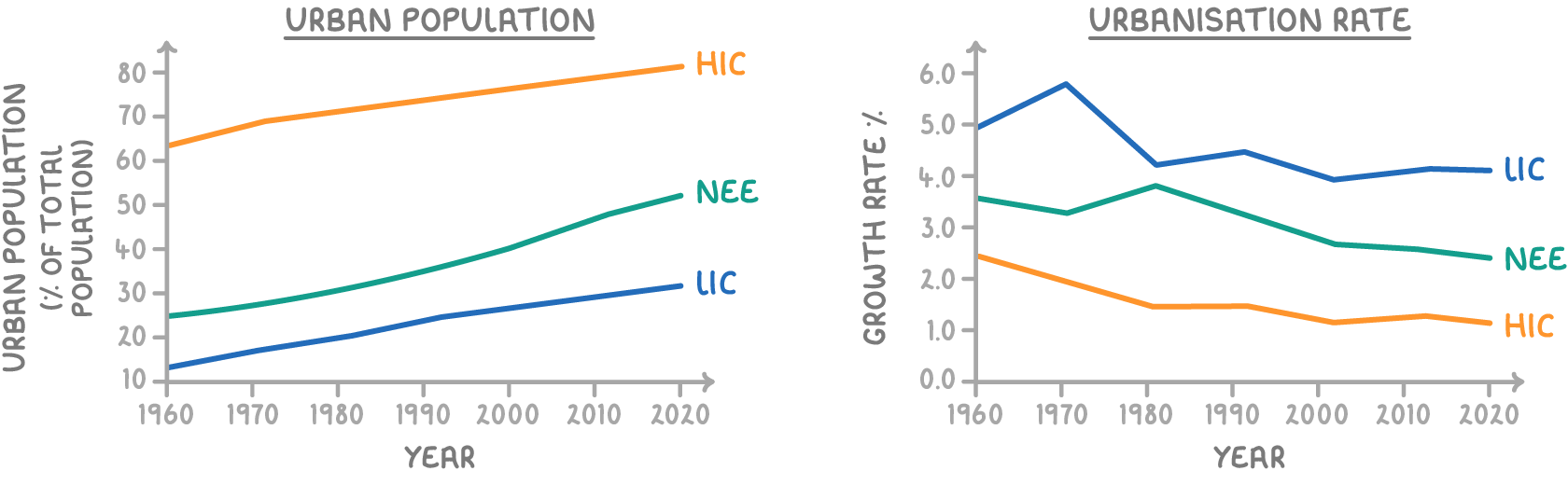
Urbanisation in higher income countries (HICs)
- High urban population - Around 80% of the population in HICs, which are more economically developed, live in urban areas.
- Slow growth rate - The rate of urbanisation in HICs is low, typically below 1%, as most urbanisation has already occurred.
- Counter-urbanisation trend - Many individuals in HICs move from urban to rural areas seeking less crowded, quieter environments.
Urbanisation in lower income countries (LICs)
- Lower urban population - Only about 30% of the population in LICs, which are less economically developed, currently live in urban areas.
- Rapid growth rate - LICs experience high rates of urbanisation, often reaching up to 6%, due to ongoing migration and population shifts.
Urbanisation in newly emerging economies (NEEs)
- Moderate urban population - Approximately 50% of the population in NEEs, where economic development is rapidly increasing, live in urban areas, though this can be higher in countries with significant urban growth.
- Moderate growth rate - The rate of urbanisation in NEEs typically stands at around 2%, reflecting a balance between developing infrastructure and population movement.
Causes of urbanisation: rural-urban migration
Rural-urban migration, the movement of people from countryside areas to cities, is a major driver of urbanisation. This migration is influenced by a combination of push and pull factors that encourage or discourage living in certain areas.
Push factors driving people away from rural areas
- Impact of natural disasters - Events like floods or earthquakes can destroy homes and farmland, making recovery difficult due to limited resources in rural areas.
- Mechanisation of agriculture - The use of advanced equipment reduces the need for manual labour, leading to fewer job opportunities in farming.
- Desertification challenges - Land becoming unproductive due to desertification prevents people from sustaining themselves through agriculture.
- Unstable farmer incomes - Dependence on successful harvests results in fluctuating earnings, creating financial insecurity for rural families.
Pull factors attracting people to urban areas
- Greater job opportunities - Cities offer more employment options, often with higher wages compared to rural jobs.
- Improved services - Access to better healthcare and educational facilities draws individuals seeking enhanced living standards.
- Family connections - The presence of relatives who have already relocated to urban areas can encourage others to follow.
- Perception of better life - Many believe urban living offers an improved quality of life, with more amenities and opportunities.
The role of natural increase in urban growth
Natural increase occurs when the birth rate surpasses the death rate, leading to population growth. This phenomenon significantly contributes to the expansion of urban populations.
How natural increase boosts urban populations
- Youth migration - Young individuals often migrate to cities in search of employment, and they subsequently start families, adding to the urban demographic.
- Healthcare advantages - Urban areas typically provide better medical facilities, increasing life expectancy and sustaining population levels by reducing mortality rates.
- Population growth cycle - The combination of higher birth rates among migrants and lower death rates due to improved healthcare prevents urban population decline.
The emergence and growth of megacities
Megacities are urban areas with populations exceeding 10 million people. They represent extreme examples of urbanisation, often emerging in regions experiencing rapid growth.
Trends in megacity development
- Current numbers - As of 2020, there were 34 megacities worldwide, with the majority located in LICs and NEEs.
- Projected growth - By 2035, the number of megacities is expected to rise to 48, reflecting ongoing urbanisation trends in developing regions.
- Significance - Megacities highlight the concentration of population and resources in specific urban centres, often driven by economic opportunities and migration patterns.