3.7 - Filtration & Crystallisation
Filtration
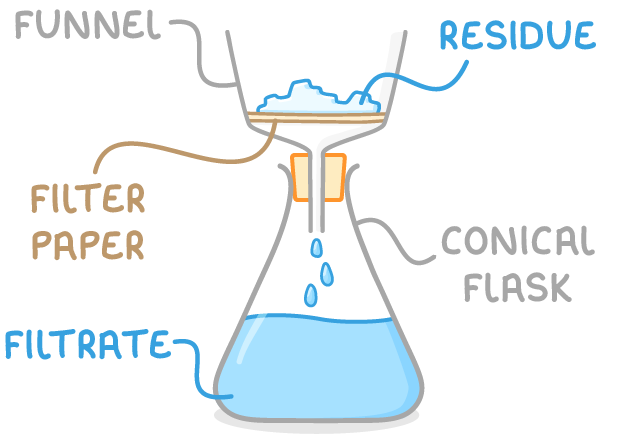
- Filtration separates an insoluble solid from a liquid.
- Filter paper has tiny holes that let liquid particles through, but trap solid particles.
- The paper is placed in a filter funnel and the mixture is poured in:
- Residue - The solid left behind on the filter paper.
- Filtrate - The liquid that passes through the filter paper.
- Filtration can't separate a dissolved solid from a liquid, because dissolved particles are small enough to pass straight through the filter paper.
Evaporation
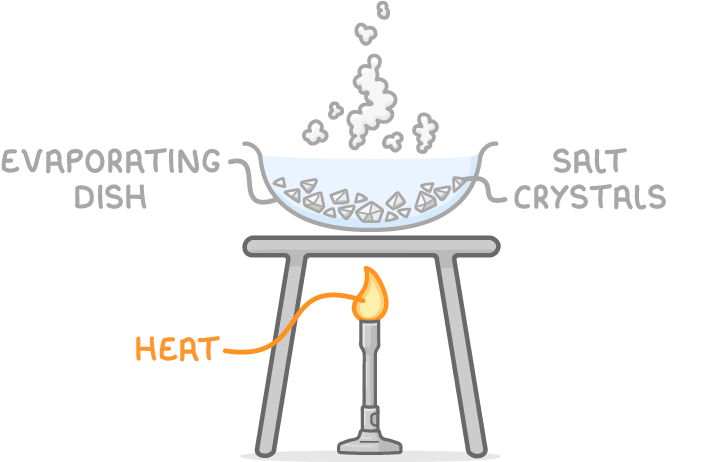
- Evaporation separates a soluble solid from a liquid by heating the solution until all the liquid has evaporated, leaving dry crystals behind.
- The solution is placed in an evaporating dish and heated. As the solvent evaporates, the solution becomes more concentrated until crystals form.
Limits of evaporation
- Some solids decompose (break down) when heated strongly, so they shouldn't be evaporated to dryness.
- The liquid evaporates into the air and isn't collected.
- It produces tiny crystals rather than large, well-formed ones.
Crystallisation
Crystallisation separates a dissolved solid from a liquid without heating to dryness, producing larger and purer crystals.
Method
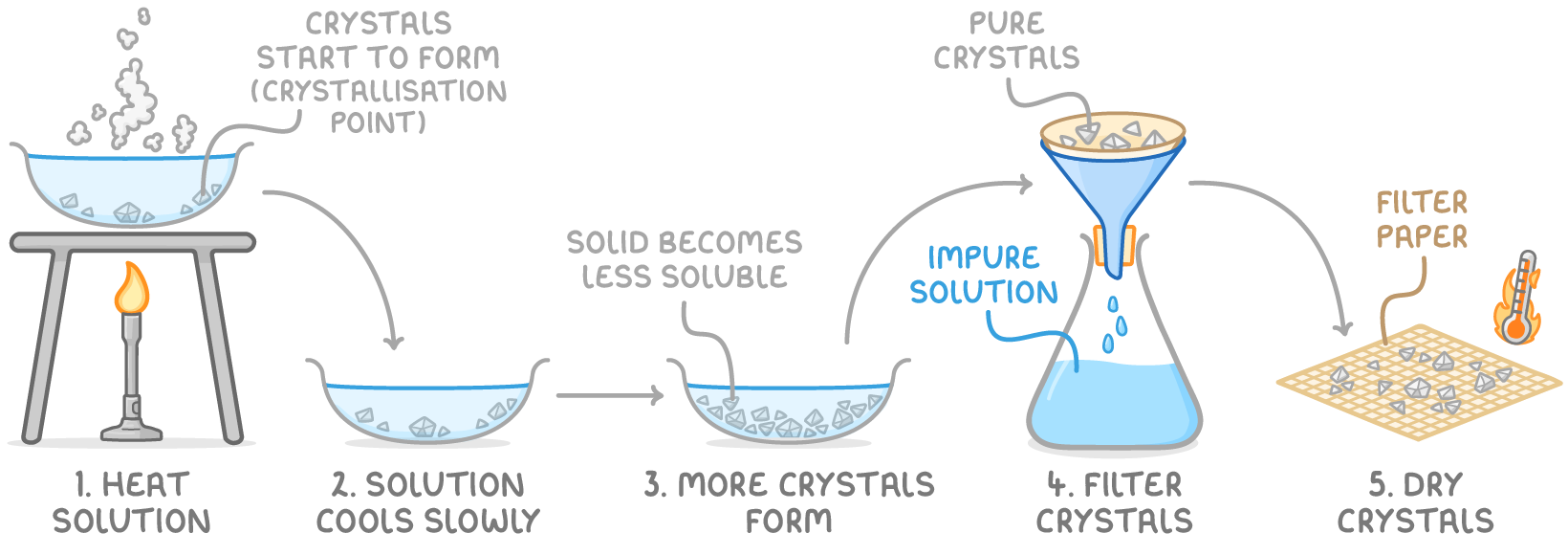
- Gently heat the solution in an evaporating dish until some of the liquid evaporates and crystals start to form (crystallisation point).
- Remove from the heat and leave the solution to cool slowly.
- As it cools, the solid becomes less soluble and more crystals form.
- Filter the crystals from the remaining liquid.
- Dry the crystals (e.g. in a warm oven, with filter paper, or in a desiccator).
Why use crystallisation
- It prevents solids from decomposing under strong heat.
- It produces purer crystals because impurities remain dissolved in the solution.
TermDefinition
FiltrationA separation technique that separates an insoluble solid from a liquid.
ResidueThe material left behind after a process. In filtration, it is the insoluble solid left on the filter paper.
FiltrateThe liquid or solution that passes through the filter paper during filtration.
EvaporationThe process where particles escape from the surface of a liquid and become a gas. As a separation technique, it separates a soluble solid from a liquid by heating the solution until all the liquid has evaporated.
CrystallisationThe formation of solid crystals from a solution. As a separation technique, a solution is heated to evaporate some of the liquid and then left to cool so crystals form.