7.6 - Half-Life & Uses of Radioisotopes
What half-life is
- A radioisotope is an isotope whose nucleus is unstable. Every unstable nucleus in a sample will sooner or later decay.
- Radioactive decay is random - you can't predict which nucleus will decay next, but with many nuclei present, the proportion that decays in a given time is constant.
- Once a nucleus decays it's no longer part of that radioisotope, so the amount of radioisotope falls steadily.
- The amount never quite reaches zero, so a sample is described by its half-life:
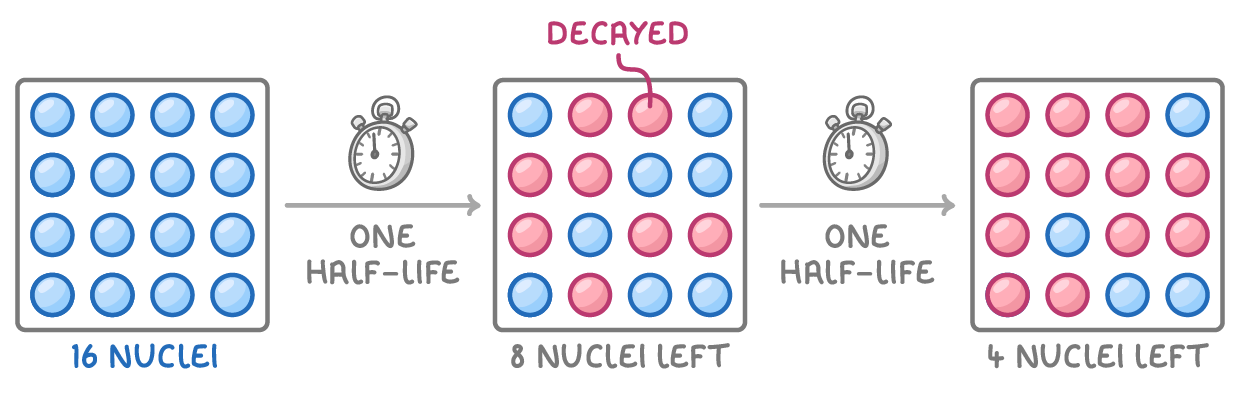
The half-life is the time taken for half of the nuclei of a particular isotope to decay.
How the amount falls
- After one half-life, half of the original nuclei are left.
- After two half-lives, a quarter is left.
- After three, an eighth - and so on.
- The mass of the radioisotope halves in step with the number of nuclei.
Short vs long half-lives
- Short half-life - Nuclei decay rapidly, so the sample loses its radioactivity quickly.
- Long half-life - Nuclei decay slowly, so the sample gives out radiation over many years.
The half-life can't be changed
- Every sample of a given isotope has the same half-life, regardless of sample size.
- Heating, cooling, compressing, dissolving, or chemically reacting the sample leaves the half-life unchanged.
- This is because decay happens in the nucleus, while physical and chemical changes involve only the electrons.
Finding a half-life
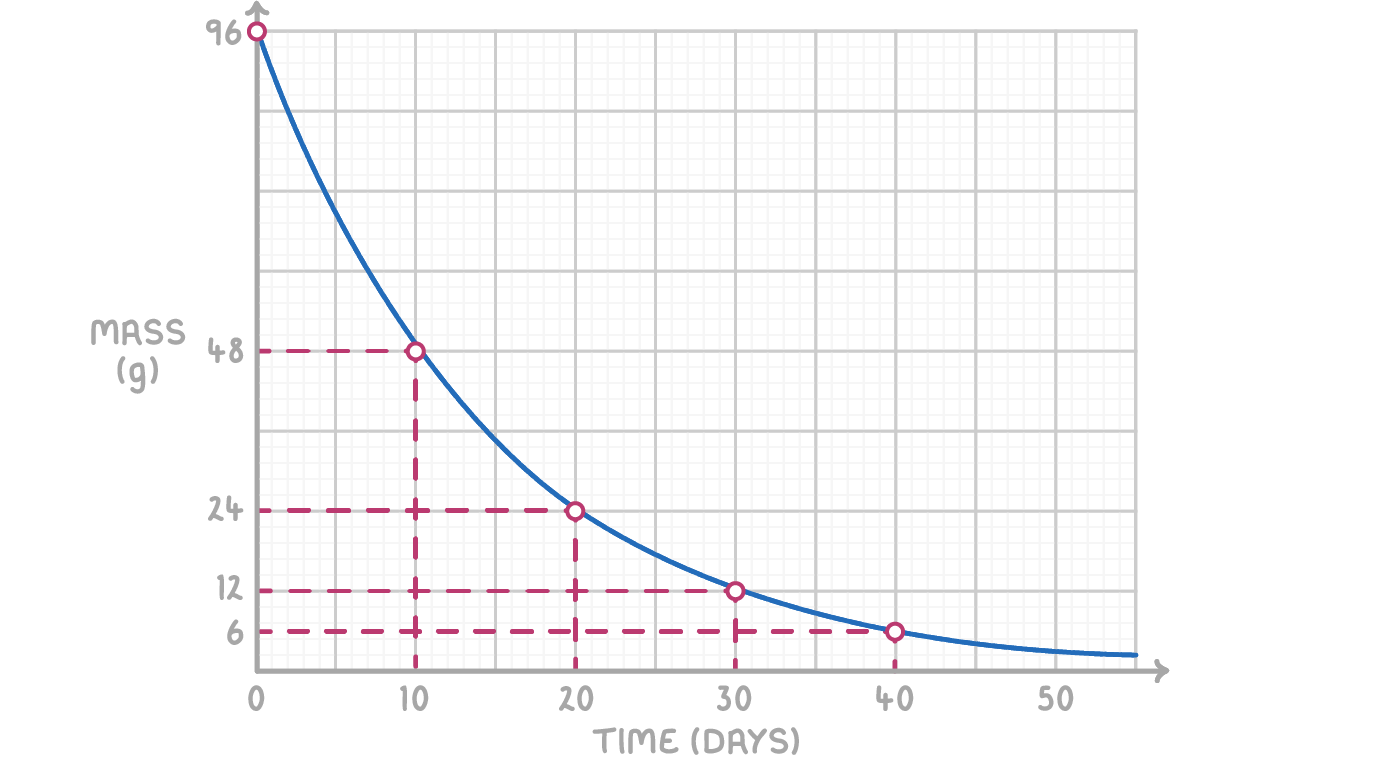
- A radioisotope's decay is shown on a decay curve - a graph of the amount remaining against time.
- The vertical axis can show mass, number of undecayed nuclei, or activity (rate of decay), which all halve together.
Reading the half-life off the curve
- Read the starting value from the vertical axis.
- Halve it.
- Find the point where the curve reaches that halved value, and read the time on the horizontal axis. That time is one half-life.
Every successive halving takes the same length of time.
Counting halvings without a graph
- Count how many halvings take the starting amount down to the final amount, then divide the total time by that number.
- Example: a 96 g sample falls to 6 g after 40 days. It has halved four times (96 → 48 → 24 → 12 → 6), so its half-life is 40 ÷ 4 = 10 days.
Using a half-life
The half-life links the total time that has passed to the amount still left.
Finding the amount left
Halve the starting amount once for each half-life that has passed. For half-lives:
The amount can be given as a mass, a number of undecayed nuclei, or a fraction/percentage of the original.
Finding the time that has passed
- Count the halvings needed to bring the starting amount down to the final amount, then multiply by the half-life.
- Example: a sample with a sixteenth of its original radioactivity has halved four times (four half-lives), so the time passed is four times the half-life.
Worked example - Mass left after a given time
Iodine-131 is a radioisotope with a half-life of 8 days. A sample of iodine-131 has a mass of 64 g. Calculate the mass of iodine-131 remaining after 24 days.
Step 1 - Find how many half-lives have passed
24 ÷ 8 = 3 half-lives
Step 2 - Halve the mass once for each half-life
After the first half-life: 64 ÷ 2 = 32 g
After the second half-life: 32 ÷ 2 = 16 g
After the third half-life: 16 ÷ 2 = 8 g
8 g of iodine-131 remains after 24 days.
Dating materials with carbon-14
- Most natural carbon is carbon-12, but a small, steady proportion is carbon-14, a radioisotope that decays by emitting beta radiation.
- Living organisms constantly absorb carbon, so the proportion of carbon-14 inside them matches their surroundings while they are alive.
What happens after death
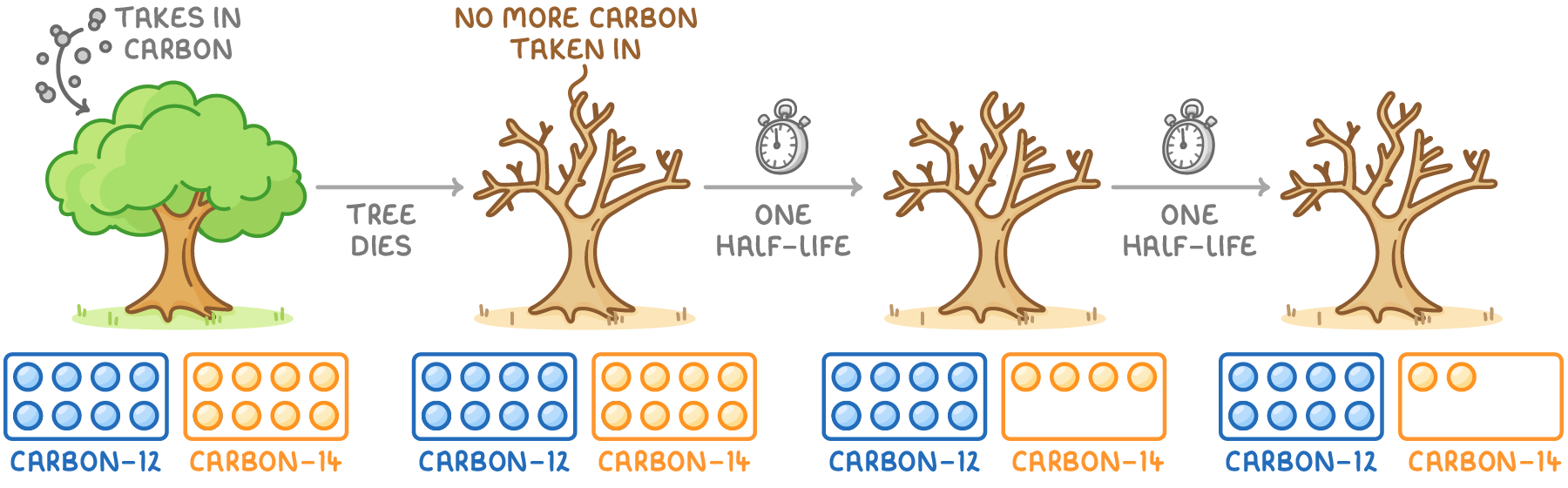
- When an organism dies, it stops taking in carbon.
- The carbon-14 decays without being replaced, while the carbon-12 does not decay.
- The ratio of carbon-14 to carbon-12 falls steadily over time.
Finding the age
- Measure the sample's radioactivity or ratio of carbon-14 to carbon-12 and compare it with living material.
- Determine what fraction of the original carbon-14 remains.
- Count the halvings needed to reach that fraction to find the number of half-lives.
- Multiply the number of half-lives by the half-life of carbon-14 to find the age.
Worked example - Age of a sample from carbon-14
A piece of wood from an archaeological site contains one eighth of the carbon-14 held by the same mass of living wood. The half-life of carbon-14 is 5,730 years. Calculate the age of the wood.
Step 1 - Count the halvings down to one eighth
all of it → one half → one quarter → one eighth
That is three halvings, so 3 half-lives have passed since the tree died.
Step 2 - Multiply the number of half-lives by the half-life
3 × 5,730 = 17,190 years
The wood is about 17,190 years old.
Choosing and using radioisotopes
Choosing a radioisotope depends on the type of radiation and the length of the half-life.
The type of radiation
- Alpha - Absorbed within a few centimetres of air; stopped by skin or thin casing.
- Beta - Penetrates thin materials but is stopped by thicker sheets (e.g. aluminium).
- Gamma - Highly penetrating; passes through most materials and body tissue.
The half-life
- Long half-life - Remains radioactive for years. Useful for sources that stay in place, but requires long-term storage and disposal precautions.
- Short half-life - Decays quickly. Ideal for medical tracers so radiation inside the patient drops quickly, but must be used soon after production.
Matching the isotope to the job
| Use | Radiation | Half-life | Why it's chosen |
|---|---|---|---|
| Treating a tumour | Gamma | - | Gamma penetrates deep tissue to kill cancer cells, where alpha and beta would be absorbed first. |
| Medical tracer (organ function) | Beta or gamma | Short | The radiation penetrates out of the body to be detected. A short half-life minimises prolonged exposure to the patient. |
| Irradiating food | Gamma | Long | Gamma penetrates packaging to kill bacteria, and a long half-life prevents frequent replacement. |
| Controlling sheet thickness | Beta | Long | Beta is partially absorbed by thin sheets (like foil or paper), so the count rate changes with thickness. Alpha would be blocked completely and gamma would pass straight through. |
Worked example - Evaluating an isotope for a job
A factory that rolls aluminium foil controls its thickness by fixing a radioactive source above the moving sheet and a detector below it. The gauge is installed permanently and runs for years. Phosphorus-32 is a beta-emitting radioisotope with a half-life of 14.3 days. Evaluate the suitability of phosphorus-32 for use in this gauge.
Step 1 - Judge the type of radiation
Beta radiation is partly absorbed by aluminium foil, so the amount reaching the detector changes as sheet thickness varies.
Alpha would be blocked completely and gamma would pass straight through without changing. Beta is the right type of radiation.
Step 2 - Judge the half-life
A half-life of 14.3 days means the source loses half its radioactivity in about two weeks and would need replacing every few weeks.
Because the gauge must run continuously for years, a long half-life is needed.
Step 3 - Give the verdict
Phosphorus-32 is not suitable. Although it emits the correct radiation (beta), its half-life is far too short for a permanent gauge.