8.1 - Collecting Gases
Choosing a way to collect a gas
- Two properties of a gas decide how it's collected:
- Whether it dissolves in water
- If it does dissolve, whether it's denser or less dense than air
- Ask about solubility first:
- A gas that does not dissolve in water (or only slightly) is collected over water, regardless of density.
- A gas that does dissolve in water is collected by displacement of air, where density decides the method.
A gas with a low solubility in water - Collection over water
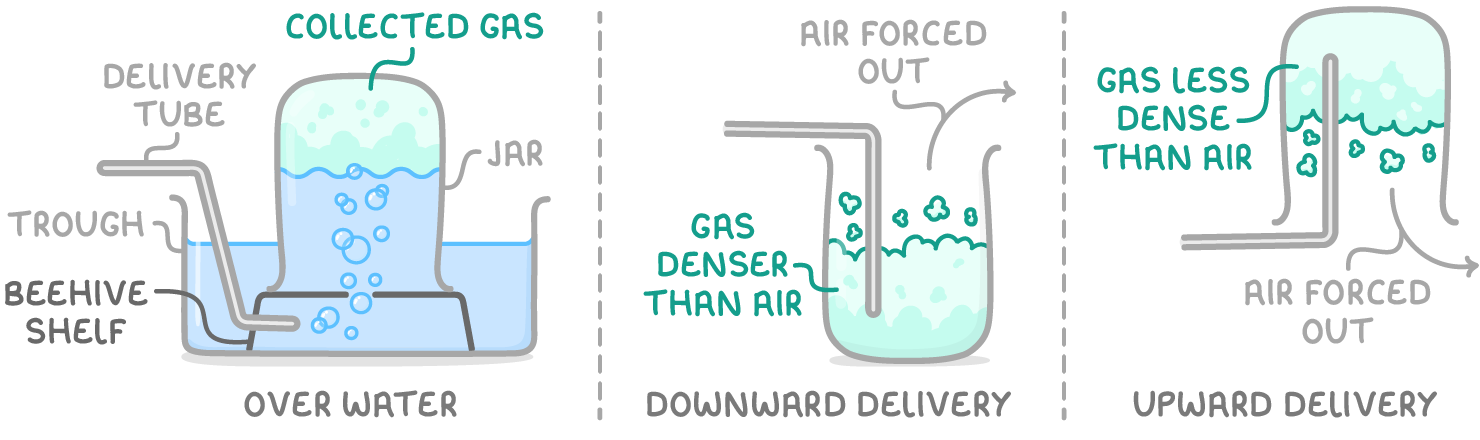
- A gas jar or measuring cylinder is filled with water and inverted in a trough of water over a beehive shelf.
- The delivery tube runs into the trough and under the shelf, so the gas bubbles up through the shelf into the mouth of the jar.
- As gas bubbles into the jar, it displaces the water downwards.
A soluble gas that is denser than air
- The gas jar stands upright with the delivery tube reaching near the bottom.
- The gas sinks to the bottom and pushes the less dense air up and out.
- This is called downward delivery (or upward displacement of air).
- Used for sulfur dioxide and hydrogen chloride.
A soluble gas that is less dense than air
- The gas jar is held upside down with the delivery tube pointing up into it.
- The gas rises to the top and pushes the denser air down and out of the mouth.
- This is called upward delivery (or downward displacement of air).
- Used for ammonia.
TermDefinition
Downward deliveryA method of collecting a soluble gas that is denser than air by letting it sink to the bottom of an upright gas jar.
Upward deliveryA method of collecting a soluble gas that is less dense than air by letting it rise to the top of an upside-down gas jar.