3.3 - Reactions of Acids
Acids with metals
Dilute acids react with many metals to produce a salt and hydrogen gas:
acid + metal → salt + hydrogen
Which salt forms depends on the acid
- Hydrochloric acid gives a chloride.
- Sulfuric acid gives a sulfate.
- Mg(s) + 2HCl(aq) → MgCl2(aq) + H2(g)
- Zn(s) + H2SO4(aq) → ZnSO4(aq) + H2(g)
- Fe(s) + 2HCl(aq) → FeCl2(aq) + H2(g)
What you see happening
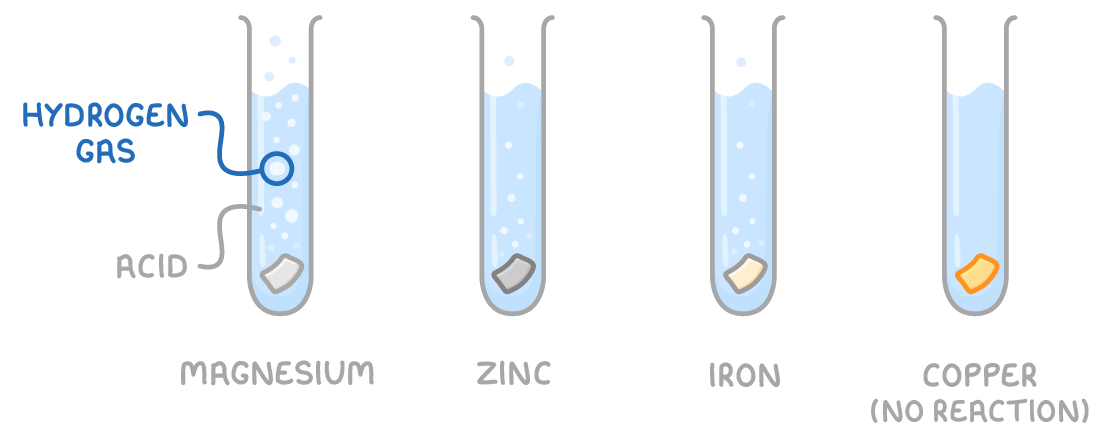
- Bubbles of hydrogen gas stream off the metal's surface.
- The piece of metal gets smaller and disappears completely if there is enough acid.
- The mixture warms up (the reaction is exothermic).
Reactivity sets the rate
The rate bubbles come off shows how reactive the metal is:
- Magnesium reacts vigorously with cold dilute acid, giving a fast stream of bubbles.
- Zinc and iron react slowly in the cold, but faster if warmed.
- Copper doesn't react with dilute acid at all.
Acids with bases and carbonates
Metal oxides and metal hydroxides are bases that neutralise acids to produce a salt and water:
acid + metal oxide (or hydroxide) → salt + water
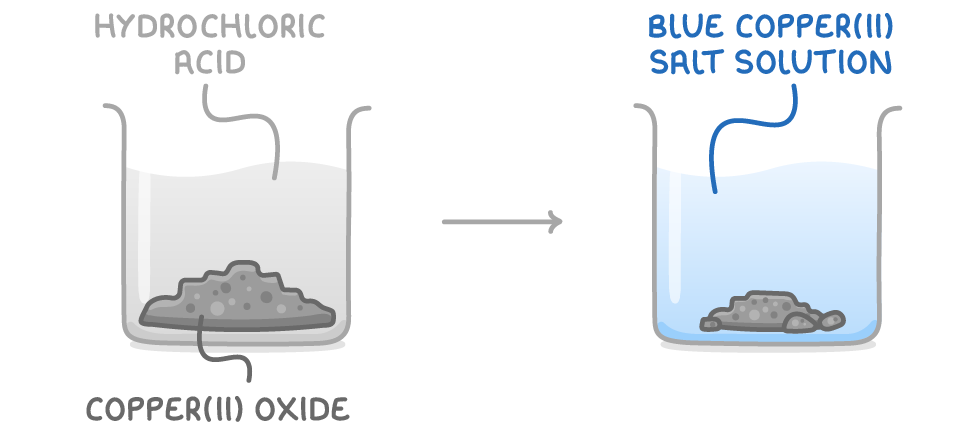
2HCl(aq) + CuO(s) → CuCl2(aq) + H2O(l)
H2SO4(aq) + 2KOH(aq) → K2SO4(aq) + 2H2O(l)
HNO3(aq) + NaOH(aq) → NaNO3(aq) + H2O(l)
Both soluble bases (alkalis, e.g. NaOH, KOH) and insoluble bases (e.g. CuO, MgO) neutralise acids this way.
Carbonates and hydrogencarbonates
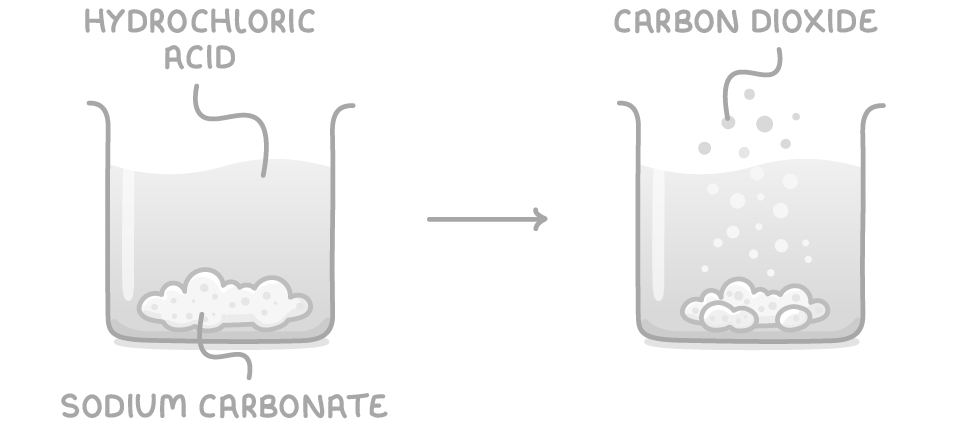
Metal carbonates and hydrogencarbonates react with acids to produce a salt, water, and carbon dioxide:
acid + metal carbonate (or hydrogencarbonate) → salt + water + carbon dioxide
2HCl(aq) + Na2CO3(aq) → 2NaCl(aq) + H2O(l) + CO2(g)
H2SO4(aq) + CaCO3(s) → CaSO4(s) + H2O(l) + CO2(g)
NaHCO3(aq) + HCl(aq) → NaCl(aq) + H2O(l) + CO2(g)
Ammonia
Ammonia reacts with an acid to form an ammonium salt only (no water forms because ammonia contains no oxygen):
acid + ammonia → ammonium salt
NH3(aq) + HCl(aq) → NH4Cl(aq)
Observations during neutralisation
- Effervescence (fizzing) occurs with carbonates and hydrogencarbonates as CO2 gas escapes; oxides and hydroxides produce no gas.
- Solid bases disappear as they react to form soluble salts.
- The reaction mixture warms up.
- If a transition metal base is used, a colour change occurs (e.g. black copper(II) oxide disappears, leaving a blue copper(II) salt solution).
Naming salts
- A salt is a compound formed when some or all of the hydrogen ions in an acid are replaced by metal ions or ammonium ions.
- A salt's name has two parts:
- First part - From the metal or ammonium in the base.
- Second part - From the acid.
| Acid | Formula | Salt formed |
|---|---|---|
| hydrochloric acid | HCl | chloride |
| sulfuric acid | H2SO4 | sulfate |
| nitric acid | HNO3 | nitrate |
- Most Group 1, Group 2, and aluminium or zinc salts form colourless solutions and white solids.
- Transition-metal salts are typically coloured (e.g. copper(II) salts are blue in solution).
Worked example - Salt from nitric acid and copper(II) oxide
Name the salt made when nitric acid reacts with copper(II) oxide, and write the word equation.
Step 1 - Name from the acid
The acid is nitric acid, so the salt is a nitrate.
Step 2 - Name from the metal
The base is copper(II) oxide, which supplies copper(II) ions.
Step 3 - Combine and write the equation
The salt is copper(II) nitrate.
nitric acid + copper(II) oxide → copper(II) nitrate + water
The neutralisation ionic equation
Neutralisation between an acid and an alkali involves hydrogen ions reacting with hydroxide ions to form water:
H+(aq) + OH-(aq) → H2O(l)
- An equation showing only the particles that react is an ionic equation.
- This single ionic equation describes every reaction between an acid and an alkali.
Spectator ions
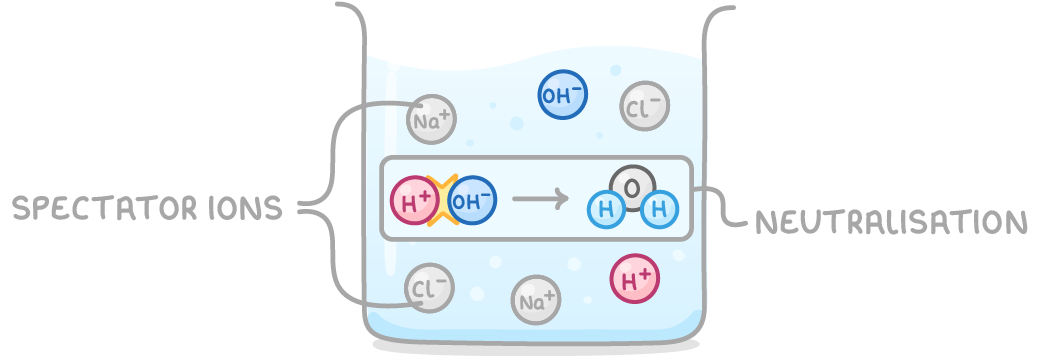
- In the reaction between hydrochloric acid and sodium hydroxide:
- The acid supplies H+(aq) and Cl-(aq) ions.
- The alkali supplies Na+(aq) and OH-(aq) ions.
- H+ and OH- react to form H2O(l).
- Na+ and Cl- remain unchanged in solution.
- Ions that remain unchanged throughout a reaction are called spectator ions, and they're omitted from the ionic equation.
- If the water is evaporated, the spectator ions combine to form the solid salt (sodium chloride).
Finding the spectator ions
Dissolved ionic compounds and aqueous acids exist as separate ions in solution:
H+(aq) + Cl-(aq) + Na+(aq) + OH-(aq) → Na+(aq) + Cl-(aq) + H2O(l)
Cancelling the spectator ions (Na+ and Cl-) that appear on both sides gives:
H+(aq) + OH-(aq) → H2O(l)
Ionic equations with other bases
Insoluble solids do not split into separate ions in solution, so they keep the state symbol (s):
| Reaction | Ionic equation |
|---|---|
| acid + metal oxide | 2H+(aq) + O2-(s) → H2O(l) |
| acid + metal hydroxide (alkali) | H+(aq) + OH-(aq) → H2O(l) |
| acid + dissolved metal carbonate | 2H+(aq) + CO32-(aq) → H2O(l) + CO2(g) |
| acid + insoluble metal carbonate | 2H+(aq) + CO32-(s) → H2O(l) + CO2(g) |