Ionic Bonding - exam practice
Ionic Bonding
Question 1 of 6
Calcium and magnesium are elements.
They are found in the Earth’s crust as compounds, often carbonates and sulphates.
Magnesium is also found as its chloride.
Calcium and magnesium are in the same group in the periodic table.
State which group this is.
(You may need a periodic table.)
Draw a 'dot and cross' diagram to show how magnesium and chlorine form magnesium chloride.
Write the chemical formula of magnesium chloride.
Name the type of bonding in magnesium chloride.
Sodium forms an ionic compound with sulfur.
Describe what happens when two atoms of sodium react with one atom of sulfur.
Give your answer in terms of electron transfer, and give the formulae of the ions formed.
This question is about ionic compounds.
Which two of the following compounds are ionic?
Calcium nitrate is an ionic compound with the formula Ca(NO3)2.
What ions does it contain?
The structure of potassium sulfide (K2S) can be represented using a ball and stick model.
Which one of the two ball and stick diagrams below, A or B, represents potassium sulfide?
Explain your choice.
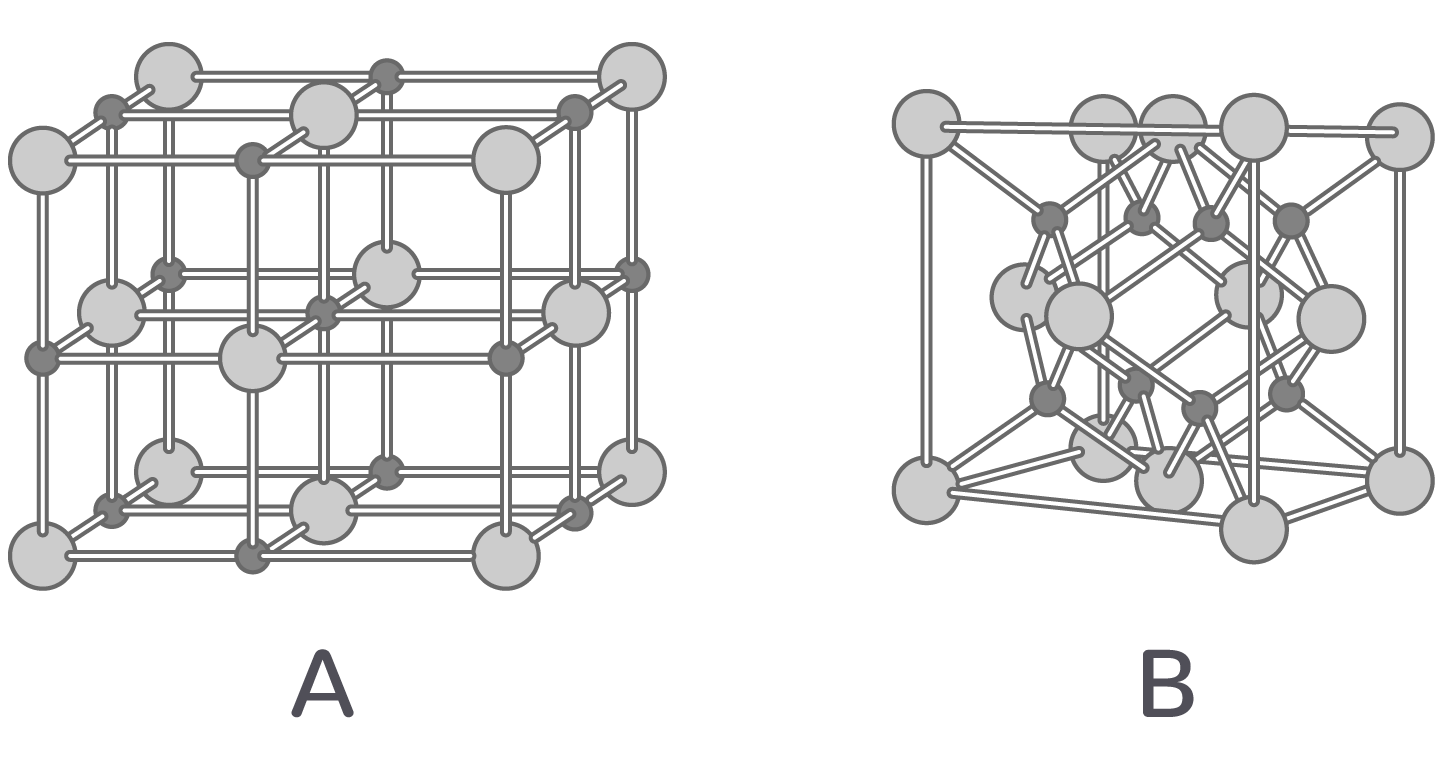
The ball and stick model is not a true representation of the structure of potassium sulfide.
Give one reason why.
This question is about sodium chloride.
Sodium chloride is also known as table salt.
Sodium chloride is an ionic compound with the chemical formula NaCl.
Which one of the statements below is true about sodium chloride?
The image below shows a two-dimensional diagram of the structure of sodium chloride, NaCl.
Only some of the charges of the ions are shown.
Complete the diagram with the missing charges.
Which ion is represented by the (-) charge, and which ion is represented by the (+) charge?
Give two limitations of a two-dimensional diagram like the one above.
Give the name of the structure represented above.
This question is about ionic bonding.
What is an ion?
Explain:
- how a metal atom becomes a metal ion
- how a non-metal atom becomes a non-metal ion
State how the charges change in both cases.
Ionic compounds have high melting points.
The melting and boiling points of sodium chloride and magnesium oxide are shown in the table below.
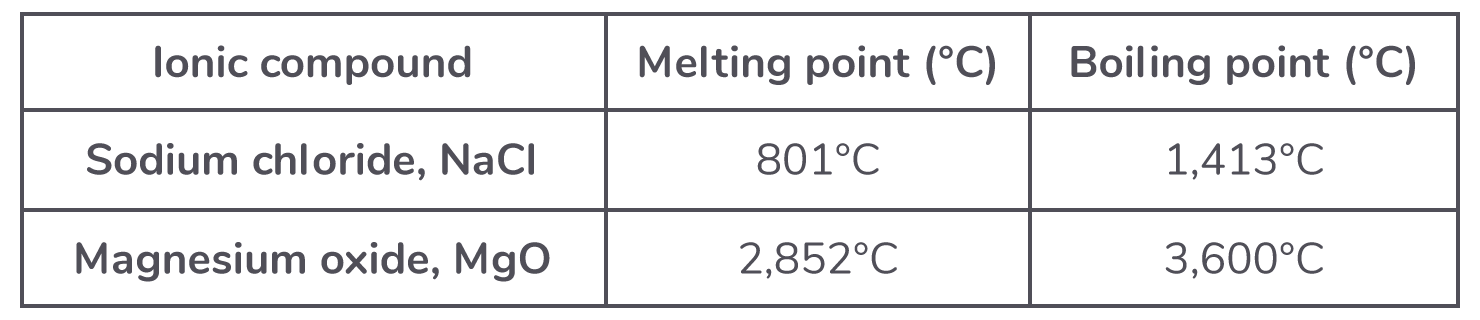
Why are the melting and boiling points of magnesium oxide higher than those of sodium chloride?
Refer to the charges of the ions in your answer.
This question is about ionic compounds.
Complete the sentence below.
When a metal and a non-metal react, the metal electrons and the non-metal electrons.
This happens so both elements can achieve a outer shell of electrons.
This gives the atom a gas configuration.
Ionic compounds have regular structures, called giant ionic lattices.
Describe how giant ionic lattices are held together.
Explain why ionic compounds have high melting and boiling points.