4.5 - Limestone & the Lime Cycle
Limestone, quicklime and slaked lime
- Limestone - A rock made mostly of calcium carbonate, CaCO3, formed from the compressed remains of sea creatures' shells and skeletons.
- Quicklime - Calcium oxide, CaO.
- Slaked lime - Calcium hydroxide, Ca(OH)2.
The limestone cycle
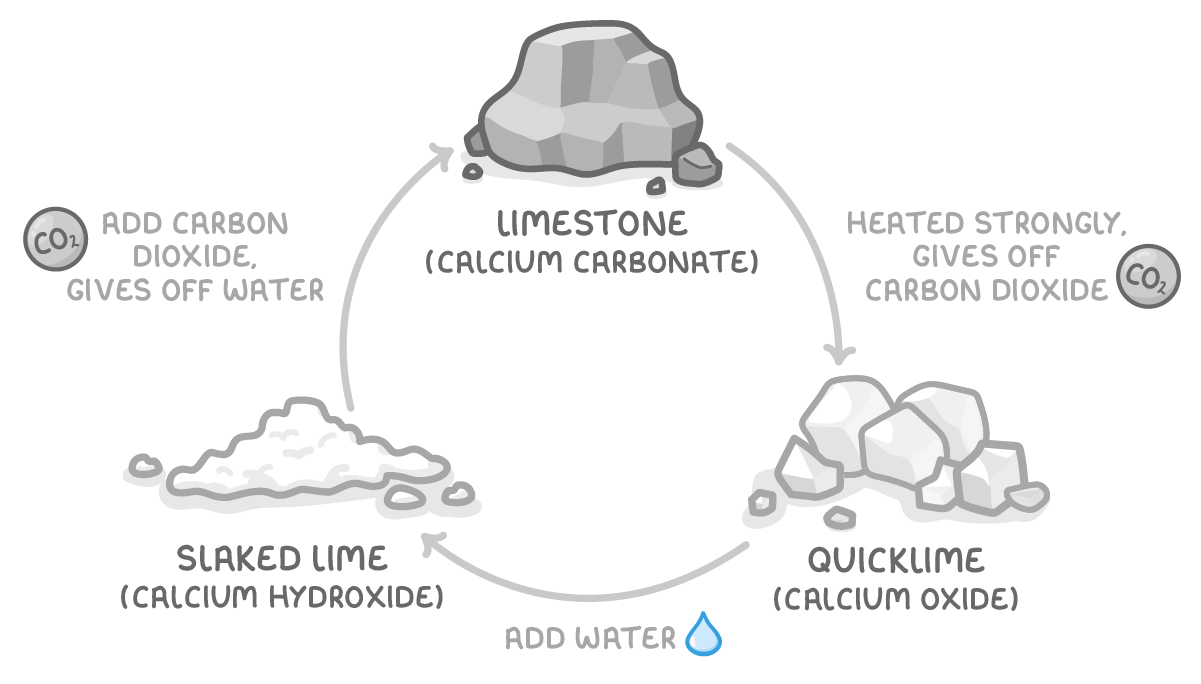
Limestone, quicklime, and slaked lime are linked by a cycle of three reactions.
Limestone → quicklime
Heating limestone strongly breaks it down into quicklime and carbon dioxide (thermal decomposition).
calcium carbonate → calcium oxide + carbon dioxide
CaCO3(s) → CaO(s) + CO2(g)
Quicklime → slaked lime
Adding water to quicklime produces slaked lime in an exothermic reaction.
calcium oxide + water → calcium hydroxide
CaO(s) + H2O(l) → Ca(OH)2(s)
Slaked lime → limestone
- Dissolving slaked lime in water gives limewater, a solution of calcium hydroxide.
- Passing carbon dioxide through limewater reforms calcium carbonate, completing the cycle.
- calcium hydroxide + carbon dioxide → calcium carbonate + water
- Ca(OH)2(aq) + CO2(g) → CaCO3(s) + H2O(l)
Uses of limestone and its products
Limestone
- Extracting iron - Removes acidic impurities in the blast furnace.
- Road-building - Crushed limestone is used as aggregate.
- Cement and concrete - Used to manufacture cement.
Neutralising acidity
Quicklime, slaked lime, and powdered limestone are all bases, so they can be:
- Spread on farmland to neutralise acidic soil and improve crop yields.
- Used to treat acidic lakes and rivers.
Quarrying limestone - Costs and benefits
| Problems | Benefits |
|---|---|
| Blasting, heavy machinery, and lorries create noise and dust. | Provides jobs in the quarry and local businesses. |
| Destroys plant and animal habitats. | Brings money into the local economy. |
| Scars the landscape and can lower nearby house prices. | Can fund improvements to local transport, roads, and infrastructure. |
TermDefinition
Limestone
Quicklime
Slaked lime
Thermal decomposition
Limewater