2.2 - Isotopes & Relative Atomic Mass
What an isotope is
- Every atom of an element has the same number of protons in its nucleus.
- That proton count is the atomic number (or proton number), and it's what determines which element an atom is.
- Isotopes are atoms of the same element with the same number of protons but different numbers of neutrons.
Isotopes have different mass numbers
- Mass number (or nucleon number) = number of protons + number of neutrons.
- Isotopes of an element share an atomic number but have different mass numbers.
- Most elements exist naturally as a mixture of two or more isotopes.
Carbon as an example
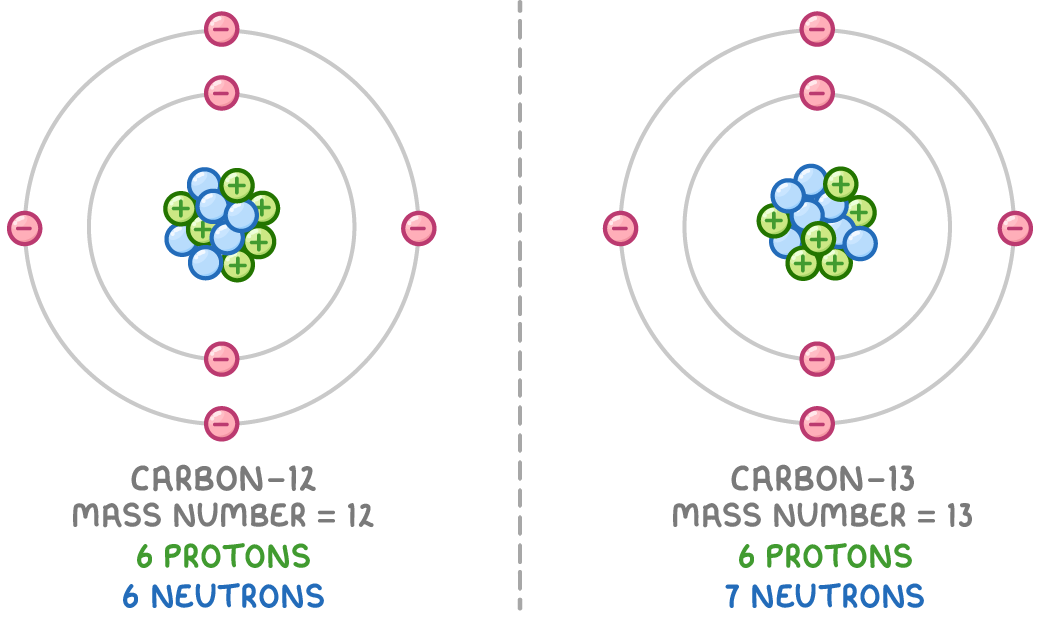
- Carbon-12 - 6 protons, 6 neutrons, 6 electrons.
- Carbon-13 - 6 protons, 7 neutrons, 6 electrons.
- Both are carbon because both have 6 protons; they differ only in their neutron count and mass number.
Relative atomic mass
- Most elements are a mixture of isotopes with different masses, so relative atomic mass () is used to describe the element as a whole.
- is a weighted average of the masses of the different isotopes, taking into account both the mass of each isotope and its relative abundance (how common it is).
Whole number or not
- One isotope - equals that isotope's mass number, so it's a whole number.
- More than one isotope - The average is pulled towards the more common isotope, so usually isn't a whole number.
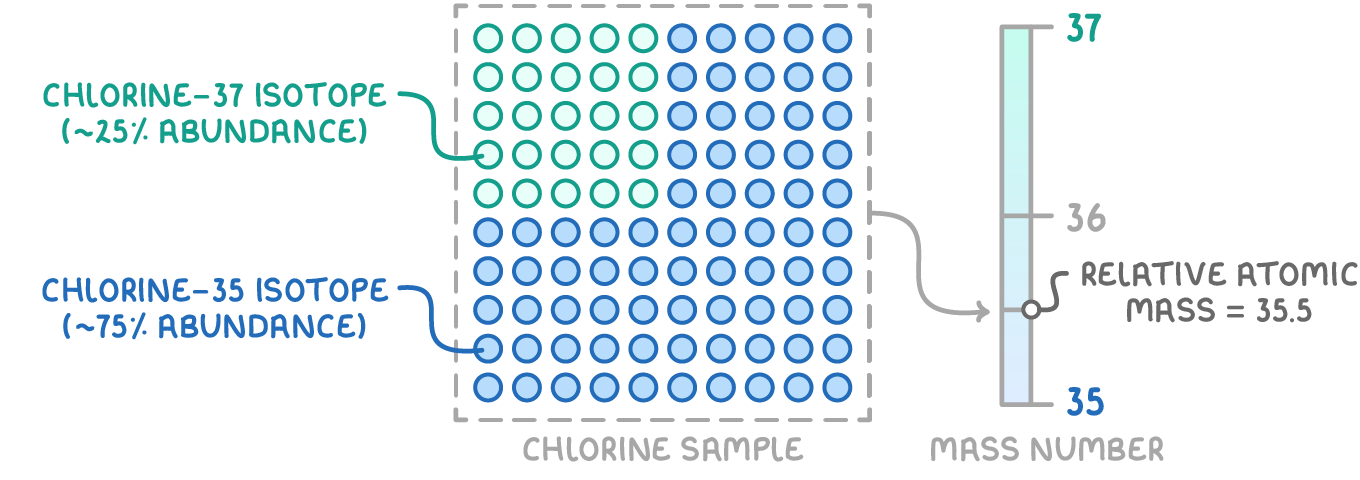
- Chlorine is the standard example: it has two main isotopes, chlorine-35 and chlorine-37. Because chlorine-35 is much more abundant, chlorine's is 35.5.
Relative atomic mass vs mass number
- Mass number - The number of protons plus neutrons in one specific atom (always a whole number).
- Relative atomic mass () - the average mass of all the isotopes of an element, taking abundance into account (often not a whole number).
Formula for relative atomic mass
Where:
- = Relative atomic mass
- Abundance is how common each isotope is, given as a percentage, a fraction, or a ratio of relative amounts
- Mass number is the mass number of each isotope
The denominator is the total of the abundances (which equals 100 when abundances are percentages).
Worked example - Relative atomic mass of copper
Copper has two stable isotopes. Copper-63 has an abundance of 69.2% and copper-65 has an abundance of 30.8%. Calculate the relative atomic mass of copper to one decimal place.
Step 1 - Multiply each isotope's mass number by its abundance
63 × 69.2 = 4,359.6
65 × 30.8 = 2,002
Step 2 - Add the products together
4,359.6 + 2,002 = 6,361.6
Step 3 - Add the abundances and divide
The abundances are percentages of the same element, so they total 69.2 + 30.8 = 100.
Step 4 - Round to the accuracy asked for
To one decimal place, the relative atomic mass of copper is 63.6.
Step 5 - Interpretation
The answer lies between 63 and 65 and sits nearer to 63, which matches copper-63 being the more abundant isotope.
TermDefinition
Atomic number
Isotope
Mass number
Relative atomic mass