6.8 - Electrochemical Cells & Series
A simple cell and its electrolyte
- An electrochemical cell turns a chemical reaction into electrical energy.
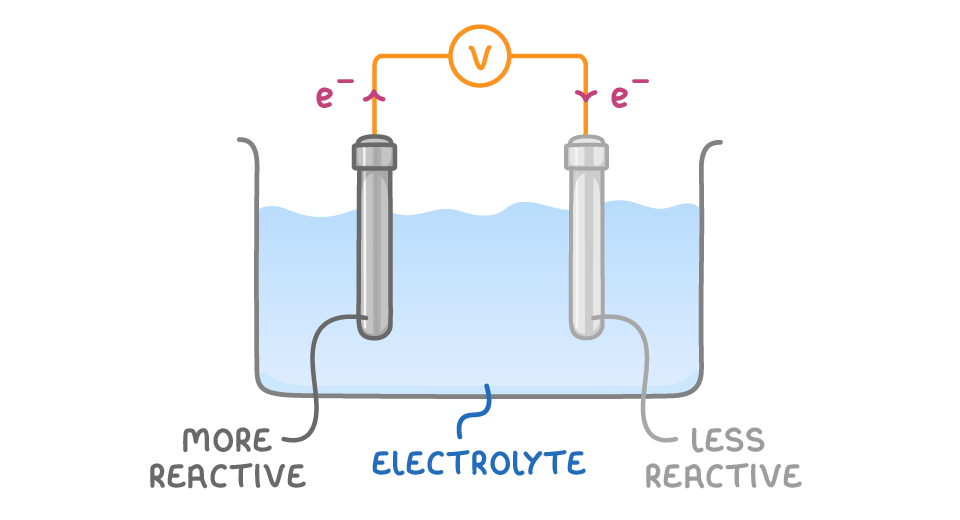
- A simple cell is made by placing strips of two different metals in an electrolyte and connecting them with a wire.
- A voltmeter in the circuit measures the voltage produced.
Why a current is produced
- Metals differ in how easily they give up electrons.
- The more reactive metal gives up electrons, so it is oxidised.
- Electrons flow through the wire to the less reactive metal, where reduction takes place.
- This flow of electrons through the wire is the electric current.
Voltage and the metals used
- The metals must be different - Identical metals have the same tendency to lose electrons, so no current flows and the voltage is zero.
- The further apart the metals are in reactivity, the larger the voltage.
The electrolyte
- An electrolyte is an ionic solution that conducts electricity.
- Electrons flow through the external wire, while ions move through the electrolyte to complete the circuit.
- Ionic solutions (e.g. sodium chloride solution) work because their ions are free to move.
- Covalent solutions (e.g. sugar solution) do not work because they contain molecules rather than free ions.
Half-cells and the ion bridge
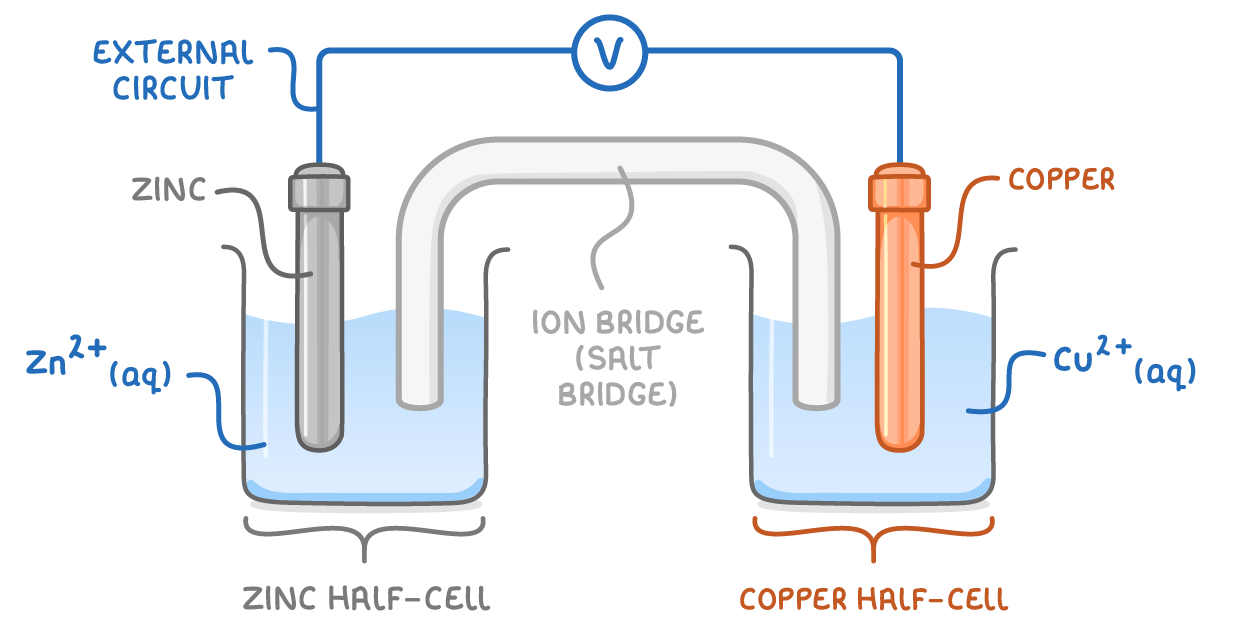
- A half-cell is a metal electrode standing in a solution of its own ions (e.g. zinc in zinc sulfate solution).
- An electrochemical cell is made by connecting two half-cells together.
- An electrode is a solid conductor that carries electrons into or out of the solution.
Joining two half-cells requires two connections
- A wire - Connects the two electrodes (often via a voltmeter) to let electrons flow through the external circuit.
- An ion bridge (salt bridge) - Links the two solutions. It is typically a strip of filter paper or a U-shaped tube containing an ionic solution (such as potassium nitrate, KNO3(aq), or potassium chloride, KCl(aq)).
Purpose of the ion bridge
- As electrons leave one half-cell and enter the other, charge would build up in the beakers and stop the reaction.
- Ions move through the ion bridge to balance the charge and complete the circuit, allowing current to keep flowing.
Non-metal half-cells
- A half-cell can contain a non-metal solution (e.g. aqueous bromine) instead of a metal.
- An inert graphite rod is used as the electrode because it:
- Conducts electricity
- Does not react with the solution
The electrochemical series and electron flow
The electrochemical series arranges elements in order of how easily they give up electrons, based on measured voltages.
How the series is written as half-cell reactions
Entries are written as reduction ion-electron equations.
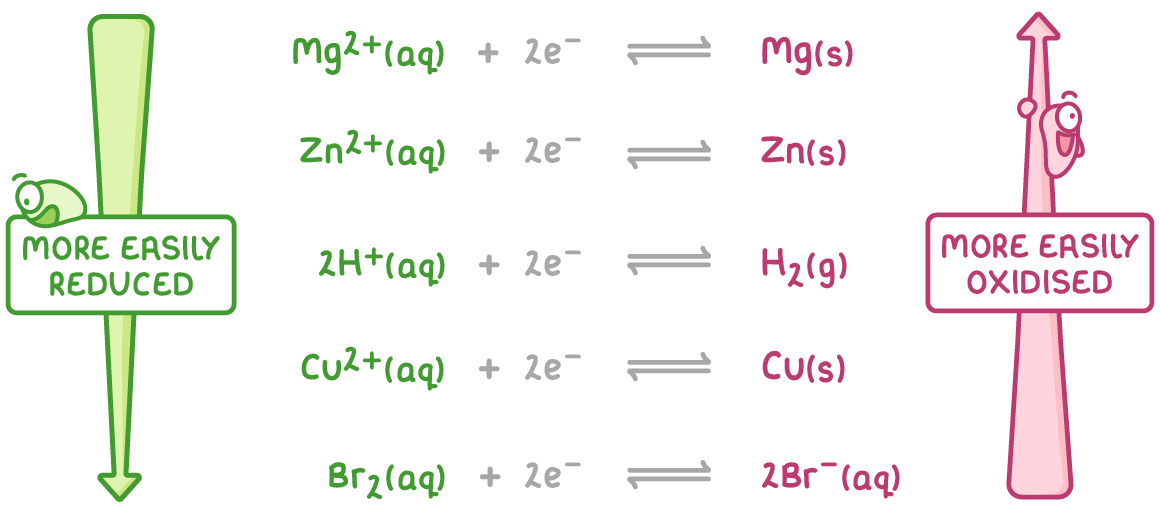
- The higher a substance is in the series, the more easily it is oxidised (giving up electrons; reaction goes right to left).
- The lower a substance is, the more easily it is reduced (taking in electrons; reaction goes left to right).
Reading electron flow and voltage
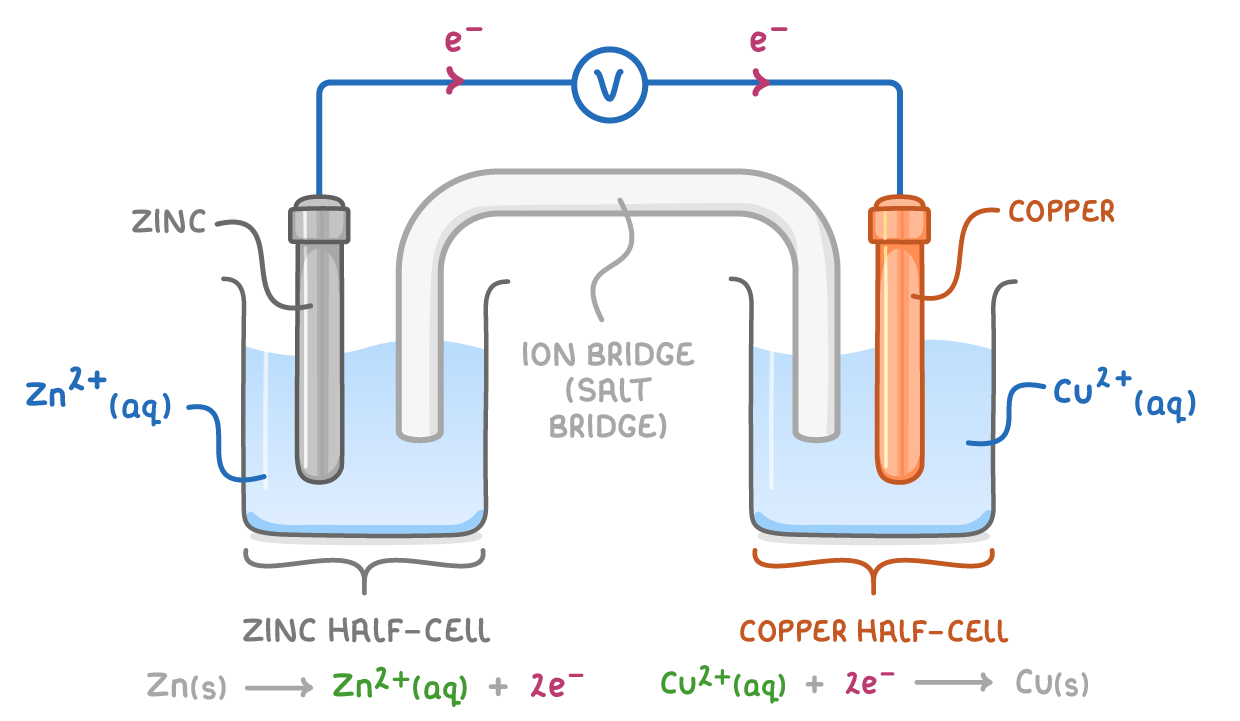
- Electron flow - Electrons flow through the wire from the half-cell higher in the series to the one lower.
- Voltage - The further apart the two half-cells are in the series, the larger the voltage produced.
Working out an order from measured voltages
The direction of electron flow and size of the voltage allow metals to be placed in order:
| Metal | Voltage (V) | Direction of electron flow |
|---|---|---|
| W | 1.1 | W to copper |
| X | 0.3 | copper to X |
| Y | 0.5 | Y to copper |
| Z | 0.8 | copper to Z |
Step 1 - Place each metal above or below copper
Electrons leave the higher metal, so W and Y sit above copper, while X and Z sit below copper.
Step 2 - Order by voltage size
A larger voltage means a greater distance in the series. W (1.1 V) sits further above copper than Y (0.5 V). Z (0.8 V) sits further below copper than X (0.3 V).
Step 3 - Write the order, highest first
W, Y, copper, X, Z
Differences from the reactivity series
- Determined by measuring cell voltages rather than reaction speeds.
- Written as ion-electron reduction equations rather than metal names.
- Includes non-metals (such as bromine) and hydrogen, not just metals.
Ion-electron equations in a cell
- An ion-electron equation shows the oxidation or reduction taking place at an electrode, with electrons written as e-.
- The species higher in the electrochemical series is oxidised; the species lower is reduced.
Worked example - Zinc and copper cell
Step 1 - Write the oxidation equation
Zinc is higher than copper in the series, so zinc is oxidised:
Zn(s) → Zn2+(aq) + 2e-
Step 2 - Write the reduction equation
Copper(II) ions accept the electrons and are reduced to copper metal:
Cu2+(aq) + 2e- → Cu(s)
Step 3 - Combine to give the overall redox equation
Add the two equations together so the electrons cancel out:
Zn(s) + Cu2+(aq) → Zn2+(aq) + Cu(s)
Non-metal half-cells
- In a half-cell without a metal, an inert graphite rod transfers electrons to or from the solution.
- In a magnesium and bromine cell, magnesium is higher and is oxidised, while bromine is reduced at the graphite electrode:
- Br2(aq) + 2e- → 2Br-(aq)