1.8 - Formation of Ions
How an atom becomes an ion, and its charge
- An ion is a charged particle. It can be:
- A single atom that has gained or lost electrons (e.g. a chloride ion), or
- A group of atoms bonded together carrying an overall charge (e.g. a hydroxide ion).
- Atoms form ions to get a full outer shell of electrons - the stable arrangement a noble gas already has.
- An atom with an incomplete outer shell reaches this by losing or gaining electrons. It then has more protons than electrons (or more electrons than protons), so it carries a charge.
Metals lose, non-metals gain
- Metal atoms lose outer-shell electrons to form positive ions - called cations.
- Non-metal atoms gain electrons into their outer shell to form negative ions - called anions.
- The size of the charge is set by how many electrons move: lose two electrons and the charge is 2+; gain three and the charge is 3−.
Reading the charge off the periodic table
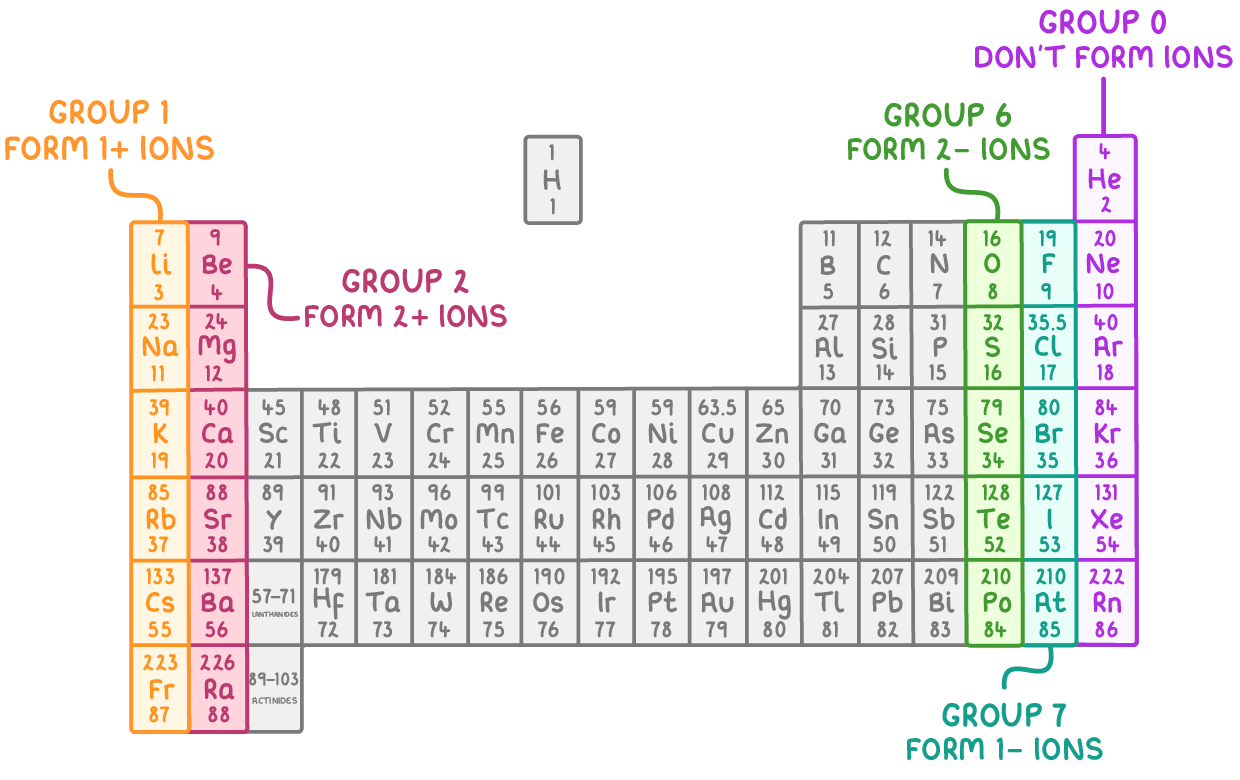
Every element in a group has the same number of outer electrons, so it loses or gains the same number to reach a full shell - making the charge predictable.
| Group | What happens | Charge | Example |
|---|---|---|---|
| 1 | Loses 1 electron | 1+ | Sodium forms Na+ |
| 2 | Loses 2 electrons | 2+ | Magnesium forms Mg2+ |
| 6 | Gains 2 electrons | 2− | Oxygen forms O2- |
| 7 | Gains 1 electron | 1− | Chlorine forms Cl- |
| 0 | Outer shell already full | None | Neon and argon do not form ions |
The electronic configuration of an ion
- To work out an ion's electronic configuration from its atom:
- Write out the atom's electron arrangement.
- Add or remove electrons from the outer shell to match the ion's charge.
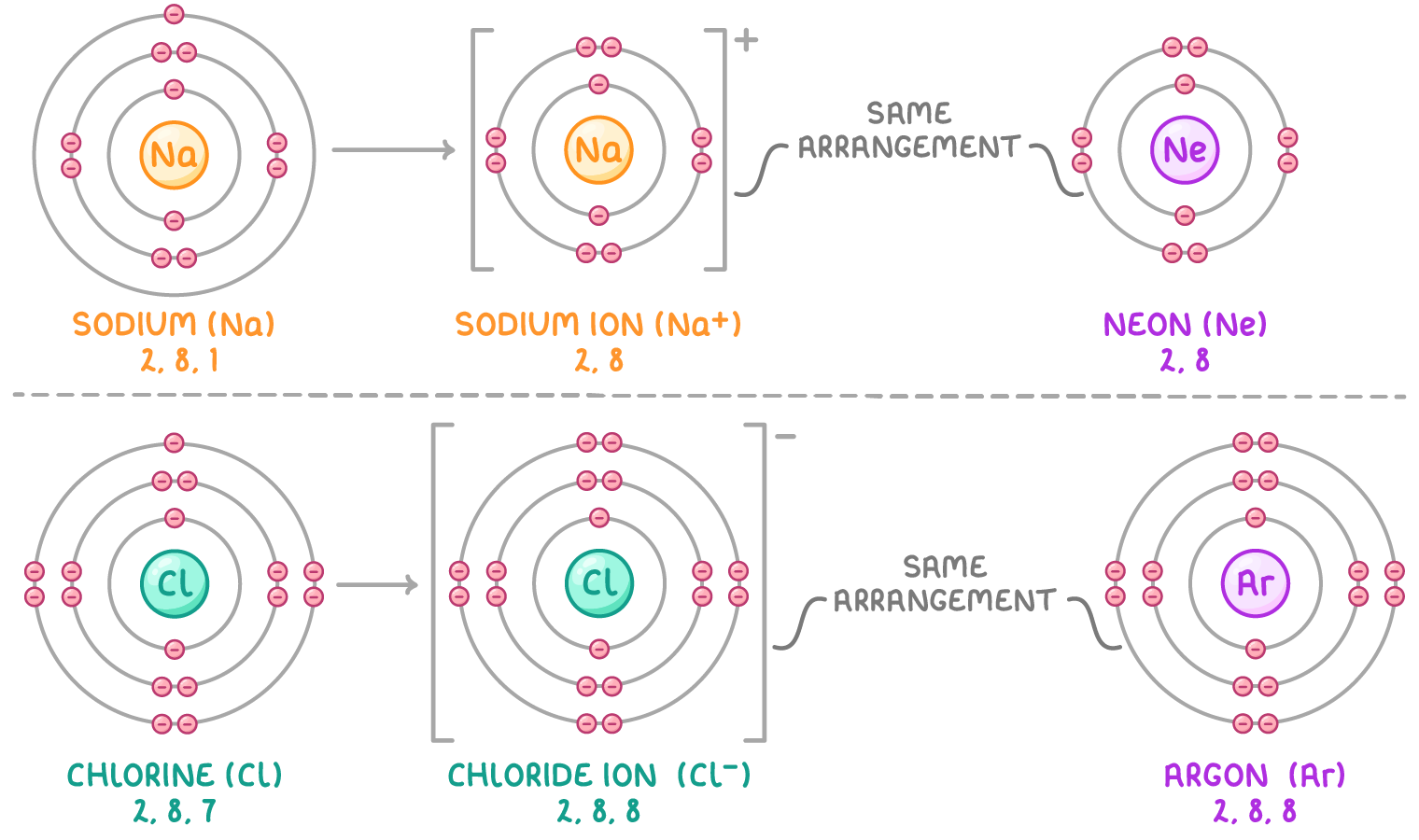
- For elements in Groups 1, 2, 3, 5, 6 and 7, the ion ends up with the electron arrangement of the nearest noble gas. Transition metal ions such as Fe2+, below, do not follow this rule.
Worked examples of ion configurations
- Na (2,8,1) loses 1 electron → Na+ (2,8) - same as neon.
- Cl (2,8,7) gains 1 electron → Cl- (2,8,8) - same as argon.
- Mg (2,8,2) loses 2 electrons → Mg2+ (2,8).
- O (2,6) gains 2 electrons → O2- (2,8).
Using the numbers alone
- You can find the number of particles without drawing shells:
- Protons are unchanged from the atom, so they equal the atomic number.
- Electrons = atomic number adjusted by the charge - subtract the charge for a positive ion, add it for a negative ion.
- Fluorine has atomic number 9 (9 protons); F- has one more electron = 10 electrons.
- Iron has atomic number 26 (26 protons); Fe2+ has two fewer electrons = 24 electrons.
Worked example - Configuration of an ion
Finding an ion's electronic configuration follows three steps.
Step 1 - Write the atom's arrangement
Lithium's atom has the arrangement 2,1.
Step 2 - Find the change from the charge
Lithium is a Group 1 metal, so it loses its one outer electron, forming Li+.
Step 3 - Apply the change
Removing that electron leaves 2 - a full first shell, the same arrangement as helium.
Applying the same steps to fluorine (arrangement 2,7): as a Group 7 non-metal it gains one electron to complete its outer shell, forming F- with the arrangement 2,8 - the same as neon.
Each ion reaches whichever noble gas is nearest to it in the periodic table.
Writing an ion-electron equation
- An ion-electron equation shows what happens to the electrons when an atom becomes an ion.
- The symbol e- stands for one electron.
How to write one
- Use the element's group number to find the charge on the ion it forms:
- Group 1 metal - loses 1 electron → 1+ ion
- Group 2 metal - loses 2 electrons → 2+ ion
- Group 6 non-metal - gains 2 electrons → 2− ion
- Group 7 non-metal - gains 1 electron → 1− ion
- Write the atom on one side and the ion it becomes on the other.
- Add the electrons to balance the charge:
- Losing electrons - they go on the same side as the ion.
- Gaining electrons - they go on the same side as the atom.
The number of electrons always matches the size of the ion's charge, so the charge balances on both sides.
Worked example - Ion-electron equation
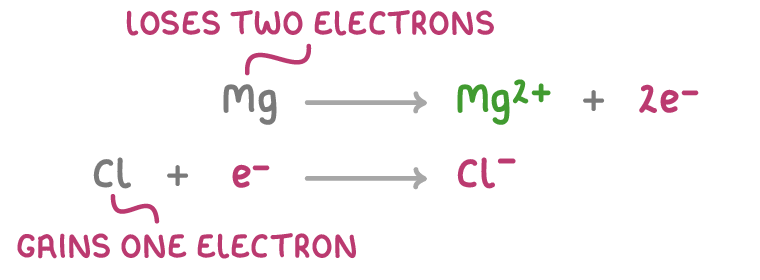
Barium is in Group 2, so a barium atom loses two electrons to form a Ba2+ ion.
Step 1 - Write the atom and its ion
Barium loses electrons, so they go on the same side as the ion (the right):
Ba → Ba2+ + 2e-
Step 2 - Check the charge balances
The 2+ charge on the ion is balanced by the two electrons lost, each carrying away one unit of negative charge.
Applying the same to oxygen (Group 6), which gains two electrons - the electrons go on the same side as the atom (the left):
O + 2e- → O2-
The two electrons added on the left balance the 2− charge on the ion on the right.