6.3 - Extracting Metals from Their Ores
Ores, native metals, and extraction as reduction
- Most metals are found combined with other elements as metal compounds in rocks, usually as oxides.
- An ore is a rock containing enough metal compound to make extracting the metal worthwhile:
- Haematite (or hematite) - An iron oxide ore
- Bauxite - An aluminium oxide ore
Native metals
- Unreactive metals, such as gold, do not readily react with other elements and are found as pure metal.
- Metals found like this are described as uncombined, or in their native form.
Extraction is reduction
- Extracting a metal from its oxide requires removing the oxygen.
- Losing oxygen is reduction, so extracting a metal from its oxide is a reduction reaction.
Reactivity and extraction
- A reactive metal forms stable compounds and holds its oxygen tightly, making it harder and more expensive to extract.
- A less reactive metal forms less stable compounds and releases its oxygen more easily.
Choosing an extraction method
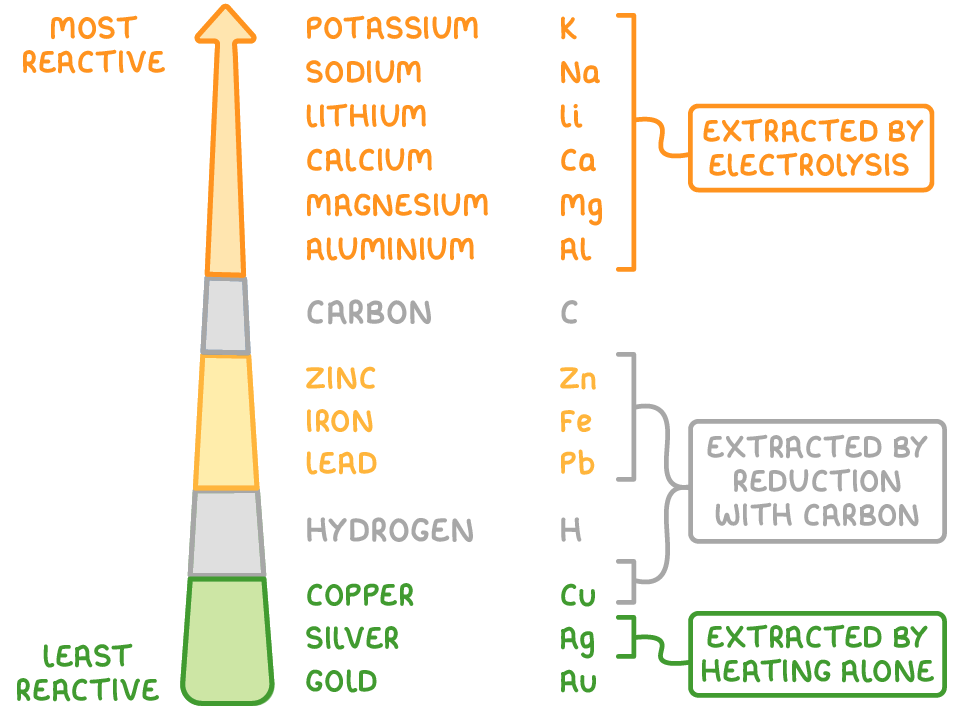
The method used to extract a metal from its ore depends on where it sits in the reactivity series.
Least reactive - Heating alone
The least reactive metals need only heating. Silver and mercury are so unreactive that their oxides decompose on heating with nothing added.
Below carbon - Reduction with carbon
A metal below carbon is extracted by reduction with carbon. The ore is heated with carbon (or carbon monoxide), which removes the oxygen from the metal oxide:
iron(III) oxide + carbon → iron + carbon dioxide
2Fe2O3(s) + 3C(s) → 4Fe(l) + 3CO2(g)
Zinc sits below carbon too, and zinc oxide can be reduced using carbon monoxide:
zinc oxide + carbon monoxide → zinc + carbon dioxide
ZnO(s) + CO(g) → Zn(g) + CO2(g)
This only works for metals below carbon because carbon can only displace less reactive metals from their oxides.
Above carbon - Electrolysis
- A metal above carbon must be extracted by electrolysis. The compound is melted and an electric current is passed through it, splitting it into its elements.
- Aluminium sits above carbon, so it must be extracted from aluminium oxide using electrolysis.
- Electrolysis is also used if a metal reacts with carbon to form a carbide instead of the pure metal.
Cost
- Electrolysis is much more expensive than reduction with carbon because:
- Melting the compound requires large amounts of thermal energy
- Passing the electric current uses large amounts of electrical energy
- Reduction with carbon is cheaper because carbon is cheap and acts as both fuel and reducing agent.
Worked example - Choosing an extraction method
A company has a sample of magnesium oxide, a sample of zinc oxide, and a sample of silver oxide, and wants to obtain the metal from each. Using this extract from the reactivity series, decide which extraction method to use for each, and why.
| More reactive |
|---|
| magnesium |
| carbon |
| zinc |
| silver |
| Less reactive |
Step 1 - Find each metal in the series
Magnesium, zinc and silver are all in the list, with carbon between magnesium and the other two.
Step 2 - See where each metal falls
- Magnesium is above carbon.
- Zinc is below carbon.
- Silver is below carbon, at the bottom of the series.
Step 3 - Read the method off each position
- Magnesium is above carbon, so carbon cannot displace it. Magnesium oxide must be melted and extracted by electrolysis.
- Zinc is below carbon, so carbon can displace it. Zinc oxide is extracted by reduction with carbon:
- zinc oxide + carbon → zinc + carbon dioxide
- Silver is one of the least reactive metals, so silver oxide decomposes simply by heating alone.
Step 4 - Interpretation
Electrolysis requires large amounts of energy to melt the compound and supply the electrical current, making magnesium much more expensive to extract than zinc, while heating silver oxide alone is the cheapest method.