7.5 - Nuclear Equations
Writing and balancing a nuclear equation
- A nuclear equation shows what a nucleus turns into and what it emits during radioactive decay.
- It's written like a chemical equation: the nucleus before decay on the left, an arrow, then the new nucleus plus the emitted particle or radiation.
- If a nucleus absorbs a particle, that particle goes on the left.
- Every species is written in nuclide notation: mass number at the top left, atomic number at the bottom left (e.g. ).
Emitted particles
- Alpha particle - (mass number 4, atomic number 2)
- Beta particle - (mass number 0, atomic number -1)
- Proton - (mass number 1, atomic number 1)
- Neutron - (mass number 1, atomic number 0)
Balancing the equation
- The total mass number (top) on the left must equal the total mass number on the right.
- The total atomic number (bottom) on the left must equal the total atomic number on the right.
Finding an unknown species
- Work out the missing mass number by balancing the top row.
- Work out the missing atomic number by balancing the bottom row.
- If it's a particle, match the numbers to the list above. If it's a nucleus, use the atomic number to look up the element on the periodic table.
What each emission does to the nucleus
| Emission | Written as | Mass number | Atomic number | What is left behind |
|---|---|---|---|---|
| Alpha particle | falls by 4 | falls by 2 | a different element, two places back in the periodic table | |
| Beta particle | unchanged | rises by 1 | a different element, one place further along | |
| Neutron | falls by 1 | unchanged | a lighter isotope of the same element | |
| Proton | falls by 1 | falls by 1 | a different element, one place back | |
| Gamma ray | γ | unchanged | unchanged | the same nucleus with less energy |
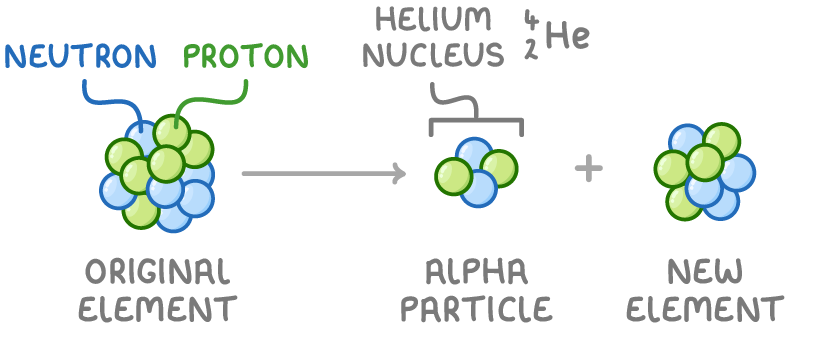
Alpha emission
- An alpha particle is two protons and two neutrons (a helium nucleus).
- The mass number falls by 4 and the atomic number falls by 2, forming a different element.
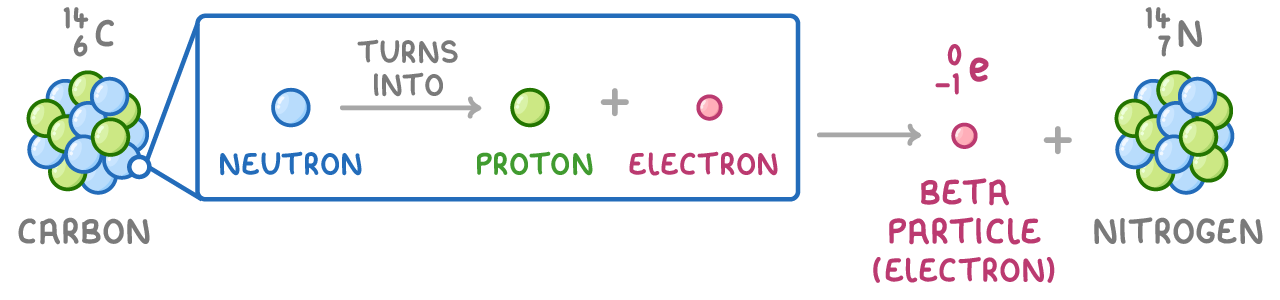
Beta emission
- A neutron inside the nucleus turns into a proton and an electron; the electron is ejected as a beta particle.
- The mass number is unchanged and the atomic number rises by 1, forming a different element:
→ +
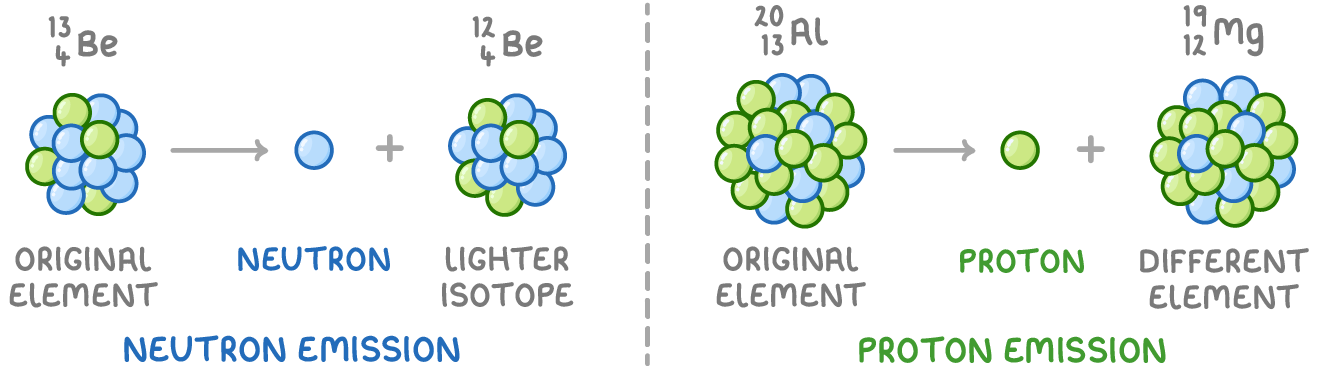
Neutron and proton emission
- Neutron emission - The mass number falls by 1 and the atomic number is unchanged, leaving a lighter isotope of the same element.
- Proton emission - The mass number falls by 1 and the atomic number falls by 1, forming a different element.
Gamma emission
- Gamma radiation is high-energy electromagnetic radiation, not a particle.
- Emitting a gamma ray releases excess energy without changing the mass number or atomic number:
→ + γ
Worked example - Writing a decay equation
Uranium-238 decays by alpha emission. Write the balanced nuclear equation for the decay.
Step 1 - Write the decaying nucleus
Uranium has atomic number 92, and uranium-238 has mass number 238:
Step 2 - Take away the alpha particle's numbers
An alpha particle is , so it removes 4 from the mass number and 2 from the atomic number:
- mass number: 238 - 4 = 234
- atomic number: 92 - 2 = 90
Step 3 - Name the new nucleus and write the equation
The element with atomic number 90 is thorium (Th), so the nucleus left behind is :
→ +
Step 4 - Check both totals
- mass numbers: 238 = 234 + 4
- atomic numbers: 92 = 90 + 2
Both sides match, so the equation is balanced.
Worked example - Identifying an unknown particle
A nitrogen-14 nucleus absorbs a neutron and forms a carbon-14 nucleus and one other particle, X. Identify X.
+ → + X
Step 1 - Add up the mass numbers on the left
14 + 1 = 15
Carbon-14 accounts for 14, so X has a mass number of 15 - 14 = 1.
Step 2 - Add up the atomic numbers on the left
7 + 0 = 7
Carbon has atomic number 6, so X has an atomic number of 7 - 6 = 1.
Step 3 - Name the particle with those two numbers
A particle with mass number 1 and atomic number 1 is , so X is a proton.
Worked example - Counting the emissions in a decay series
An atom of thorium-227 decays by a series of alpha emissions to form an atom of lead-211. How many alpha particles are released?
Step 1 - Count using the mass numbers
Thorium-227 starts at 227 and lead-211 ends at 211, a fall of 227 - 211 = 16.
Each alpha particle carries away a mass number of 4:
16 ÷ 4 = 4 alpha particles
Step 2 - Count using the atomic numbers
Thorium has atomic number 90 and lead has atomic number 82, a fall of 90 - 82 = 8.
Each alpha particle carries away an atomic number of 2:
8 ÷ 2 = 4 alpha particles
Step 3 - State the answer
Both counts agree, so 4 alpha particles are released.