1.3 - Diffusion & Particle Motion
What diffusion is
- In a liquid or a gas, particles are in constant, random motion.
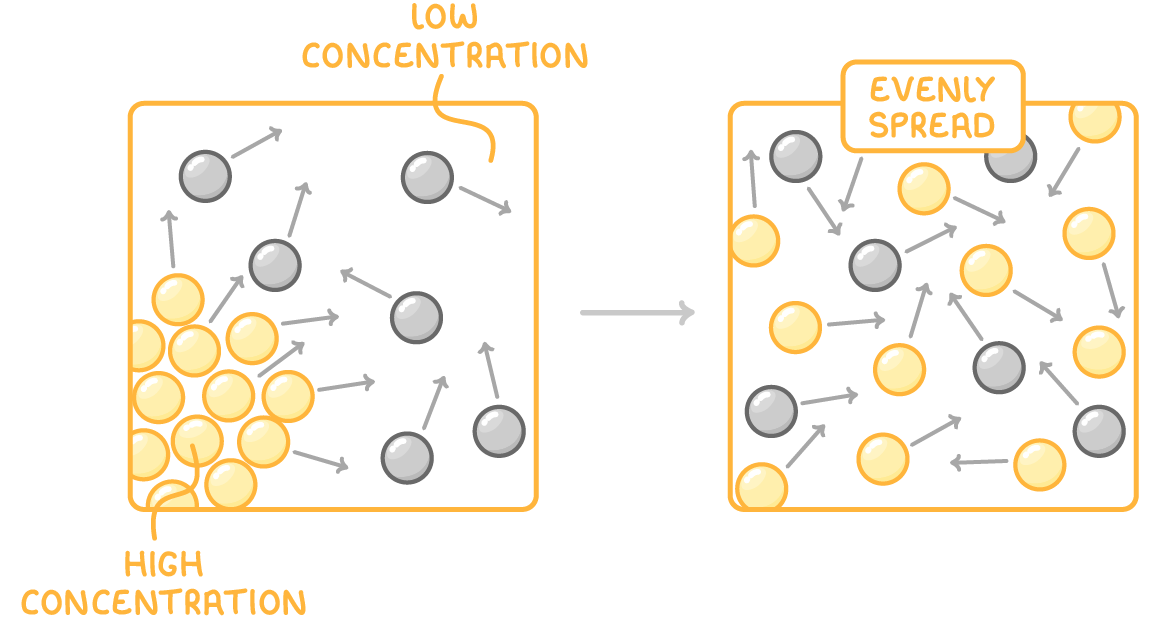
- Diffusion is the spreading out of particles from a region of higher concentration to a region of lower concentration, until they're evenly spread.
- The greater the difference in concentration, the faster diffusion happens.
- Once particles are evenly spread, they continue to move, but there's no further overall change.
Diffusion happens in liquids and gases only
- It happens in liquids and gases because the particles are free to move past one another.
- It does not happen in a solid - each particle is held in a fixed position and can only vibrate on the spot, so it can't move from place to place.
Evidence for diffusion
Diffusion in a liquid - Potassium manganate(VII)
- Drop a crystal of potassium manganate(VII) into a beaker of water.
- Left undisturbed, the purple colour spreads slowly until the whole beaker is a uniform pale purple, as the potassium manganate(VII) particles diffuse among the water particles.
- Adding more water dilutes the solution: the particles spread further apart throughout the larger volume, so the colour looks paler.
Diffusion between gases - Bromine and air
- Set up two gas jars mouth to mouth, one filled with brown bromine gas and the other with air, separated by a glass plate.
- When the plate is removed, the brown gas spreads into the jar of air until it's evenly spread through both jars.
Different gases diffuse at different speeds - Ammonia and HCl
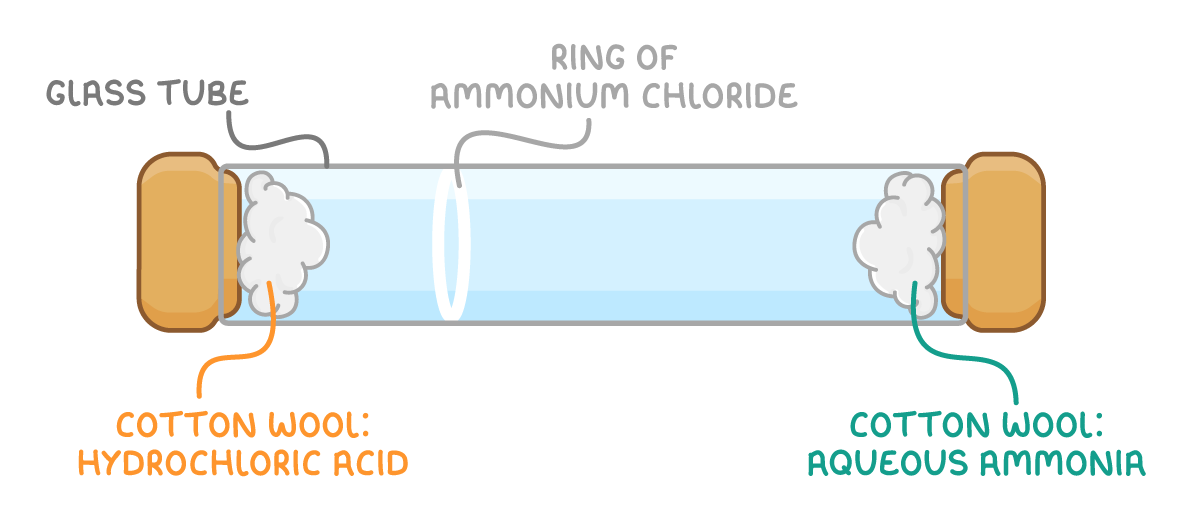
- Push a cotton wool plug soaked in aqueous ammonia into one end of a glass tube and a plug soaked in hydrochloric acid into the other, then seal both ends.
- Ammonia gas and hydrogen chloride gas diffuse along the tube towards each other.
- Where they meet, they react to form a white ring of solid ammonium chloride.
- The ring forms nearer the hydrochloric acid end because ammonia particles are lighter, so they diffuse faster and travel further in the same time.
TermDefinition
Diffusion