3.16 - Alcohols
The alcohols
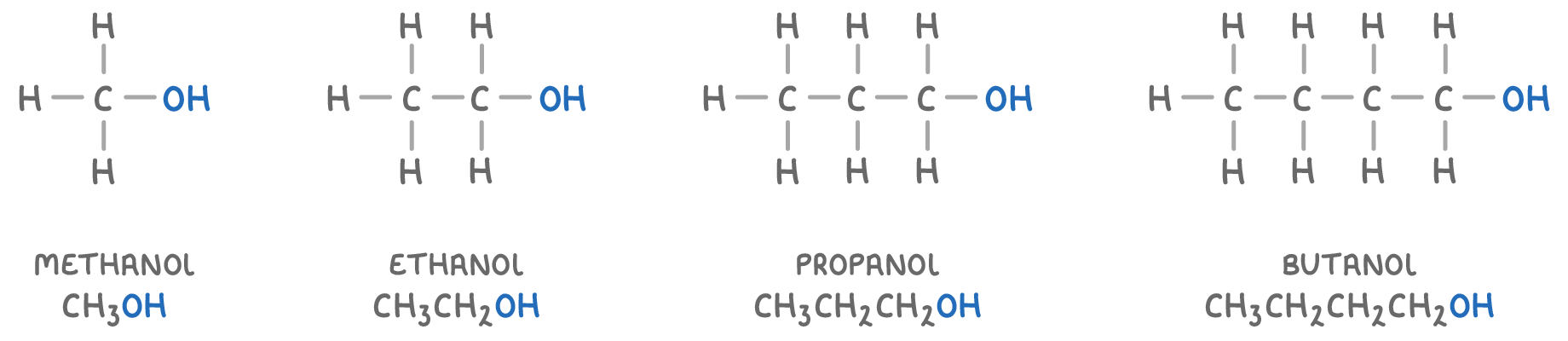
- An alcohol is a compound that carries an -OH group joined to a carbon atom.
- That -OH is the alcohols' functional group - the part that decides how the compound reacts, which is why all alcohols behave in much the same way.
Naming the alcohols
- The stem of the name shows how many carbon atoms are in the chain, and the ending -ol shows it's an alcohol (e.g. ethane becomes ethanol).
- The first four are methanol, ethanol, propanol and butanol, with one, two, three and four carbon atoms.
Formulae keep the -OH visible on purpose, which is why ethanol is written C2H5OH or CH3CH2OH, never C2H6O.
How alcohols burn
Alcohols are flammable, and burning them is their most useful reaction.
Burning in plenty of air
- With plenty of air an alcohol undergoes complete combustion.
- The carbon is oxidised to carbon dioxide and the hydrogen is oxidised to water, releasing a good deal of energy.
- ethanol + oxygen → carbon dioxide + water
- C2H5OH + 3O2 → 2CO2 + 3H2O
Balancing the equation
- The alcohol already contains an oxygen atom, which must be counted when balancing the equation.
- In the equation above, the right-hand side needs seven oxygen atoms (four in the CO2, three in the H2O). One comes from the ethanol itself, leaving six to come from oxygen gas - so three O2 molecules.
Burning without enough air
- With a limited air supply, combustion is incomplete.
- Not all the carbon is oxidised to carbon dioxide - some is released as carbon in fine solid particles (soot) or as carbon monoxide, making the flame smoky.
- Less energy is released than in complete combustion.
Oxidising an alcohol
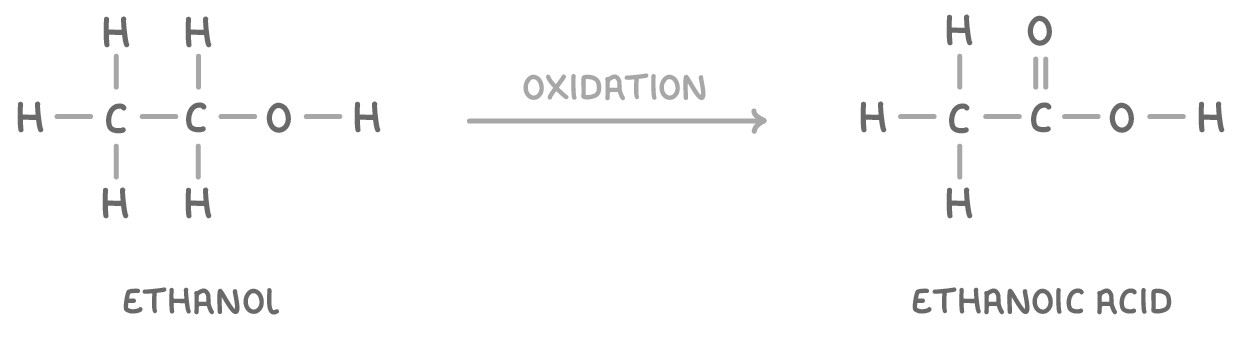
- An alcohol can be oxidised to form a carboxylic acid - an organic acid whose name ends in -oic acid.
- The acid has the same number of carbon atoms as the alcohol it came from:
- ethanol → ethanoic acid
Ethanoic acid is the acid in vinegar.
Two ways it happens
- With an oxidising agent - Warming an alcohol with a chemical oxidising agent converts it to the carboxylic acid quickly.
- With the oxygen of the air (microbial oxidation) - Microorganisms use ethanol as an energy source, oxidising it slowly to ethanoic acid. This is why a bottle of wine left open goes sour.
What alcohols are used for
As solvents
- Alcohols dissolve most substances that water dissolves, as well as substances water won't dissolve (such as oils, fats and hydrocarbons).
- Methanol and ethanol are widely used as solvents in inks, paints and cleaning fluids.
As fuels
- Alcohols are highly flammable and burn cleanly with a blue flame, releasing a good deal of energy.
- Ethanol is used as a fuel in spirit burners and as a biofuel.
In alcoholic drinks
- Ethanol is the alcohol in alcoholic drinks.
- Health risks - Excessive consumption damages organs including the liver, heart and brain, and causes alcohol poisoning.
- Social and economic costs - Alcohol misuse contributes to violent crime, healthcare costs and policing expenses.
TermDefinition
AlcoholAn organic compound containing the -OH functional group joined to a carbon atom.
Functional groupAn atom or group of atoms in a molecule that determines how the molecule reacts.
Carboxylic acidAn organic compound containing the -COOH functional group, whose name ends in -oic acid.
Key points to remember
How were these notes?