2.8 - Metals & Non-Metals
Where metals and non-metals sit
- Most elements in the periodic table are metals. They sit towards the left and the bottom.
- Non-metals occupy the smaller region at the top right.
- The two regions are split by a stepped dividing line that runs from boron to astatine:
- Everything to the left of the line is a metal, except hydrogen, which is a non-metal.
- Everything to the right of the line is a non-metal.
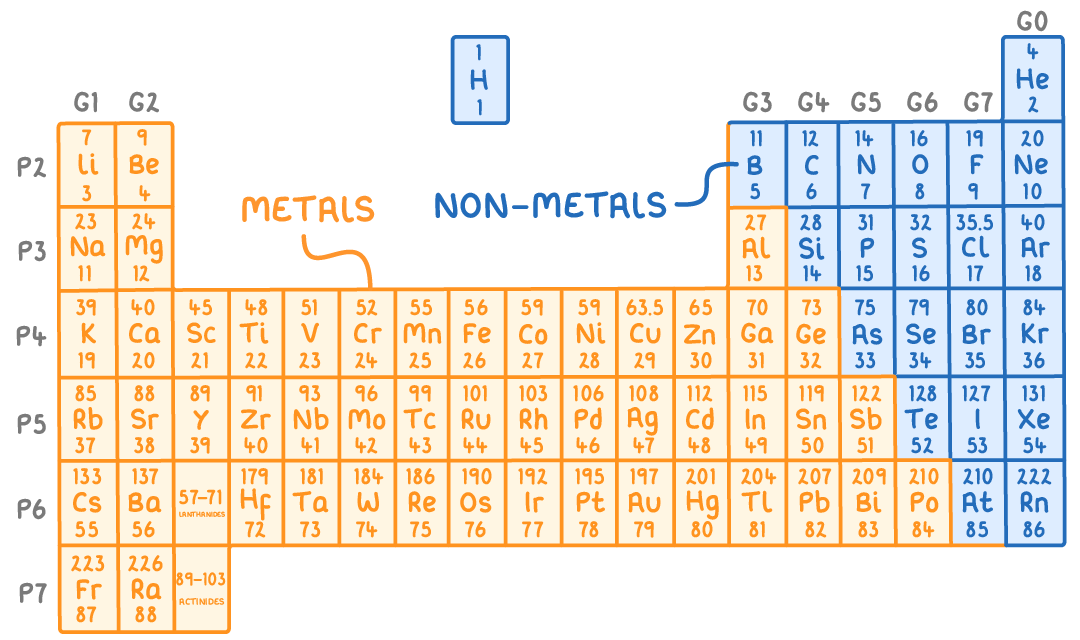
Elements along the dividing line
Elements lying along the dividing line show some properties of metals and some of non-metals, giving them intermediate character (metalloids).
How character changes across a period
Metallic character decreases gradually from left to right across a period, moving from metals on the left to non-metals on the right.
Why metals form positive ions
- Metals and non-metals can be defined by how their atoms react:
- A metal is an element whose atoms form positive ions when they react.
- A non-metal is an element whose atoms do not form positive ions - they either form negative ions or share electrons.
- Atoms react to achieve a full outer shell, losing, gaining, or sharing electrons depending on which costs the least energy.
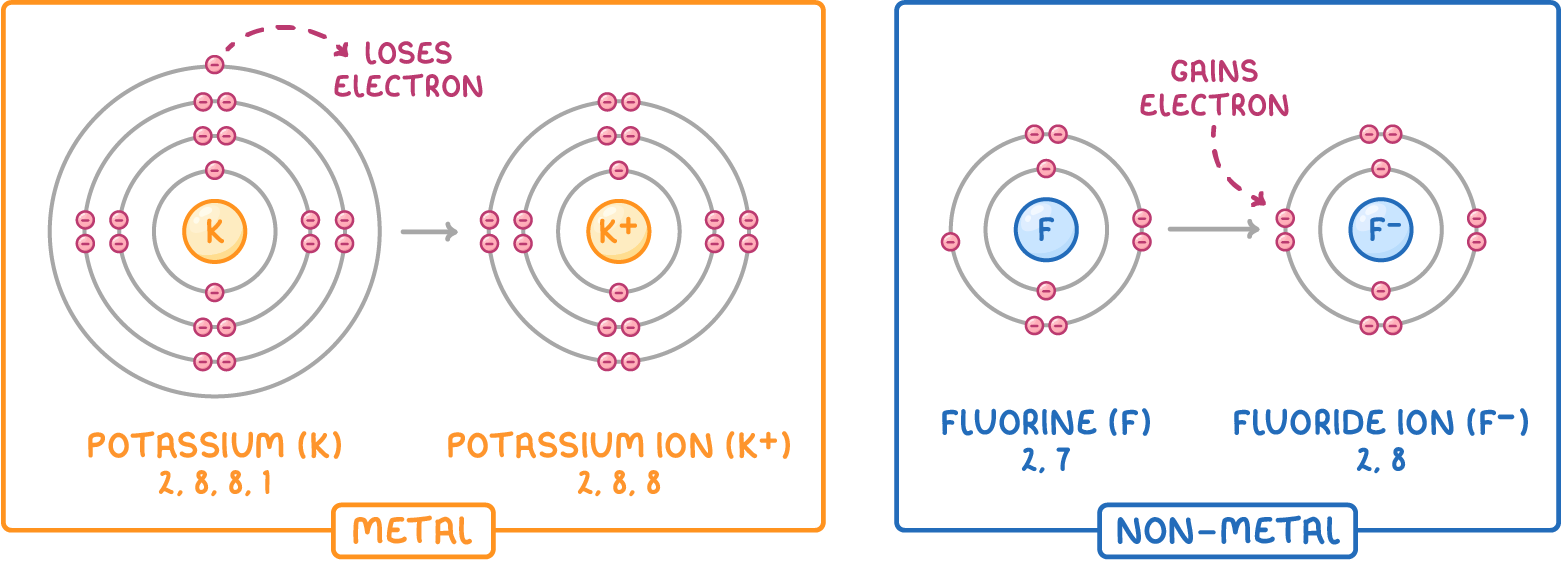
Why metals lose electrons
- Elements on the left have only a few electrons in their outer shell.
- Elements towards the bottom hold outer electrons further from the nucleus with more inner shells, so the nuclear attraction on them is weaker.
- Losing these outer electrons takes little energy, so these elements react by losing them to form positive ions.
Why non-metals don't
- Elements on the right have many electrons in their outer shell.
- Elements towards the top hold their outer electrons close to the nucleus and tightly.
- Removing those electrons would take far too much energy, so these elements achieve a full outer shell by gaining or sharing electrons instead.
Telling metals and non-metals apart
Metals and non-metals have distinctly different physical properties:
| Property | Metals | Non-metals |
|---|---|---|
| Appearance | Shiny (lustrous) | Dull |
| Conduction of heat and electricity | Good conductors of both | Poor conductors (graphite is an exception for electricity) |
| Malleability and ductility | Malleable (hammered into shape) and ductile (drawn into wires) | Brittle when solid |
| Melting and boiling point | Generally high | Generally low |
| State at room temperature | Nearly all solid (mercury is liquid) | Solids, liquids, or gases |
| Density | Generally high | Generally low |
| Sonority | Sonorous (ring when struck) | Not sonorous |
TermDefinition
MetalloidAn element that shows some properties of metals and some of non-metals.
MetalAn element whose atoms form positive ions when they react.
Non-metalAn element whose atoms do not form positive ions when they react.
MalleableAble to be hammered or pressed into shape without breaking.
DuctileAble to be drawn into wires.
SonorousMaking a ringing sound when struck.
Key points to remember
How were these notes?