3.17 - Reactions of Alkenes
Alkenes and addition reactions
- All alkenes contain the functional group C=C (a carbon-carbon double bond).
- This double bond makes alkenes much more reactive than alkanes.
Addition reactions
- Alkenes typically react by addition.
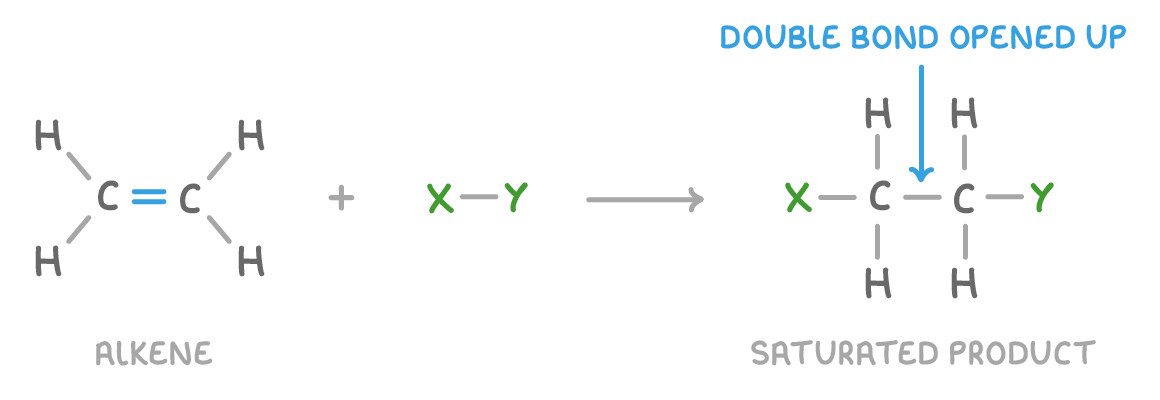
- The carbon-carbon double bond opens up into a single bond, allowing a new atom or group to join each of the two carbon atoms.
- Two molecules combine to form one saturated product:
- alkene + X-Y → saturated product
- The X joins one carbon atom and the Y joins the other.
- The product is saturated because all the carbon-carbon bonds are single bonds.
The reactions of alkenes
- The carbon-carbon double bond (C=C) in an alkene makes it reactive.
- The double bond can open up into a single bond, leaving each carbon atom with a spare bond where another molecule joins on. This is an addition reaction.
- Only one product is formed and the product is saturated.
Bromine adds across the double bond
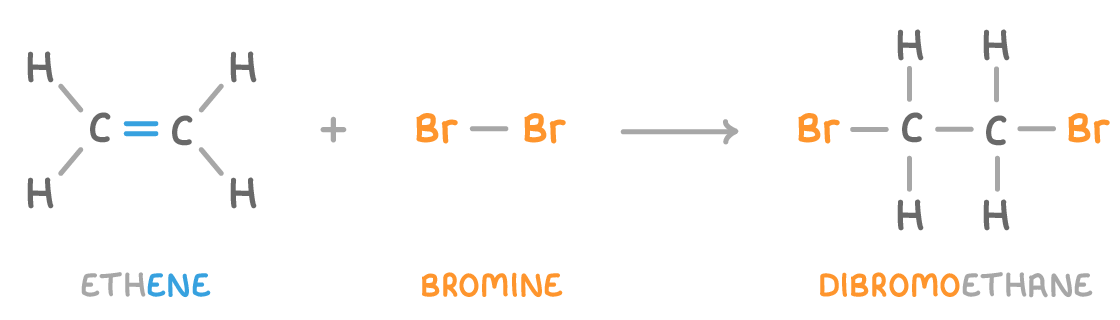
- The bromine molecule (Br2) splits, the double bond opens, and one bromine atom joins each of the two carbon atoms that shared it.
- Compounds made this way are called dibromoalkanes.
For ethene:
ethene + bromine → dibromoethane
C2H4 + Br2 → C2H4Br2
The bromine water test
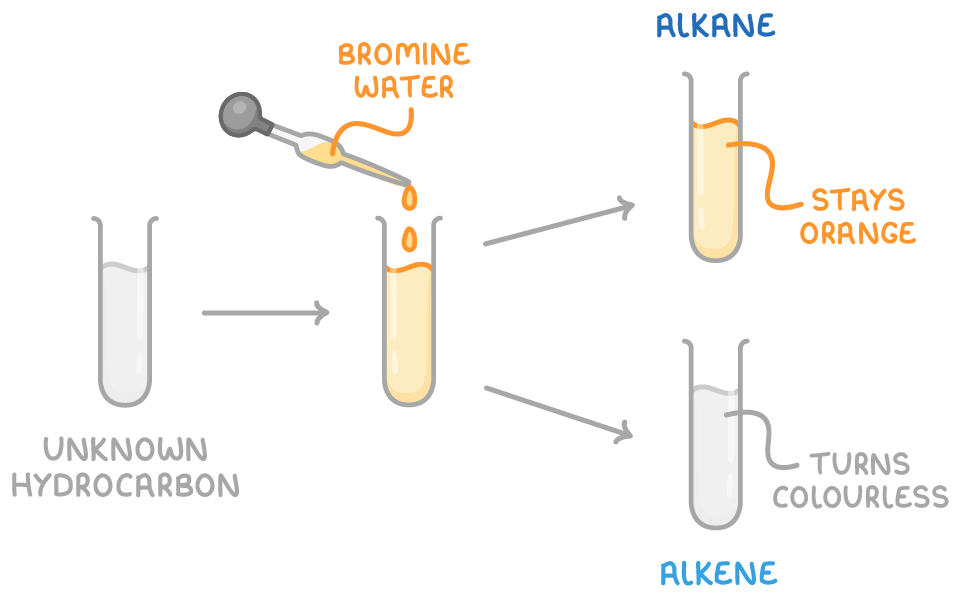
Bromine water is an orange solution of bromine in water. Put a sample of an unknown hydrocarbon in a test tube, add a few drops of bromine water, and shake.
- With an alkane, nothing happens and the bromine water stays orange because there's no double bond for bromine to add across.
- With an alkene, the orange colour disappears, turning the mixture colourless, because bromine adds across the double bond.
The change must be described as orange to colourless, not "clear", because the starting solution is already clear.
TermDefinition
Addition reactionA reaction in which two molecules join to form a single product, as when atoms add across the C=C double bond of an alkene.
Key points to remember
How were these notes?