5.7 - Instrumental Methods of Analysis
Instrumental methods of analysis and their advantages
- An instrumental method uses a machine to detect and identify the elements and compounds in a sample, in place of a chemical test done by hand.
- The machine measures the sample and presents its result as a chart or a table of numbers.
Three advantages over chemical tests
- Sensitive - They detect very small amounts of a substance, far less than a chemical test needs for a visible result.
- Accurate - The result is a measurement made by the machine, not a judgement made by eye.
- Fast (rapid) - Measurements are quick, and machines can be automated to run samples continuously.
Reading an instrumental result
- The result is compared against reference data - the results the same machine gives for known substances.
- The known substance whose data matches the sample's is the substance in the sample.
Flame emission spectroscopy
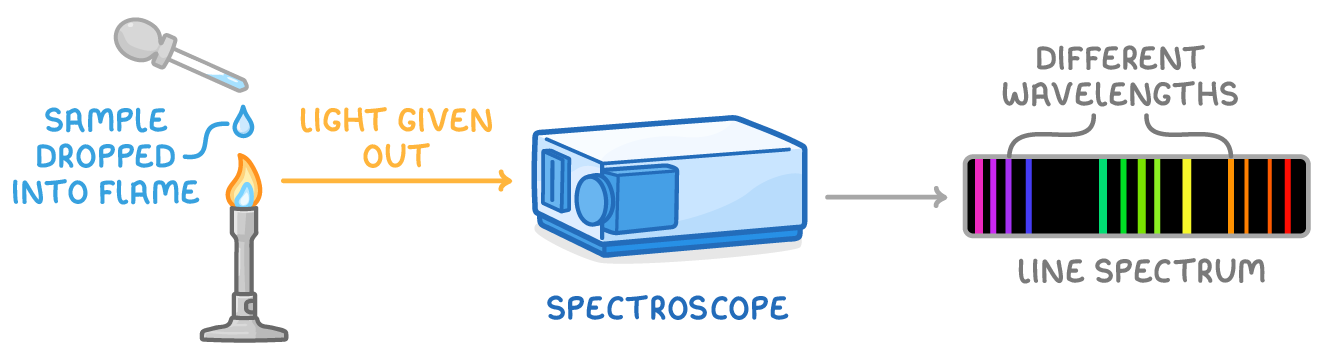
Flame emission spectroscopy (also called emission spectroscopy or flame photometry) analyses the metal ions in a solution to identify them and measure their concentration.
How the sample gives a spectrum
- A sample of the solution is put into a flame.
- As the metal ions heat up, their electrons become excited - gaining energy and moving to a higher energy level.
- When those electrons drop back to their original levels, the energy is released as light.
- The light passes through a spectroscope, which separates the individual wavelengths to produce a line spectrum.
The wavelengths emitted depend on the ion's charge and electron arrangement, so every metal ion produces its own unique pattern of lines.
Reading the spectrum against reference data
- The sample's spectrum is compared against reference data of spectra for known ions.
- An ion is in the sample when every one of its lines appears in the sample's spectrum.
- A solution holding several metal ions gives one spectrum carrying all their lines together, identifying each ion from the single measurement.
What the intensity shows
The intensity of a line (how bright it is) indicates the concentration of the ion that produced it.
Worked example - Metal ions from a line spectrum
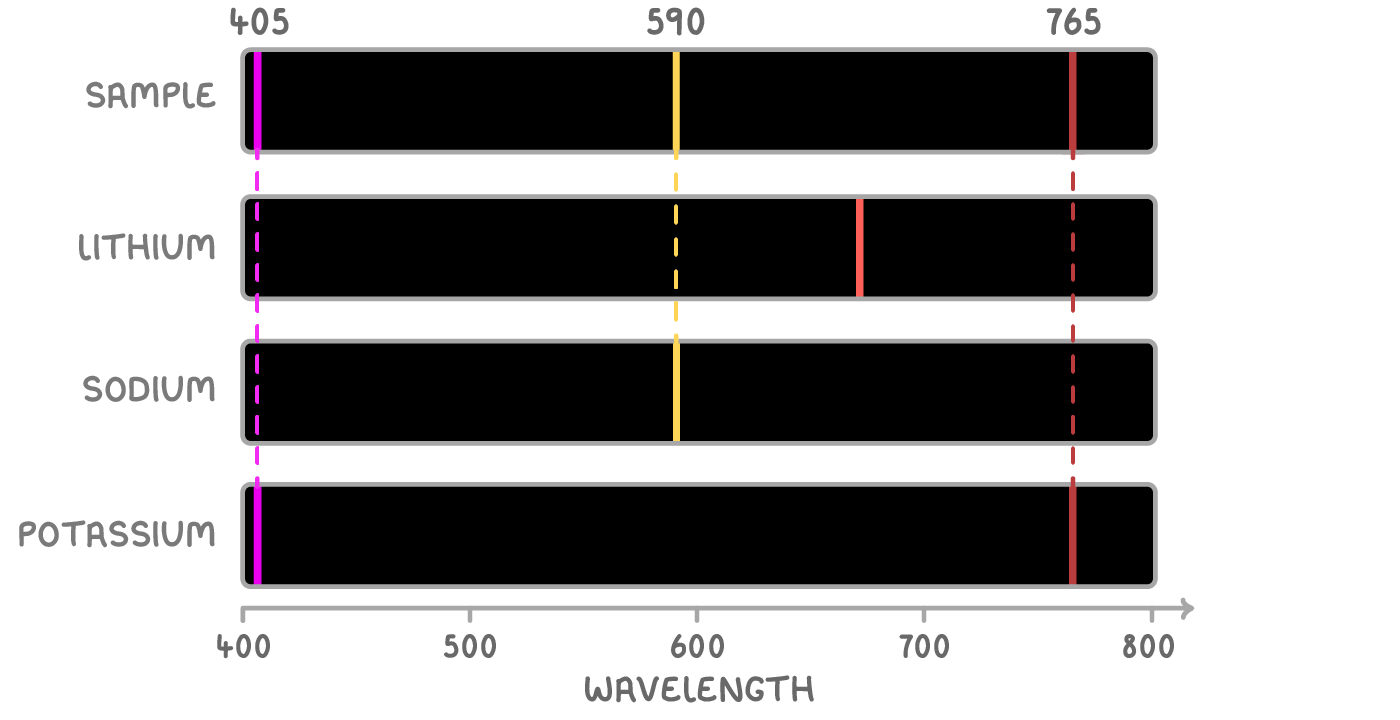
A solution is analysed by flame emission spectroscopy. Its spectrum has lines at 405 nm, 590 nm and 765 nm. Using the reference data below, work out which metal ions the solution contains.
| Wavelengths of the lines (nm) | |
|---|---|
| the sample | 405, 590, 765 |
| lithium | 670 |
| sodium | 590 |
| potassium | 405, 765 |
Step 1 - Read off the sample's wavelengths
The sample has lines at 405 nm, 590 nm and 765 nm.
Step 2 - Compare against each ion in turn
- Lithium - Line at 670 nm, which is not in the sample's list.
- Sodium - Line at 590 nm, which is in the list.
- Potassium - Lines at 405 nm and 765 nm, both in the list.
Step 3 - Keep only ions whose every line appears
- Every line of sodium appears and every line of potassium appears, so both are present.
- Not every line of lithium appears, so lithium is not present.
- The solution contains sodium ions and potassium ions.
TermDefinition
Instrumental methodA method of analysis that uses a machine to detect and identify the elements and compounds in a sample.
Flame emission spectroscopyAn instrumental method that analyses the metal ions in a solution to identify them and measure their concentration.
Key points to remember
How were these notes?