6.12 - The Haber Process
Making ammonia in the Haber process
Ammonia (NH3) is manufactured by the Haber process, and is used mainly to make fertilisers.
The reaction
Nitrogen and hydrogen react reversibly to make ammonia:
N2(g) + 3H2(g) ⇌ 2NH3(g)
Sources of the raw materials
- Nitrogen - Extracted from the air (which is about 78% nitrogen).
- Hydrogen - Obtained from natural gas (by reacting methane with steam).
The conditions and the plant
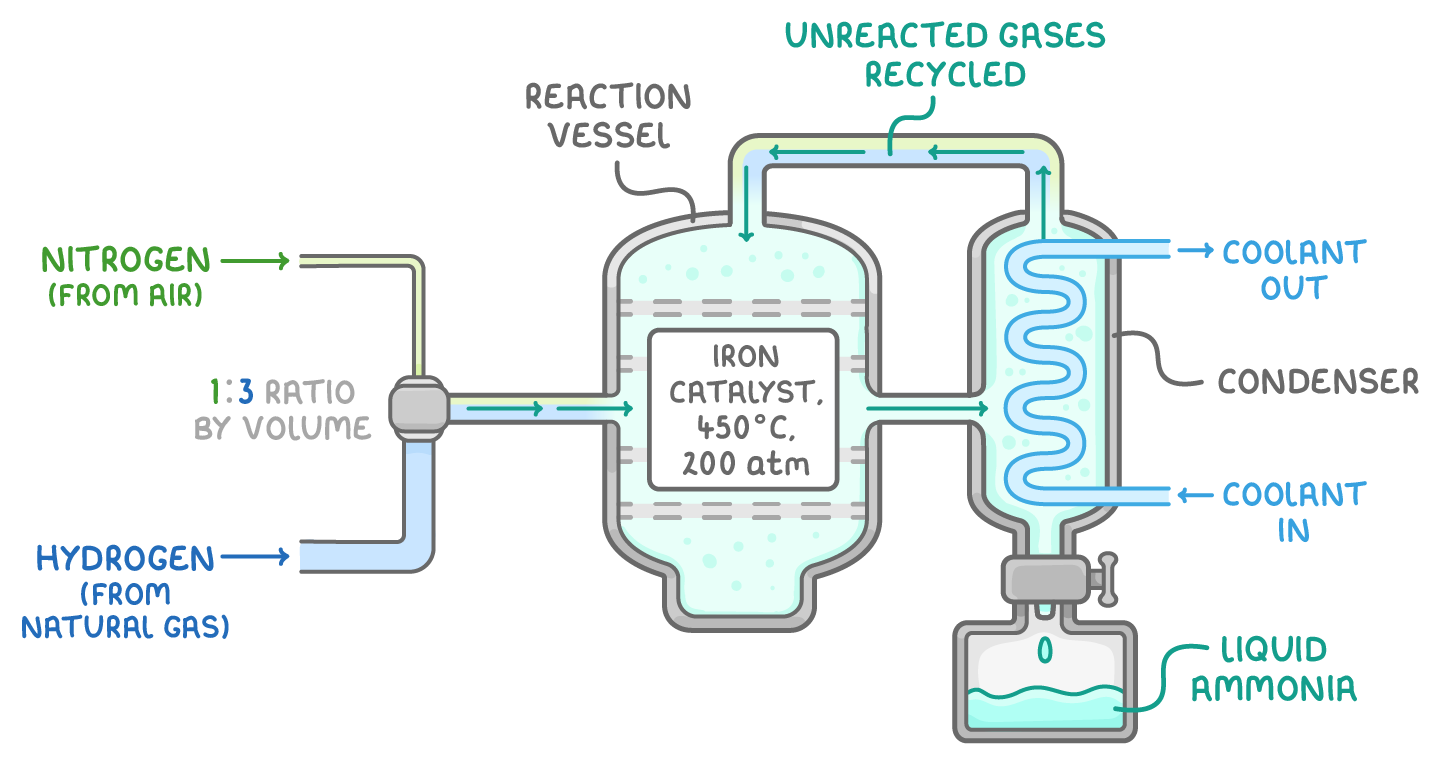
- Purified nitrogen and hydrogen are mixed in a 1:3 ratio by volume (one volume of nitrogen to three of hydrogen) and pumped into the reaction vessel.
- The conditions inside the vessel are:
- Temperature - About 450 °C
- Pressure - About 200 atmospheres
- Catalyst - Iron
Separating the ammonia
- Because the reaction is reversible, only some of the nitrogen and hydrogen turns into ammonia.
- The mixture passes into a condenser and is cooled. Ammonia has a much higher boiling point than nitrogen or hydrogen, so it condenses into a liquid and is removed.
Recycling unreacted gases
The unreacted nitrogen and hydrogen stay as gases and are piped back into the reaction vessel, so very little reactant is wasted.
Why those conditions are used
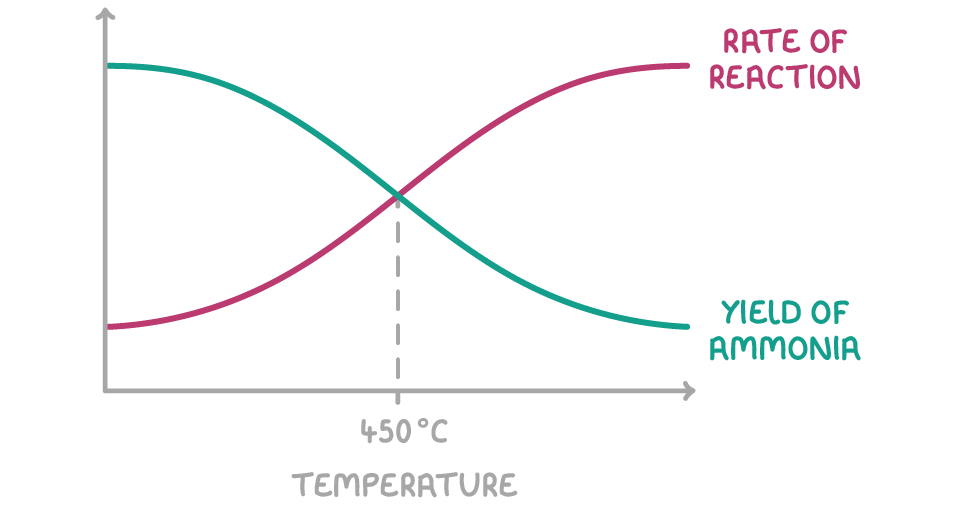
The conditions are chosen as a compromise between the rate of reaction, the yield, and the cost.
Temperature - About 450 °C
- The forward reaction is exothermic, so a lower temperature shifts the equilibrium towards ammonia (higher yield).
- But a lower temperature makes the reaction slower.
- 450 °C is a compromise - It's hot enough to react quickly, but cool enough to give an acceptable yield.
Pressure - About 200 atmospheres
- There are fewer gas molecules on the product side (2 molecules) than the reactant side (4 molecules), so a higher pressure shifts the equilibrium towards ammonia.
- A higher pressure also makes the reaction faster.
- However, very high pressures are dangerous and require expensive, thick-walled equipment.
- 200 atmospheres is a compromise between a high yield, a fast rate, and safe running costs.
The iron catalyst
- The iron catalyst speeds up the reaction in both directions, so it reaches equilibrium faster, but does not change the yield of ammonia.
- Without it, the reaction would have to be run at a higher temperature to be fast enough, which would reduce the yield.
TermDefinition
Haber processThe industrial process used to manufacture ammonia from nitrogen and hydrogen.
Key points to remember
How were these notes?