3.11 - Hydrocarbons & Homologous Series
Hydrocarbons and homologous series
- Organic chemistry is the chemistry of compounds that contain carbon.
- A hydrocarbon is a compound made up of hydrogen and carbon only.
- Methane (CH4) is a hydrocarbon. Ethanol is not, because it contains oxygen.
Why there are so many carbon compounds
- A carbon atom forms four covalent bonds, and it bonds readily to other carbon atoms.
- Carbon atoms join end to end into chains (short or long) and into rings.
- Each carbon uses its remaining bonds to join to hydrogen atoms or atoms of other elements.
Homologous series
- A homologous series is a family of similar compounds.
- Members of the same homologous series share:
- The same general formula.
- Each member differs from the next by a CH2 unit.
- A gradual change in physical properties (melting and boiling points rise as molecules get bigger, because larger molecules have stronger intermolecular forces).
- Similar chemical properties (they react in similar ways).
- The same functional group.
Functional groups
- A functional group is an atom or group of atoms in a molecule that determines how it reacts.
- Every member of a homologous series has the same functional group, so they all react similarly.
- Alkenes have a carbon-carbon double bond (C=C). Alcohols have an -OH group.
Alkanes
- Every bond in an alkane is a single bond, and an alkane has no functional group.
- Because they lack a functional group, alkanes are much less reactive than other organic families. They burn readily but take part in few other reactions.
The alkanes
- Alkanes are the simplest homologous series of hydrocarbons.
- Every carbon-carbon bond is a single bond, and all other bonds are to hydrogen atoms.
- An alkane holds as many hydrogen atoms as its carbon framework can, making it saturated.
The first four alkanes
The first four alkanes are all gases at room temperature and pressure.
| Name | Number of carbon atoms | Molecular formula | State at room temperature |
|---|---|---|---|
| Methane | 1 | CH4 | gas |
| Ethane | 2 | C2H6 | gas |
| Propane | 3 | C3H8 | gas |
| Butane | 4 | C4H10 | gas |
Each alkane has one more carbon atom and two more hydrogen atoms than the one before it (the CH2 step).
General formula
The general formula for all alkanes is:
CnH2n+2
- is the number of carbon atoms.
- For propane ( = 3): hydrogens = (2 × 3) + 2 = 8, giving C3H8.
- For an alkane with 8 carbons ( = 8): hydrogens = (2 × 8) + 2 = 18, giving C8H18.
Ways to write an alkane
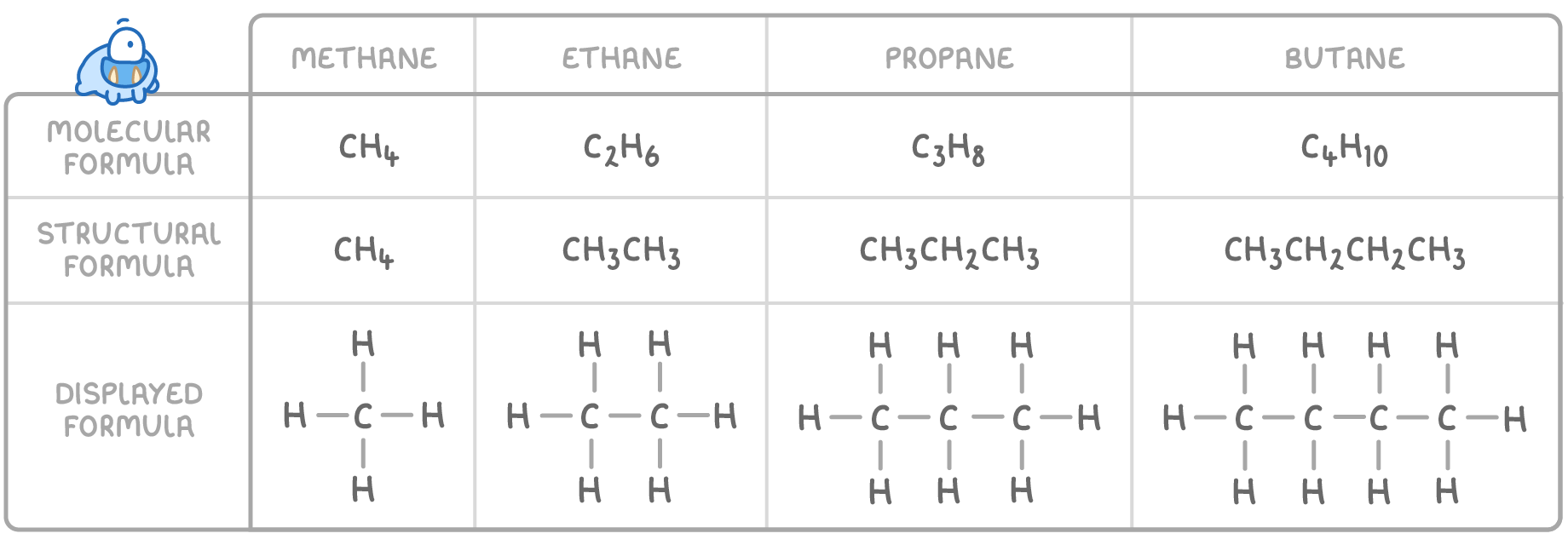
- Molecular formula - Shows the actual number of atoms of each element in a molecule (e.g. propane is C3H8).
- Structural formula (also called a shortened structural formula) - Shows the arrangement of atoms along the chain without drawing every bond (e.g. propane is CH3CH2CH3).
- Displayed formula (also called a full structural formula) - Shows every atom and every covalent bond as a line. Some questions call this fully drawn form simply a structural formula, so when a question asks you to draw a structural formula, draw every atom and every bond.
When drawing a displayed formula, check that every carbon atom has four bonds and every hydrogen atom has one.
Recognising an alkane
- A name ending in -ane.
- A molecular formula that fits CnH2n+2.
- A structure containing only carbon and hydrogen with single C-C bonds only.
Alkanes are insoluble in water and are widely used as fuels.
The alkenes
- Alkenes are hydrocarbons that contain a carbon-carbon double bond (C=C).
- Every other bond in the molecule is a single bond.
- The double bond is the alkenes' functional group.
Why alkenes are unsaturated
- Because two bonds are shared between two carbons in the C=C double bond, each of those carbons has one fewer bond available for hydrogen.
- An alkene therefore has two fewer hydrogen atoms than the alkane with the same number of carbons (e.g. ethane is C2H6; ethene is C2H4).
- Compounds containing double bonds that could hold more hydrogen atoms are unsaturated.
The first four alkenes
| Name | Number of carbon atoms | Molecular formula |
|---|---|---|
| Ethene | 2 | C2H4 |
| Propene | 3 | C3H6 |
| Butene | 4 | C4H8 |
| Pentene | 5 | C5H10 |
There is no alkene with one carbon atom, because a C=C double bond requires at least two carbons.

General formula
The general formula for all alkenes is:
CnH2n
- is the number of carbon atoms.
- For propene ( = 3): hydrogens = 2 × 3 = 6, giving C3H6.
- For an alkene with 8 carbons ( = 8): hydrogens = 2 × 8 = 16, giving C8H16.
Recognising an alkene
- A name ending in -ene.
- A molecular formula that fits CnH2n.
- A structure containing a carbon-carbon double bond (C=C).
TermDefinition
HydrocarbonA compound made of hydrogen and carbon atoms only.
Homologous seriesA family of compounds with the same general formula and similar chemical properties. Each member differs from the next by a CH2 unit.
Functional groupAn atom or group of atoms in a molecule that determines how the molecule reacts.
SaturatedDescribes a molecule in which all the carbon-carbon bonds are single bonds.
UnsaturatedDescribes a molecule that contains at least one carbon-carbon double bond, so more atoms can be added to it.
Key points to remember
How were these notes?