3.1 - Metallic Bonding & Alloys
The metallic bonding model
- Metals are giant structures of atoms arranged in a regular, repeating pattern.
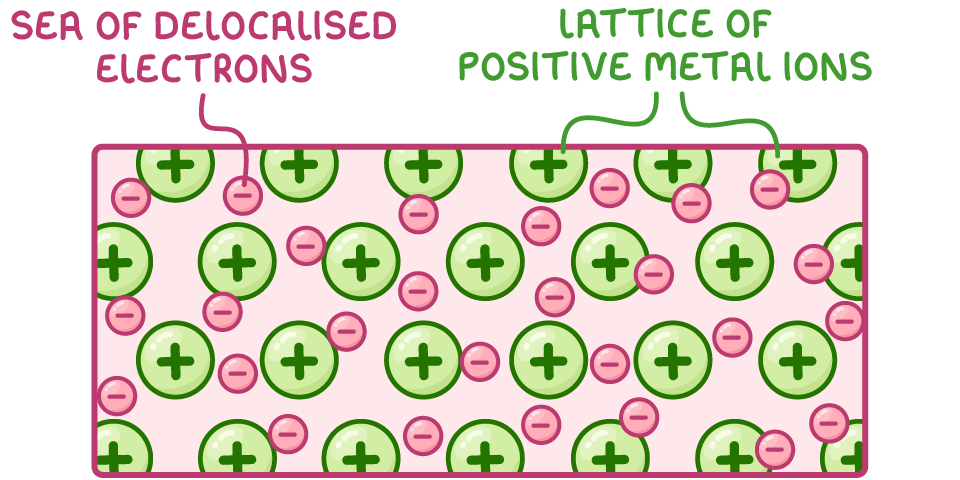
- Each atom gives up its outer-shell electrons, which move freely through the whole structure.
- Electrons free to move like this are called delocalised electrons (often pictured as a "sea" of electrons).
- The atoms that lose electrons become positive ions in a regular lattice.
- Metallic bonding is the strong electrostatic attraction between the positive ions and the sea of delocalised electrons.
Properties of metals
- High melting and boiling points - Strong electrostatic attraction between the positive ions and the delocalised electrons requires a lot of energy to break.
- Good conductors of electricity and heat - The delocalised electrons are free to move through the structure and carry electrical charge or thermal energy. Metals conduct in both the solid and liquid states.
- Malleable and ductile - The positive ions are arranged in layers that can slide over one another without breaking the metallic bond. This allows metals to be hammered into sheets (malleable) or drawn into wires (ductile).
Alloys
- An alloy is a mixture of a metal with one or more other elements, which can be other metals or non-metals such as carbon.
- Because an alloy is held together by metallic bonding, it keeps typical metallic properties: it conducts electricity and heat, and it's generally strong.
Why alloys are harder than pure metals
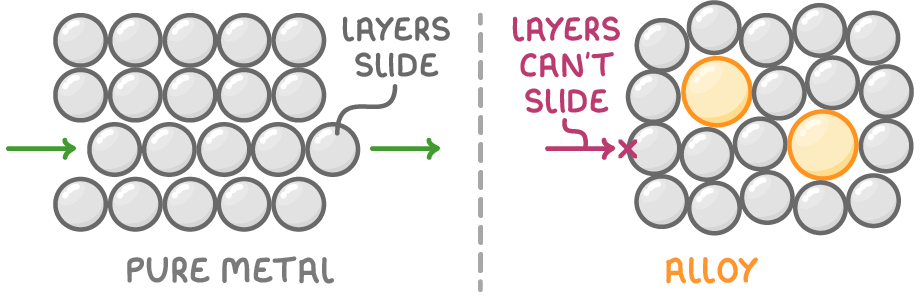
- Pure metals are malleable because they're made of identical atoms in regular layers that slide smoothly over one another.
- Mixing in atoms of a different size distorts the regular layers, making it much harder for them to slide past each other.
- This makes alloys harder and stronger than the pure metals they're made from.
Everyday alloys
| Alloy | Made from | Why it is used |
|---|---|---|
| Low-carbon steel | Iron with a small amount of carbon (about 0.1-0.3%) | Easily shaped, so used for car bodies |
| High-carbon steel | Iron with more carbon (about 0.6-1.5%) | Very strong but brittle, so used for bridges and cutting tools |
| Stainless steel | Iron with chromium, and sometimes nickel | Resistant to corrosion, so used for cutlery |
| Bronze | Copper and tin | Harder than copper, so used for statues and medals |
| Brass | Copper and zinc | More malleable than bronze, so used for taps and fittings |
| Gold alloys | Gold with silver, copper and zinc | Hardens soft pure gold for jewellery |
| Aluminium alloys | Aluminium with small amounts of other metals | Combines low density with high strength, so used in aircraft |
Carats in gold alloys
The proportion of gold in a gold alloy is measured in carats:
- Pure gold is 24 carat (100% gold).
- An 18 carat gold alloy contains 18 parts gold out of 24:
Classifying a structure
| Giant ionic | Simple molecular | Giant covalent | Metallic | |
|---|---|---|---|---|
| Melting and boiling point | High | Low | Very high | Generally high |
| Conducts as a solid? | No | No | No | Yes |
| Conducts when molten or dissolved? | Yes | No | No | Yes |
| Dissolves in water? | Usually | Usually not | No | No |
| Malleable? | No, brittle | No | No, hard and brittle | Yes |
Identifying the structure
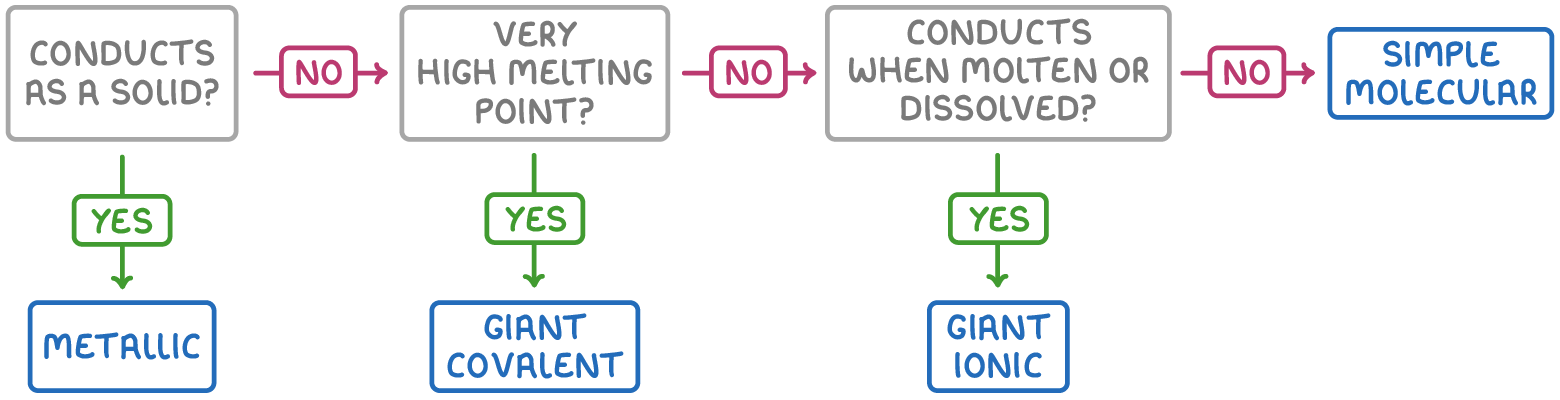
- Conducts as a solid? identifies metallic structures, which conduct as solids because delocalised electrons are free to move throughout the lattice.
- If the solid does not conduct, its melting point and conductivity when molten/dissolved identify the rest:
- Very high melting point, never conducts → Giant covalent, because breaking strong covalent bonds takes enormous energy and there are no charged particles free to move (graphite is the exception, because it conducts).
- High melting point, conducts only when molten or dissolved → Giant ionic, because ions are locked in the solid lattice but become free to move once melted or dissolved.
- Low melting point, never conducts → Simple molecular, because weak intermolecular forces take little energy to overcome and there are no free charged particles.
Worked example - Classifying two substances
A student is given data for two substances, A and B, and asked to say what type of structure each one has.
| Substance A | Substance B | |
|---|---|---|
| Melting point | 801 °C | 3,550 °C |
| Conducts as a solid? | No | No |
| Conducts when molten or dissolved? | Yes | No |
| Dissolves in water? | Yes | No |
Step 1 - Rule out metallic
- Neither substance conducts as a solid.
- Metallic is the only structure that conducts while still solid, so neither A nor B can be metallic.
Step 2 - Classify substance A
- Melting point of 801 °C is high, but nowhere near the very high melting point of a giant covalent structure.
- Doesn't conduct as a solid, but does once molten or dissolved (and dissolves in water).
- A high melting point with conductivity only after the solid lattice breaks down is the giant ionic signature - the ions are held firmly in the solid but become free to move once molten or dissolved.
- Substance A has a giant ionic structure.
Step 3 - Classify substance B
- Melting point of 3,550 °C is far higher than A's.
- Doesn't conduct in any state, and doesn't dissolve in water.
- A very high melting point with no conductivity at all is the giant covalent signature - every atom is joined to its neighbours by strong covalent bonds that take enormous energy to break, and there are no charged particles to carry a current.
- Substance B has a giant covalent structure.
TermDefinition
Metallic bondingThe strong electrostatic attraction between positive ions and a sea of delocalised electrons.
Delocalised electronAn electron that is not attached to a particular atom or bond and is free to move through a structure.
MalleableAble to be hammered or pressed into shape without breaking.
DuctileAble to be drawn into wires.
AlloyA mixture of a metal with one or more other elements.
CaratA measure of the proportion of gold in an alloy, where 24 carat is pure gold.
Key points to remember
How were these notes?