6.11 - Fertilisers & Their Production
Why crops have to be fed, and the three nutrients
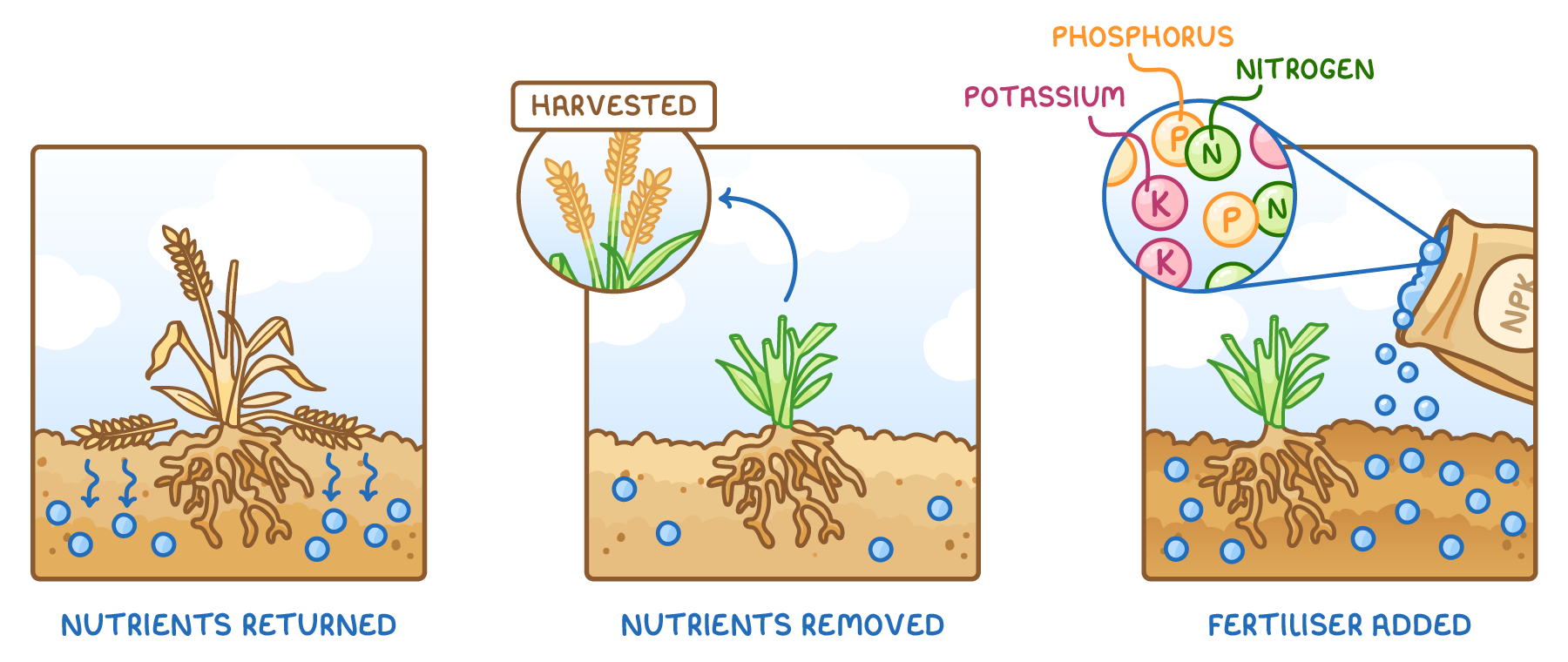
- Growing crops take nutrients from the soil as they grow.
- Harvesting removes these nutrients from the field instead of letting them decompose back into the soil.
- Over time, the soil becomes depleted, which slows plant growth and reduces crop yield.
What a fertiliser does
- A fertiliser is a substance added to soil to replace missing nutrients or supply more than the soil naturally contains.
- Replacing nutrients allows the same land to be cropped repeatedly and increases crop yields.
Why fertilisers matter
- The world's population is rising, but agricultural land is limited, so crop yield per hectare must increase.
- Most manufactured fertilisers are made using ammonia.
The three elements a plant needs most
- Plants need three main elements in large amounts: nitrogen (N), phosphorus (P), and potassium (K).
- If crops lack any of these, growth slows and yields fall.
The form they must be supplied in
Plants cannot absorb these elements directly; they must be dissolved in soil water and taken up through the roots as soluble compounds:
- Nitrogen - Ammonium salts and nitrates
- Phosphorus - Soluble phosphates
- Potassium - Soluble potassium salts
NPK fertilisers
- An NPK fertiliser is a formulation supplying nitrogen, phosphorus, and potassium.
- It's a mixture of salts, not a single compound.
- The proportions of N, P, and K are varied to suit different crops and soil types.
Making a fertiliser salt from ammonia
- Ammonia dissolves in water to form an alkaline solution.
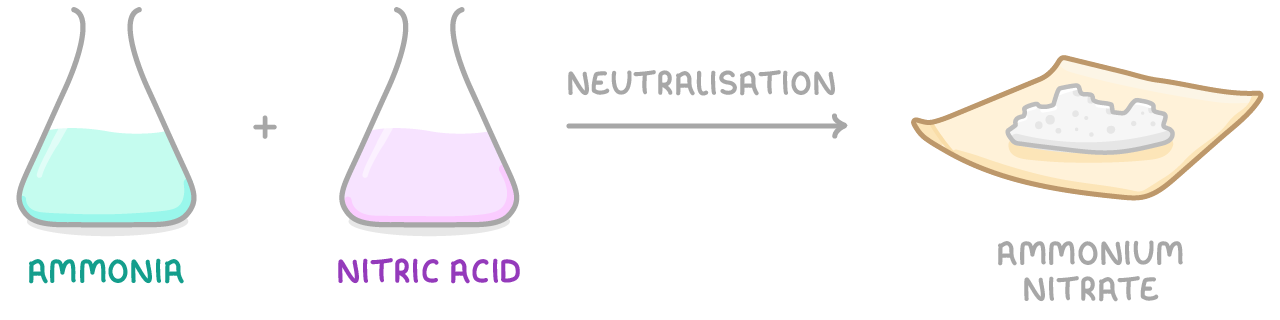
- Reacting ammonia with an acid neutralises it, forming an ammonium salt:
- Ammonia + acid → ammonium salt
- The salt contains the ammonium ion (NH4+).
- The acid used determines which salt is made.
Nitric acid gives ammonium nitrate
Ammonia + nitric acid → ammonium nitrate
NH3(aq) + HNO3(aq) → NH4NO3(aq)
Ammonium nitrate contains nitrogen from both the ammonia and the nitric acid, so it delivers a high percentage of nitrogen by mass.
Sulfuric acid gives ammonium sulfate
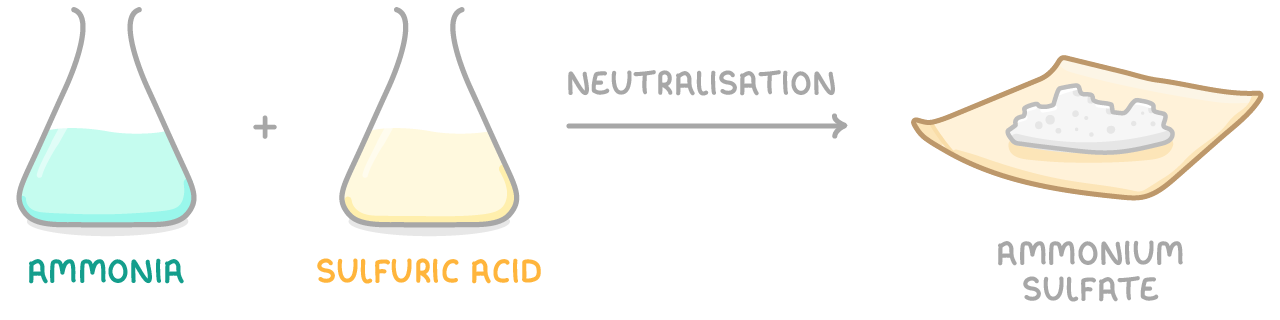
Ammonia + sulfuric acid → ammonium sulfate
2NH3(aq) + H2SO4(aq) → (NH4)2SO4(aq)
Two ammonia molecules react per molecule of sulfuric acid because sulfuric acid provides two hydrogen ions.
Why ammonium salts work as fertilisers
Ammonium salts are very soluble in water, so they dissolve in soil water and are easily absorbed by plant roots.
Nitric acid is made from ammonia
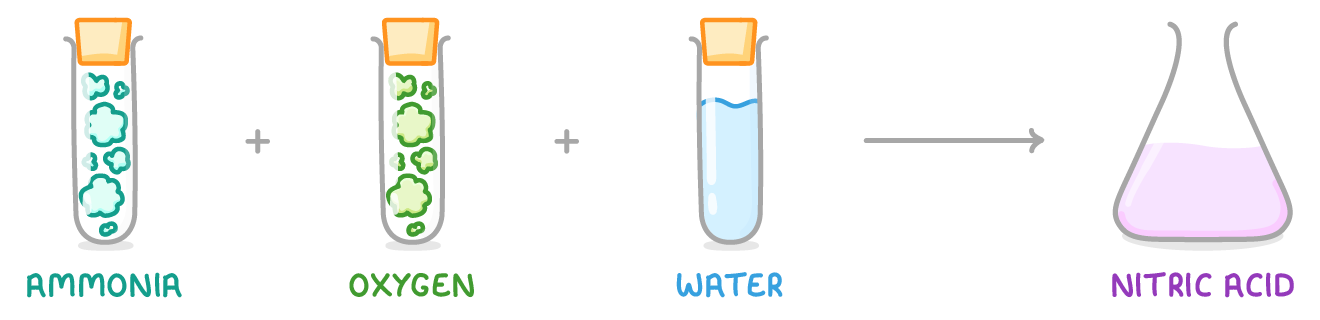
Nitric acid is made by reacting ammonia with oxygen and water, so ammonia is the starting material for both the ammonium and nitrate ions in ammonium nitrate.
Making fertilisers on an industrial scale - Plant layout
Industrial production of fertilisers differs significantly from laboratory preparation.
Several processes joined together
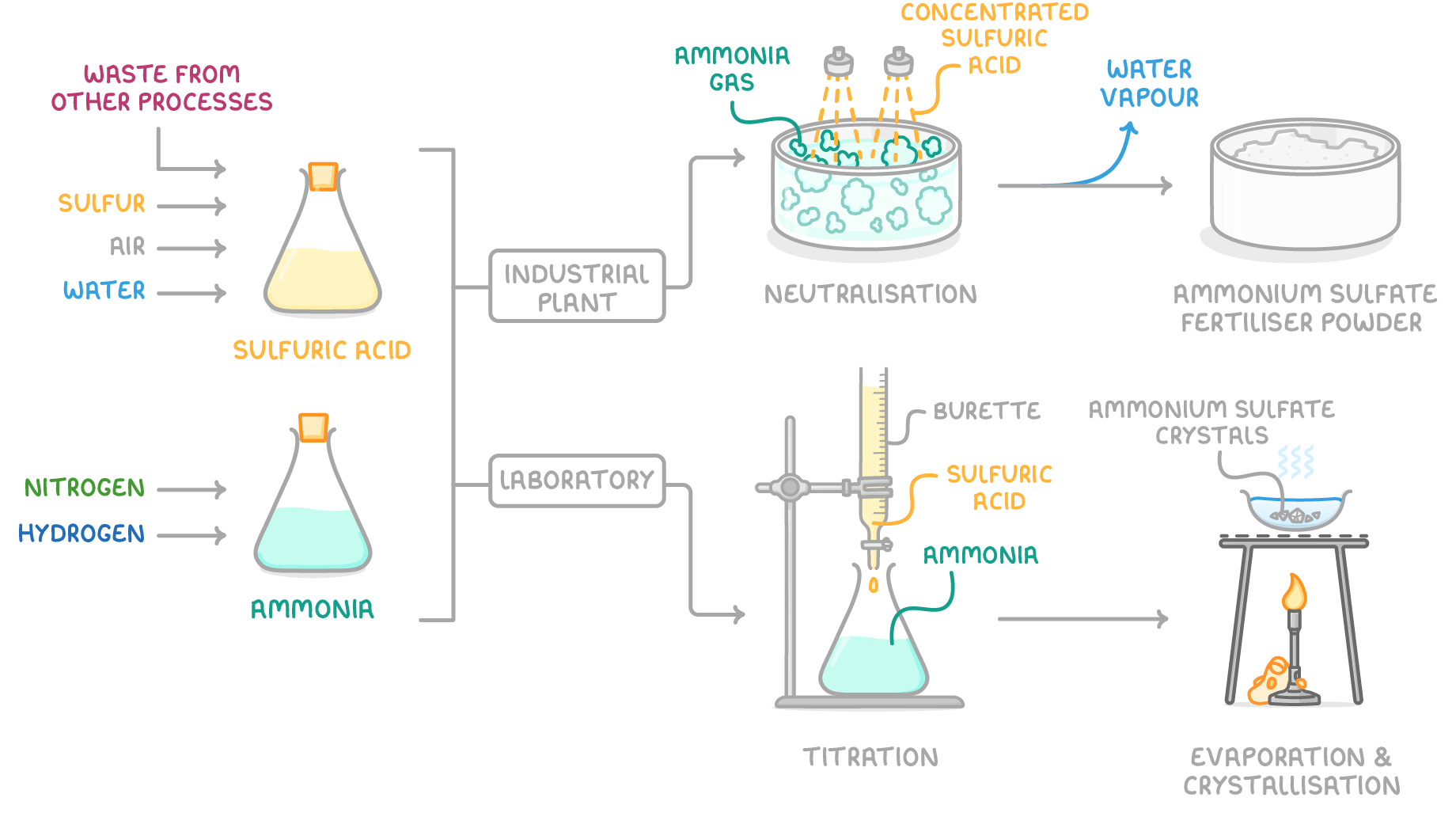
A fertiliser plant links several processes so the product of one becomes the raw material for the next:
- Ammonia is manufactured first.
- The acid is manufactured.
- The ammonia and acid are reacted in a neutralisation stage.
More than one route to the same fertiliser
- Raw materials can also come from industrial by-products or waste products.
- For example, ammonium sulfate can be made using waste products from other chemical processes, reducing costs and waste.
Why the laboratory method does not scale
- In the laboratory, an ammonium salt is made by titration followed by crystallisation: acid is added from a burette, then the solution is evaporated and left to crystallise.
- This method cannot be scaled up directly:
- Burettes only handle small volumes.
- Evaporating and crystallising takes hours.
- It is a slow batch process with high labour costs.
- An industrial plant carries out the reaction differently. Concentrated acid can be sprayed into ammonia gas, producing solid fertiliser powder immediately without needing an evaporation stage.
Batch and continuous processes
- Batch process (laboratory): reactants are loaded, reacted, and products collected before cleaning and restarting. It makes small quantities and requires significant labour.
- Continuous process (industry): reactants enter constantly and product is continuously removed. It runs non-stop, producing tonnes of fertiliser with lower labour costs per unit.
The sequence of manufacturing stages
Across both scales, the process involves the same key stages:
- Choosing and preparing reactants.
- Running and monitoring the reaction.
- Separating and purifying the product.
- Safely disposing of waste.
- Testing product purity.
Process flow charts
A process flow chart summarises the entire manufacturing process, showing raw materials, reaction stages, flow of materials, products, and waste.
What fertilisers do to rivers and lakes
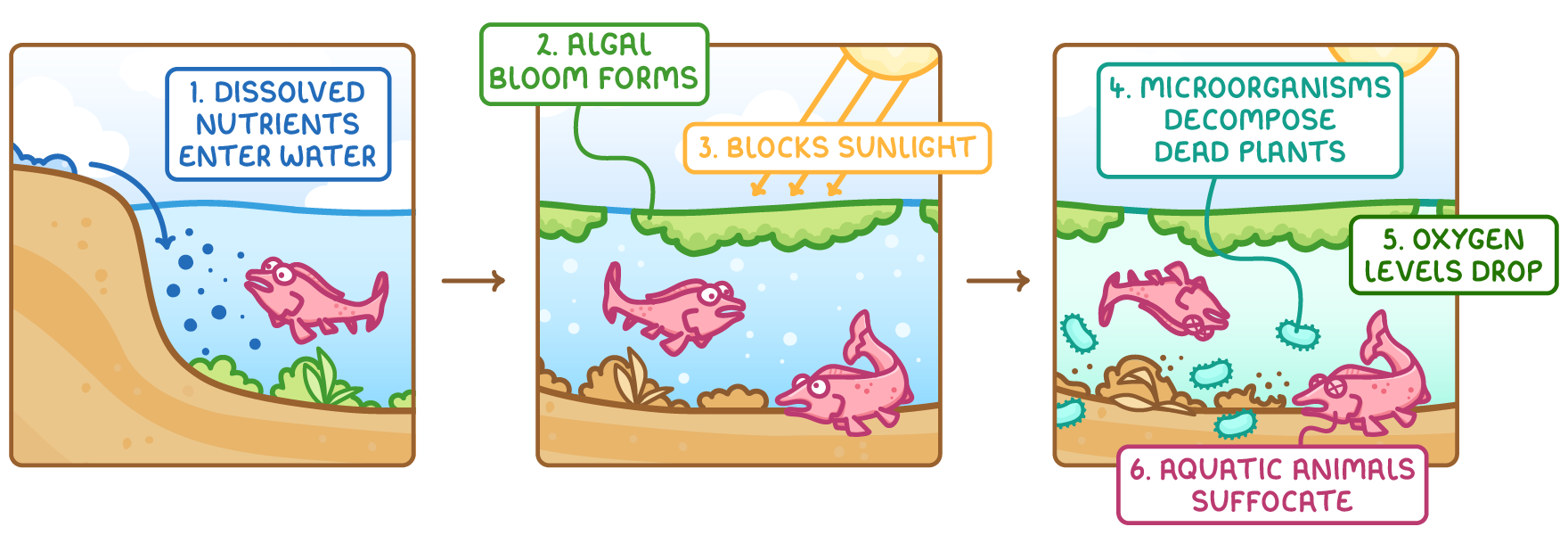
Rain washes unabsorbed fertiliser from fields into streams, rivers, and lakes.
The chain of eutrophication
- High levels of dissolved nutrients enter the water.
- Algae take up the nutrients and multiply rapidly, forming an algal bloom on the surface.
- The algal bloom blocks sunlight, preventing aquatic plants from photosynthesising, causing them to die.
- Microorganisms feed on the dead plants and multiply rapidly.
- The microorganisms respire aerobically, using up dissolved oxygen in the water.
- Dissolved oxygen levels drop so low that fish and other aquatic animals suffocate.
Comparing natural and manufactured fertilisers
- Natural fertilisers (e.g. manure, compost):
- Bulky and expensive to transport.
- Low and variable nutrient content.
- Manufactured fertilisers:
- Known, precise composition and concentration.
- Can be produced on a large scale.
- Cause eutrophication if excess runs off into waterways.