5.4 - Distillation
Simple distillation
- Distillation separates substances in a liquid mixture using their different boiling points.
- Simple distillation separates a liquid from a dissolved solid (or from another liquid with a significantly different boiling point): the liquid boils off, condenses back into a liquid, and is collected.
- The liquid collected is called the distillate.
The apparatus
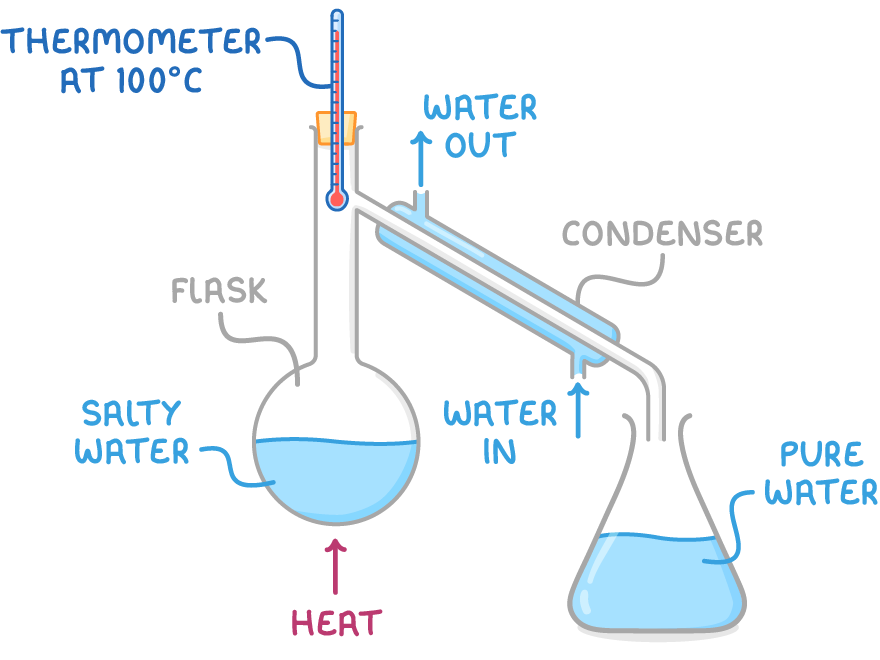
- The mixture goes into a flask connected to a condenser.
- A thermometer sits in the neck with its bulb level with the outlet to measure the temperature of the vapour leaving into the condenser.
- The condenser has an outer jacket of cold water. Cooling water enters at the bottom and leaves at the top to keep the jacket completely full.
- A beaker or flask collects the distillate.
How it works
- Heat the flask gently - the liquid with the lowest boiling point evaporates first.
- The vapour enters the condenser, where cold water cools it so it condenses back into a liquid.
- The liquid runs down into the collecting vessel.
Example:
- Example - salt water - Water boils at 100 °C and salt has a much higher boiling point, so water evaporates, condenses, and collects as pure water, leaving solid salt in the flask.
- The thermometer stays at 100 °C while the water boils off, identifying which substance is being collected.
Limitation
- Simple distillation only separates substances whose boiling points are a long way apart.
- If two liquids have similar boiling points, both evaporate and condense together, requiring fractional distillation instead.
Fractional distillation
- Miscible liquids mix completely into a single layer.
- Immiscible liquids do not mix, settling out into separate layers.
- Fractional distillation separates miscible liquids with similar boiling points.
The apparatus
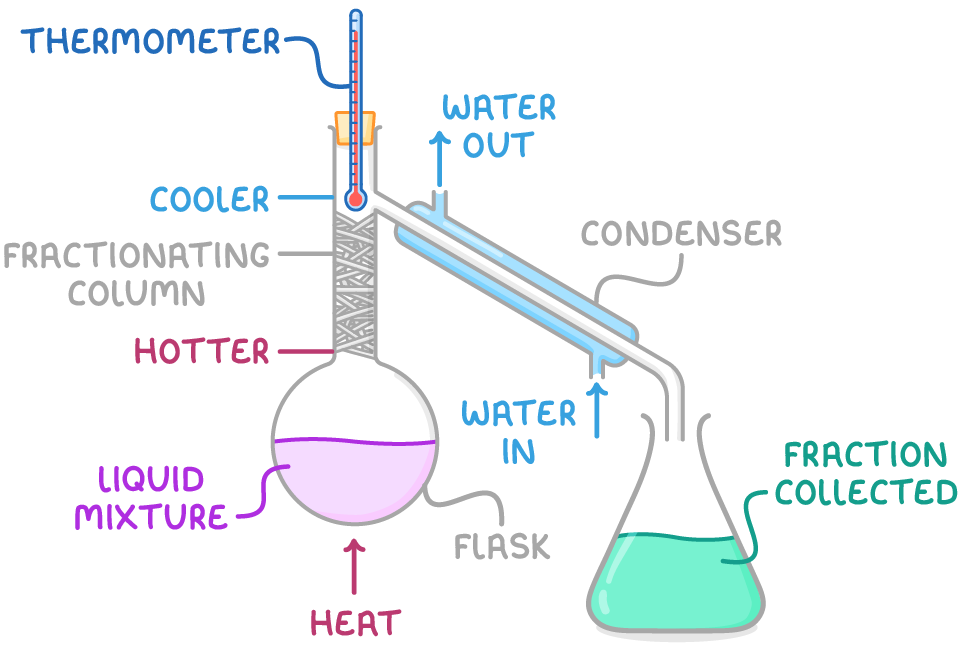
- A fractionating column stands between the flask and the condenser.
- The thermometer sits at the top of the column to measure the temperature of the vapour entering the condenser.
- The column is packed with glass rods or beads, giving a large surface area for repeated condensation and evaporation.
- The column is hottest at the bottom and coolest at the top.
- A vapour rising into a region cooler than its boiling point condenses on the packing and drips back down. Only the substance with the boiling point matching the temperature at the top passes into the condenser.
How it works
- Heat the flask - the liquid with the lowest boiling point rises up the column first.
- When the top thermometer reaches its boiling point, that vapour passes into the condenser, condenses, and is collected.
- Once that liquid has completely distilled over, the temperature rises, signalling to change the collecting vessel.
- Continue heating to collect the next liquid at its boiling point.
Each portion collected over a specific temperature range is called a fraction.
Example - Ethanol and water
- Ethanol boils at 78 °C and water at 100 °C, so ethanol distils over first and is collected while the thermometer reads 78 °C.
- Without the fractionating column, water vapour would carry over with the ethanol because water evaporates below its boiling point, producing an impure distillate.
Choosing the right separation technique
The technique chosen depends on the physical properties of the substances in the mixture:
- Insoluble solid in a liquid - Use filtration: the solid is trapped by the filter paper, while the liquid passes through as filtrate.
- Solid dissolved in a liquid (solid wanted) - Use crystallisation: heating evaporates some liquid, and crystals form as the concentrated solution cools.
- Solid dissolved in a liquid (liquid wanted) - Use simple distillation: the liquid boils off, condenses, and is collected, leaving the solid behind.
- Two or more miscible liquids - Use distillation: simple distillation if boiling points are far apart, or fractional distillation if boiling points are close together.
Worked example - Choosing a technique for substance X
A mixture contains X and Y. X is a liquid (boiling point 60 °C). Y is a solid (boiling point 1,218 °C) that dissolves completely in X. Which technique gives a pure sample of X?
Step 1 - Identify what is wanted and its state
X is the liquid solvent in a solution and needs to be recovered, which requires distillation.
Step 2 - Compare the boiling points
Y does not boil until 1,218 °C, which is far above 60 °C. Because the boiling points are far apart, a fractionating column is not needed.
Step 3 - Answer
Simple distillation gives a pure sample of X.
TermDefinition
DistillationA separation technique that separates substances in a liquid mixture using their different boiling points.
Simple distillationA technique used to separate a liquid from a dissolved solid or from another liquid with a significantly different boiling point.
DistillateThe liquid collected during distillation after the vapour condenses.
MiscibleDescribes liquids that mix completely to form a single layer.
ImmiscibleLiquids that do not mix and instead settle out into separate layers.
Fractional distillationA separation technique that separates a mixture of miscible liquids (liquids that mix together) with different boiling points, using a fractionating column.
FractionA mixture of substances with similar boiling points that is collected together during fractional distillation. In crude oil, the molecules in a fraction have a similar number of carbon atoms.
Key points to remember
How were these notes?